

Event Recap · 21 September 2026
HR Essentials Over Breakfast: Watch All Five Sessions
A full house at HR Essentials Over Breakfast heard from employment lawyers, the NSW regulator and a global payroll specialist. Psychosocial hazards, AI and redundancy, the non-compete ban, long service leave and payroll trends. Every session is below, with the points that matter.
In this article
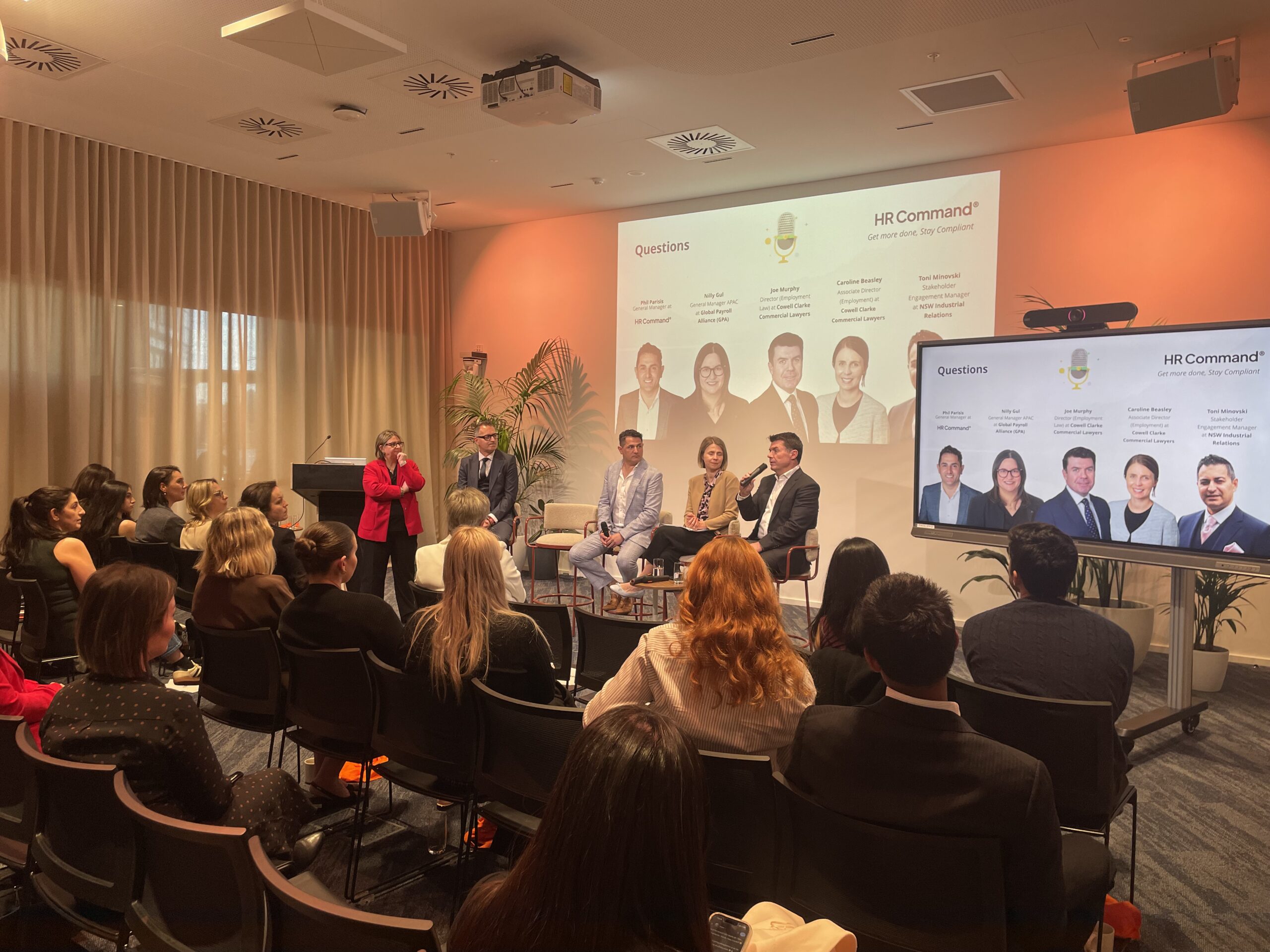
On Thursday 17 September 2026, more than 75 HR managers, business advisers and payroll professionals braved a freezing Sydney morning for HR Essentials Over Breakfast at Telford at Greenhouse, 180 George Street. Five sessions, one message: the compliance load on employers is growing, and the businesses that document everything are the ones that come out fine.
Key takeaways
- The NSW psychosocial code of practice is now enforceable, and employers must apply the hierarchy of controls to psychosocial risk.
- AI is not yet driving mass redundancies, but it is changing how redeployment, consultation and surveillance have to be handled.
- The exposure draft goes further than expected: non-solicit and no-poach clauses are in scope for all employees. Consultation closes 2 October 2026.
- NSW Industrial Relations has changed its view on long service leave, including casual absences, bonuses and part years of service.
- Australia adopts global payroll trends slowly and cautiously. Fairness, not speed, shapes how pay transparency, AI and earned wage access land here.
- Across every session: document every step. It is your evidence when an inspector or the Commission comes asking.
Session 1: Psychosocial hazards in NSW, where we are now
Joe Murphy, Director, Cowell Clarke · Caroline Beasley, Cowell Clarke · Phil Parisis, HR Command
Psychosocial risk is not new. What is new is that NSW has put teeth on it. The WHS regulation now makes the Code of Practice: Managing psychosocial hazards at work enforceable, and the WHS Act has been amended to require businesses to apply the hierarchy of controls when deciding how to manage these risks.
Joe put it plainly. An inspector can walk in and say “show me how you’ve applied this”. Most businesses in the state would not have an answer. With around 100 psychosocial inspectors now in the field and a fresh SafeWork regulatory statement putting psychosocial risk squarely in focus, that is a real exposure.
The other point that landed: almost anything can be a psychosocial hazard. It depends on the workplace and the person. A generic risk assessment bought off the shelf does not cut it. Neither does the “common sense” test. If an employee tells you they have a mental health condition, you have to adjust, as far as you reasonably can, for them.
The risk management cycle
| Step | What it looks like in practice |
|---|---|
| 1. Identify hazards | Use what you already have: consultation with staff and HSRs, complaints, incident reports, exit data. Observe work in all conditions, not just on a quiet Tuesday. |
| 2. Assess and prioritise | Look at frequency, duration, severity and foreseeability. Ask whether any individual or group experiences the hazard differently. |
| 3. Control the risk | Work down the hierarchy of controls. Change the design and management of work first. Policies and EAPs still matter, but they are lower order controls. |
| 4. Review | Review on a schedule, and again after any incident or unexpected event. |
| Always: document | Every step, every time. It is the evidence you hand an inspector. |
Two cases worth knowing
SafeWork NSW v Western Sydney Local Health District. Two nurses were under investigation and the district did not strictly follow its own investigation policy. The prosecution was withdrawn, but the court ruled that the nurses’ statements to colleagues about how badly they were coping were admissible. Those comments should have told the employer something was wrong.
The NSW Department of Education compliance notice. An employee was suspended and did not receive the allegations for three months. The investigation was still running ten months in when they complained to SafeWork. A compliance notice followed, and the Industrial Relations Commission backed it: any misconduct process is a psychosocial hazard, and one complaint was enough to require a systemic, organisation-wide response.
From the Q&A
Can you force an employee to disclose a mental health condition? No. Ask, explain why you are asking (the WHS risk assessment and their own wellbeing), and guarantee the information is kept secure and confidential. If you have done all that, you are in a strong position if something goes wrong. In Victoria and Queensland, workers compensation law goes further: failing to disclose a relevant condition when asked can affect a later claim, and HR Command contracts flag this for employees in those states.
How HR Command helps
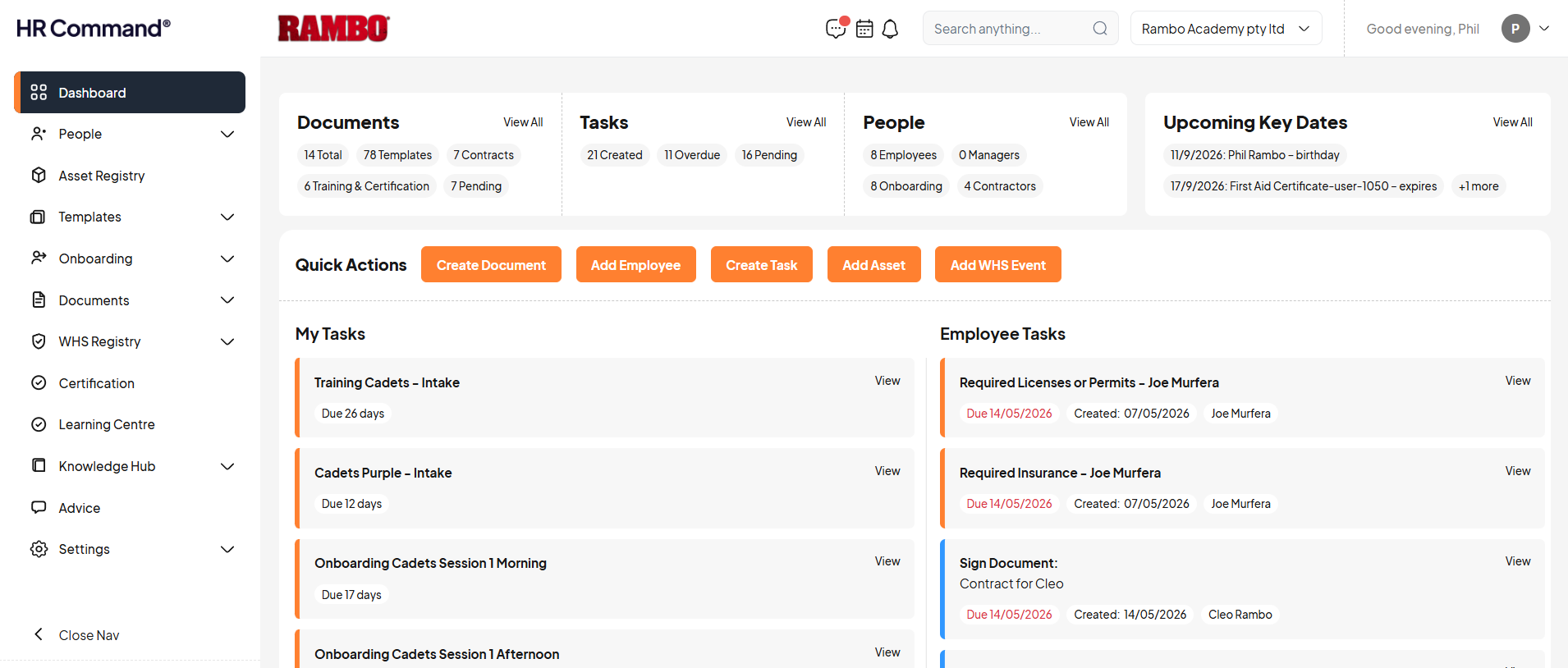
The psychosocial module in HR Command’s WHS suite was built on the back of these talks and client feedback. Employees can self-report bullying, overwork and other hazards. Reports go through triage, and if the issue involves the employee’s direct manager, it routes around them to the person you nominate. Assessments, actions and records sit in one place. The supporting policies and plans are already in the HR Command library for existing clients. The psychosocial module is an add-on.
Session 2: Redundancy, AI and workplace surveillance
Joe Murphy and Caroline Beasley, Cowell Clarke · Phil Parisis, HR Command
The headlines say AI is taking jobs. NAB, Woolworths, Atlassian, WiseTech and CommBank have all restructured this year, with some roles moved offshore and others replaced or reshaped by AI. But the Department of Employment and Workplace Relations’ AI and Employment in Australia report, released in July, found no evidence yet of an AI-driven upheaval in the labour market.
Caroline’s read: the data looks at job ads and hours worked, not at how duties inside existing roles are shifting. Joe’s experience on the ground: the redundancies Cowell Clarke is handling right now are driven by the economy, not AI. Watch this space.
What AI changes in a redundancy
The legal process does not change. The considerations do.
- Digital work systems. NSW WHS duties now apply to digital work systems. If AI is part of the change, factor that in.
- Redistributing duties. Who absorbs the work: other employees, or the AI? Plan it and document it.
- Redeployment. The Helensburgh Coal decision widened what employers must consider. Vacant or soon-to-be-vacant contractor roles count, and reasonable retraining is expected. In an AI restructure, ask what retraining would make redeployment possible before you rule it out.
- Enterprise agreements. Unions are pushing AI-specific clauses into agreements, and the ACTU has asked for extra notice for AI-related job losses under the NES. That is not law, but a clause in an approved agreement has the force of law for that business.
- Psychosocial risk. Redundancy is confronting for everyone involved. Manage it as the psychosocial hazard it is.
AI as a surveillance tool
AI supercharges monitoring. Algorithmic work allocation can quietly bury your most productive people. Enterprise AI tools log everything staff type, work and personal. Before rolling out any AI-based surveillance, the session proposed three questions:
| Question | What to check |
|---|---|
| Can we? | Workplace surveillance notice and policy requirements (strict in NSW and the ACT), Privacy Act obligations, and what your contracts say. |
| Should we? | The psychosocial impact of the monitoring, and whether there is a legitimate business purpose. |
| Can we defend it? | Is the output accurate? Is there bias? Is there human review? Inaccurate monitoring data can sink your defence and strengthen an injury claim. |
A basic reminder: if you have not given the required notice and have a policy in place, you may not be allowed to look at what employees do on your own systems. Build it into the employment contract up front.
Surveillance runs the other way too. Smart glasses, smartwatches and phones mean employees can record meetings and colleagues. Without a policy, it is hard to act. And AI notetakers start recording the moment a meeting opens. One case discussed: two managers kept talking after an employee left the call, and the employee received the transcript saying he would be made redundant.
From the Q&A
Profiling staff from AI usage metadata is no safer than reading their conversations if the purpose is still profiling. You need a legitimate business reason and disclosure in your employee privacy notice from day one. And check where your AI notetaker stores data. Many route everything through the US.
Session 3: Protecting your business without non-competes
Joe Murphy and Caroline Beasley, Cowell Clarke
The Government signalled a non-compete ban in the 2025 Budget. The exposure draft released in September goes much further, amending both the Fair Work Act and the Competition and Consumer Act.
| Clause type | Position under the exposure draft |
|---|---|
| Non-compete | Banned for employees under the high income threshold, currently over $190,000 and indexed each 1 July. Enforcing legacy clauses would also be banned. Extra conditions for those above the threshold. |
| Non-solicit | Banned for all employees, with no income threshold. |
| No-poach | Banned for all employees, with competition law penalties for businesses that collude. |
| Cascading restraints | Captured by the draft. |
| Confidentiality | Not touched. |
Joe has no issue with the non-compete ban. The non-solicit extension is another matter. Businesses invite staff in, introduce them to colleagues and clients, and encourage those relationships. If a departing employee can freely poach both, some employers will keep relationships cold and limit client access for anyone under the threshold. That is the worst case, and in some industries it is a real one.
For context, 2023 ABS data shows 20% of employers use non-competes, while 25% use non-solicits. That may explain where the draft landed.
What to do now
Don’t panic. It is not law yet. Use the time:
- Review existing arrangements and find where you are exposed if the draft passes as is.
- Beef up confidentiality clauses, policies, confidentiality agreements and deed polls. Courts take signed confidentiality agreements seriously.
- Lock down the tech. USB restrictions, monitoring and access controls.
- Get specific in policy. No personal use of work systems. No sending work documents to personal email addresses. Train staff on it.
Joe’s point: an email of client data going to a personal Gmail account, in clear breach of policy, is far stronger evidence than a restraint clause you first have to prove is enforceable.
HR Command is already preparing its contract library for the outcome, with onboarding questions that steer you to the right contract for each hire.
Session 4: NSW long service leave, what has changed
Toni Minovski, Stakeholder Engagement Manager and Acting Director of the Inspectorate, NSW Industrial Relations
The Long Service Leave Act 1955 has not changed. The regulator’s reading of it has. After NSW Industrial Relations sought feedback from the Crown Solicitor’s Office on its methodology, it now has to follow that advice. The result is a 46-page guidance document that applies to new cases from 1 March 2026.
The basics stand: two months’ paid leave (8.67 weeks) after ten years’ continuous service, pro rata access after five years in certain circumstances, no cashing out, and unpaid parental leave does not count as service.
| What changed | What it means for employers |
|---|---|
| Casual absences | Time a casual says they are unavailable (study, social plans, moving house) may not count as service. A casual with ten years on paper may need hundreds more days. Record the reason for every absence, for every employee. |
| Rate of pay: 3(1)(a) vs 3(1)(b) | The guidance clarifies which method applies. Anyone whose pay changed over the five years, through increases, bonuses or higher duties, will usually fall under section 3(1)(b). |
| Bonuses | Only count if paid under a scheme the employee was eligible for at the prescribed date. A one-off cash thank you at Christmas does not. Call it a bonus, incentive or reward: if it works like a bonus scheme, it is one. |
| Service after 15 years | All service counts, including part years. It is no longer only completed years. |
The regulator is not going backwards. Earlier matters are assessed under the old guidance, and NSW IR says it is still in an education phase. The guidance has already been cited by the NSW Industrial Relations Commission in United Workers Union v Allstaff Australia on transmission of business.
Resources include FAQs, an updated long service leave calculator, a webinar, eLearning and the 2026 long service leave digital credential, now seven modules. Tony’s advice for payroll teams: check your systems can record absence reasons now, because the records you do not keep today are the claims you cannot defend later.
Session 5: Global payroll trends and how Australia adopts them
Nilly Gul, Global Payroll Alliance
Every workplace law starts as a social shift. Psychosocial hazards were barely a phrase 15 years ago. Now they are regulated. Payroll sits at the very end of that chain. It is where the change finally shows up on a payslip. Nilly walked through five trends: pay transparency, AI, earned wage access, cross-border compliance and payroll as a strategic function. The interesting part is not the trends themselves. It is why each country takes them on differently.
| Trend | Elsewhere | Australia |
|---|---|---|
| Pay transparency | EU focuses on the individual employee. UK and much of Asia focus on organisational disclosure. The US focuses on pay ranges at recruitment, state by state. | A “fair go” approach. Employees and candidates have a right to know what is happening inside the organisation. |
| AI in payroll | US and much of APAC adopt fast. UK uses it mainly for compliance and efficiency. | Cautious. Adoption in payroll is low. Most AI use is on front-end manual tasks. |
| Earned wage access | US is the clear leader with mature wallet products. APAC is expanding quickly, with some employers even paying in crypto. | Available, mainly through recruitment and temp desks. Open questions: who pays the withdrawal fee, how it is recorded in payroll, and whether it is a loan. |
Nilly’s personal take on AI was a caution, not about jobs, but about thinking. If people stop questioning what they are given, who challenges the boss, the policy or the regulation that gets it wrong?
What to do now
| Action | Why |
|---|---|
| Run a real psychosocial risk assessment | Tailored to your business and people, working through the hierarchy of controls, with every step documented. |
| Put timelines on investigations | A slow or policy-breaching investigation is a psychosocial hazard in its own right, as the Department of Education case shows. |
| Check your surveillance notices and policies | Including AI tools, notetakers and personal devices. Without them you may not be able to rely on your own data. |
| Audit restraint clauses | Non-competes, non-solicits and no-poach clauses. Move protection into confidentiality, IP, IT and offboarding. |
| Record absence reasons | NSW long service leave now turns on it, especially for long-serving casuals. |
| Review LSL calculations | Check your rate of pay method, bonus treatment and part-year service against the new guidance. |
HR Essentials Over Breakfast FAQ
Is the NSW psychosocial code of practice enforceable?
Yes. The NSW WHS regulation now makes the Code of Practice for managing psychosocial hazards at work enforceable, and the WHS Act requires businesses to apply the hierarchy of controls when managing psychosocial risk.
Can an employer make an employee disclose a mental health condition?
No. Employers can ask, explain that the information is for the WHS risk assessment and the employee’s wellbeing, and guarantee it is kept secure and confidential. In Victoria and Queensland, failing to disclose a relevant condition when asked can affect a later workers compensation claim.
Does AI change the redundancy process?
The legal process stays the same, but AI adds considerations: WHS duties for digital work systems in NSW, how duties are redistributed, what retraining would allow redeployment, and any AI clauses in enterprise agreements.
Are non-solicit clauses being banned?
The exposure draft released in September 2026 would ban non-solicit and no-poach clauses for all employees, not only those under the high income threshold. It is not law yet. Consultation closes 2 October 2026.
What has changed with NSW long service leave?
The Act is unchanged, but NSW Industrial Relations guidance applying from 1 March 2026 changes how it is interpreted. Casual absences may not count as service, bonuses only count if paid under a scheme, most employees fall under section 3(1)(b) for rate of pay, and part years count for service beyond 15 years.
What is earned wage access?
A service that lets employees draw part of their earned pay before payday, usually for a fee. In Australia it is mainly used by recruitment and temp providers, and questions remain about who pays the fee and how it is treated in payroll.
The bottom line
Five sessions, five different corners of HR. The same lesson in all of them. The law is moving, regulators are paying attention, and the businesses that fare best are the ones that can show their working. Thank you to our speakers and to everyone who turned up on a very cold morning. See you at the next one.
Get on top of it before the inspector does
HR Command gives Australian employers lawyer-drafted employment contracts, policies and letters, WHS and psychosocial hazard tools, compliance training, and a Workplace Advice Line staffed by employment lawyers. See how it fits alongside the systems you already run.
Book a demoThis article is general information only and is not legal advice. It summarises presentations given at HR Essentials Over Breakfast on 17 September 2026 and reflects the law, guidance and draft legislation as discussed at that date. You should obtain advice specific to your circumstances. HR Command content is developed in partnership with Cowell Clarke Commercial Lawyers.