

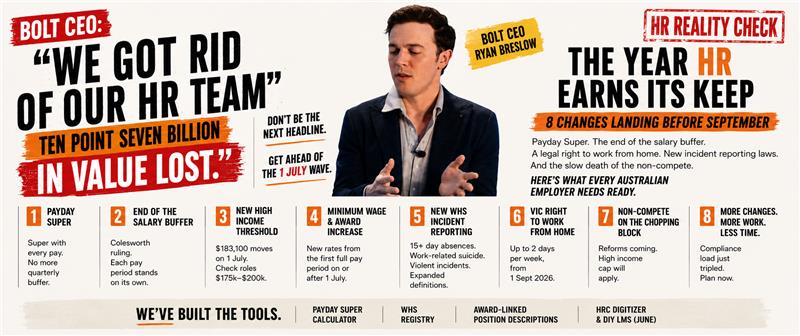
Payday Super. The end of the salary buffer. A legal right to work from home. New incident reporting laws. And the slow death of the non-compete. Here is what every Australian employer needs ready by 1 July, and what comes after.
TL;DR
What’s landing on 1 July: Payday Super, the death of the salary buffer, a new high income threshold, the annual wage review, expanded WHS incident reporting, with Victoria’s WFH right following on 1 September.
What to do this month: unlock the Resource Hub, model your cash flow on the Payday Super Calculator, and audit your salaried staff against their awards.
What we’ve built to help: the WHS Registry and award-linked Position Descriptions are live now. HRC Digitizer and a full DIY LMS ship in June.
When Ryan Breslow returned as CEO of Bolt in 2025, the fintech company had already lost 97 percent of its value. From an $11 billion peak in 2022 to $300 million by 2024. Ten point seven billion dollars, gone.
His diagnosis, delivered at the Fortune Workforce Innovation Summit in May 2026, was that the HR team had been “creating problems that didn’t exist.”
“Those problems disappeared when I let them go,” he said.
Sure they did, buddy.
Ten point seven billion in lost value is not a problem HR invented. We would gently suggest HR was trying to flag the problems before they cost the company everything.
We open with this because the next six months are going to make HR’s job a lot harder, and the businesses that come out the other side in good shape will be the ones whose leadership teams understood what HR was actually managing.
This briefing is two things. It is your prep list. It is also the document you put in front of your CEO or board when you need them to understand why the compliance load just tripled, and why the answer is not “just absorb it.”
Between 1 July and 1 September, Australian employers face the biggest stack of overlapping compliance changes in over a decade. Some have been legislated. Some are still in consultation. All of them require action.
Here is what is landing, and what to do about it.
1. Payday Super: the quietest revolution in Australian payroll in two decades
If you missed this one, you have company. Most businesses we speak to have it on the radar but have not stress-tested their payroll for it.
From 1 July 2026, every employer must pay Superannuation Guarantee contributions at the same time as wages. The quarterly model is gone. Contributions must reach the employee’s super fund within seven business days of each payday.
There is no small business exemption. The ATO’s Small Business Superannuation Clearing House closes on 1 July 2026, and if you use it you need a replacement now, not in June. The calculation base shifts from Ordinary Time Earnings to a broader concept called Qualifying Earnings, which captures salary sacrifice amounts that would otherwise have counted as wages. The maximum contribution base shifts from a quarterly cap of $62,500 to an annual cap of $250,000.
The cash flow shift is real. A business paying super quarterly today is sitting on roughly three months of accrued super before it leaves the door. From 1 July, that runway is seven business days.
Run your numbers through our Payday Super Calculator. Takes about 10 minutes.
Action: Confirm your payroll software is Payday Super ready and lock in a replacement clearing house by 15 June.
2. The Colesworth ruling: the end of the “set and forget” salary buffer
For two decades, the dominant HR advice for salaried staff went like this: “We pay this manager well above the award, so the buffer covers any overtime and penalty rates over the year.”
That advice is now dead.
In FWO v Woolworths and FWO v Coles, the Federal Court ruled that employers cannot pool above-award payments across pay periods to cover award shortfalls in busy weeks. Each pay period stands on its own.
If a salaried employee’s award entitlements exceed their base salary in any single pay period, you must top them up in that pay run. A quiet January cannot subsidise a busy December.
The knock-on effects are wide. Annual leave loading is often “included” in salary and never paid out separately at leave time. That practice is now exposed. The Court also ruled that having a roster or clock-in data is not enough. You must keep detailed records of actual overtime and penalty hours worked by salaried staff, even if you believe they sit comfortably above the award.
Action: Audit your salaried staff against their applicable awards on a per-pay-period basis. Start with your 10 highest-risk roles.
3. The new high income threshold (and why $183,100 quietly moves on 1 July)
The Fair Work Act high income threshold is currently $183,100. It is indexed every 1 July and is likely to land between $188,000 and $192,000 from 1 July 2026.
That number governs more things than people realise. It sets unfair dismissal eligibility. It defines the contractor high income opt-out under the new Section 15AA test. It will set the cap for the upcoming non-compete ban.
If you have employees or contractors sitting just under the threshold, their status may shift on 1 July without you doing anything.
Action: Map every employee and contractor earning between $175,000 and $200,000 and recheck their status from 1 July.
4. The minimum wage and award rate increase
The Fair Work Commission’s 2026 Annual Wage Review decision is due in early June, with new rates taking effect from the first full pay period on or after 1 July.
The ACTU has asked for 5 percent. Employer groups have argued for 3.5. Economists are predicting somewhere between 3 and 4. Whatever the number, every modern award classification moves with it.
Combined with the Colesworth ruling above, this is where most underpayment risk will be sitting on 1 July. If you have anyone on a salary set just above the award, the new rates may push the award above your salary and break your set-off arithmetic.
Action: Re-run your award classification check on the first full pay period after 1 July.
5. The new WHS incident notification laws
In December 2025, Safe Work Australia amended the model Work Health and Safety Act to broaden incident notification requirements. Each state and territory will adopt the changes on its own timeline. NSW has already legislated. Victoria has not yet committed.
Once adopted in your jurisdiction, you will need to notify the regulator of:
- Extended absences of 15 or more consecutive days that are reasonably attributable to a work-related physical or psychological injury or illness, within 14 days of becoming aware.
- Work-related suicides or attempted suicides where there is an identifiable link to work, including use of workplace tools, location of the incident, or exposure to prolonged psychological hazards.
- Violent incidents including physical or sexual assaults, suspected assaults, threats, and unlawful deprivation of liberty, where a person has been exposed to a serious risk of psychological harm.
- An expanded definition of serious injury or illness including injuries that would ordinarily require immediate in-patient treatment whether or not treatment is sought, serious brain injuries from single or repeated blows to the head, and any injury requiring treatment within 48 hours of substance exposure.
- An expanded definition of dangerous incident now capturing mobile plant incidents and serious falls.
- An expanded duty to preserve incident sites including electronic and digital records and witness details.
Most businesses do not have the systems to track 15-day absences against a psychosocial risk register, or the protocols to assess whether an absence is “reasonably attributable to work.”
Our Resource Hub has the updated 2025-2026 Psychosocial Hazards employer guide (17 recognised hazards, mapped state by state), an interactive Psychosocial Hazard Assessment, and a lawyer-reviewed policy template. One form unlocks the lot.
Action: Build a 15-day absence tracker linked to your psychosocial risk register before your state adopts the changes.
6. Victoria’s right to work from home: 1 September 2026
From 1 September 2026, Victorian employees whose roles can reasonably be performed remotely will have a legal right to work from home up to two days per week. The right sits inside the Equal Opportunity Act 2010 (Vic), not the Fair Work Act.
There is no small business exemption, but businesses with fewer than 15 employees get a delayed commencement to 1 July 2027.
Employers can only refuse on reasonable business grounds. Disputes go to conciliation at the Victorian Equal Opportunity and Human Rights Commission, then to VCAT.
This will be tested fast. The Fair Work Commission’s Westpac decision in late 2025 already showed that “return to office” policies, without underlying business justification, do not survive a flexibility refusal challenge.
Action: If you operate in Victoria, draft your WFH policy, role-by-role remote work assessment, and refusal process by 1 August.
7. The non-compete countdown to 2027
The Federal Government has confirmed legislation to ban non-compete clauses for employees earning below the Fair Work Act high income threshold. The ban will take effect from 2027 on a prospective basis.
The threshold does not include commissions or bonuses. Financial services businesses paying a low base plus significant commission will be hit hardest.
If you rely on non-competes to protect client relationships or IP, the work to redesign your retention strategy starts now. Non-solicitation clauses for clients and co-workers are still being consulted on but are likely to survive in a more limited form.
Action: Map every employee and contractor earning below $183,100 and identify which contracts contain non-competes. The contract refresh starts now.
8. Victoria’s NDA restrictions: 1 November 2026
The Restricting Non-disclosure Agreements (Sexual Harassment at Work) Act 2025 (Vic) was passed in December 2025. It commences on 1 November 2026 and does not operate retrospectively.
From that date, Victorian employers will face significant restrictions on the use of NDAs in workplace sexual harassment matters. Settlement agreements and complaint resolution processes will need to be redesigned. Most internal HR playbooks for these matters were written assuming NDAs would always be on the table. They no longer will be.
Action: If you operate in Victoria, have your settlement and complaint resolution playbook reviewed before 1 November.
The bonus item: AI is now an IR issue, not just an IT issue
ABC unionised staff ratified a new Enterprise Agreement in early 2026. The headline was a 10.5 percent pay rise. The real story for HR was what was left out: clauses banning AI-driven job replacement. The agreement installs governance over restriction. Human oversight. Ethical frameworks. Mandatory consultation.
If you have an Enterprise Agreement or are heading into bargaining, AI is now an IR issue, not just an IT issue. Deploy generative AI tools without formal workforce consultation and unions can block the rollout via the Fair Work Commission. When employees fear their roles are being secretly optimised away, bargaining stalls. Trust and transparency are the fix.
Our AI in the Workplace employer guide covers governance frameworks, hiring bias risks, surveillance issues and the shadow AI patterns we are seeing across Australian businesses right now.
What to do this month
- Unlock the Resource Hub for the AI in the Workplace guide, the Psychosocial Hazards guide and assessment, the HR Compliance Audit, and lawyer-reviewed policy templates. Six resources, one form.
- Run the Payday Super Calculator to model your cash flow exposure before 1 July.
- Browse the Knowledge Hub for our running coverage of the FY26 changes.
Built for what’s landing
Most of HR Command’s recent product roadmap is purpose-built for the FY26 changes covered above.
The WHS Registry, released in April, lets your team report, track and manage workplace incidents and hazards from a single registry. Photo uploads. Severity-based assignment and escalation. SLA monitoring. QR code check-in for sites. Full audit log with export. When the new incident notification laws hit your state, you have the system to comply on day one.
Position Descriptions are now linked directly to the relevant Modern Award and classification level, with an approval queue and signed acknowledgment recorded against each employee’s profile. That makes the Colesworth-driven salary-versus-award audit possible to do quickly and defensibly.
Document External Review Links let you share documents with your lawyers, consultants or clients via secure, token-based links with full audit timelines. Useful for the contract refresh work the non-compete ban will trigger.
Two more features land in June 2026.
HRC Digitizer. Upload any of your existing company PDFs or Word documents and turn them into digital forms with e-signatures. Built for everything you currently chase around for signatures. Updated employment contracts. WFH policies. Psychosocial hazard policies. AI usage policies. TFN declarations. Super choice forms. Fair Work Information Statement acknowledgments. Induction sign-offs. Code of conduct acknowledgments. If you have a form, you can digitise it.
Learning Management System. A full DIY LMS. Build your own courses, upload your existing training materials, or use our lawyer-led training across psychosocial risk, AI usage, and compliance refreshers. All in one place with completion tracking against each employee’s record.
You can see the full April release here.
If you want your contracts, policies, and payroll setup FY26-ready by 1 July, our compliance audit covers every change in this briefing mapped to your business.
Book by 13 June to leave room for fixes before the new financial year.