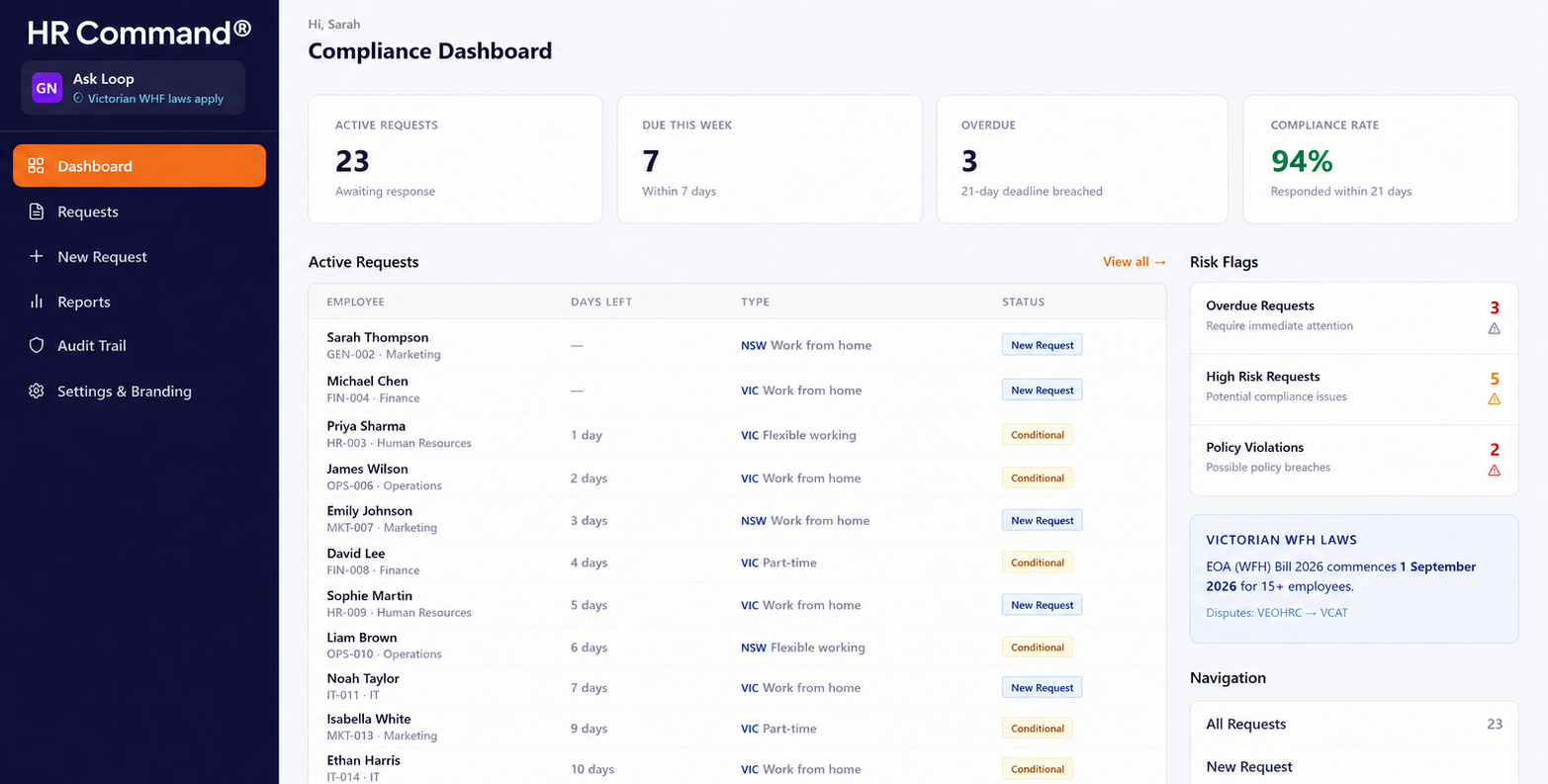



Flexible work requests. Managed. Documented. Defensible.

Victorian employees will soon have a statutory right to work from home. Every request carries a 21-day deadline and a mandatory written response. HR Command is the system that makes sure you meet both, every time.

flexible Work vic working from home app
goodhands

Backed by Cowell Clarke
Commercial Lawyers

Australian Made, Local hosting
and Support

ISO 27001
Certified

Built for Australian
Employers

The Shift, in plain terms

HR advisor and small business owner reviewing a Fair Work compliant employment contract template together at a desk

It is not a request any more. It is a notice.

Under the Equal Opportunity Amendment (Work from Home) Bill 2026, an eligible Victorian employee does not ask permission to work from home. They give you written notice of the days they intend to work remotely. The entitlement exists unless you can demonstrate it is not reasonable, and the burden of proof sits with the employer, not the employee.

The moment that notice lands, a 21-day countdown starts. Not 21 business days. 21 calendar days. No exceptions.

The response has to be in writing. It has to address the seven statutory reasonableness factors. A generic refusal will not hold up at VCAT. And a missed deadline is a breach of the Act, regardless of whether your decision was the right one.

All Australian employers are also bound by the flexible work provisions of the Fair Work Act 2009. The same 21-day rule, a mandatory consultation step before refusal, and specific business grounds required in writing.

Most businesses are managing this with email threads and instinct. That works until a dispute lands at the Fair Work Commission or VCAT.

See it. Document it. Defend it.

Why Risk officers, OHS, HR and safety leaders choose HR Command

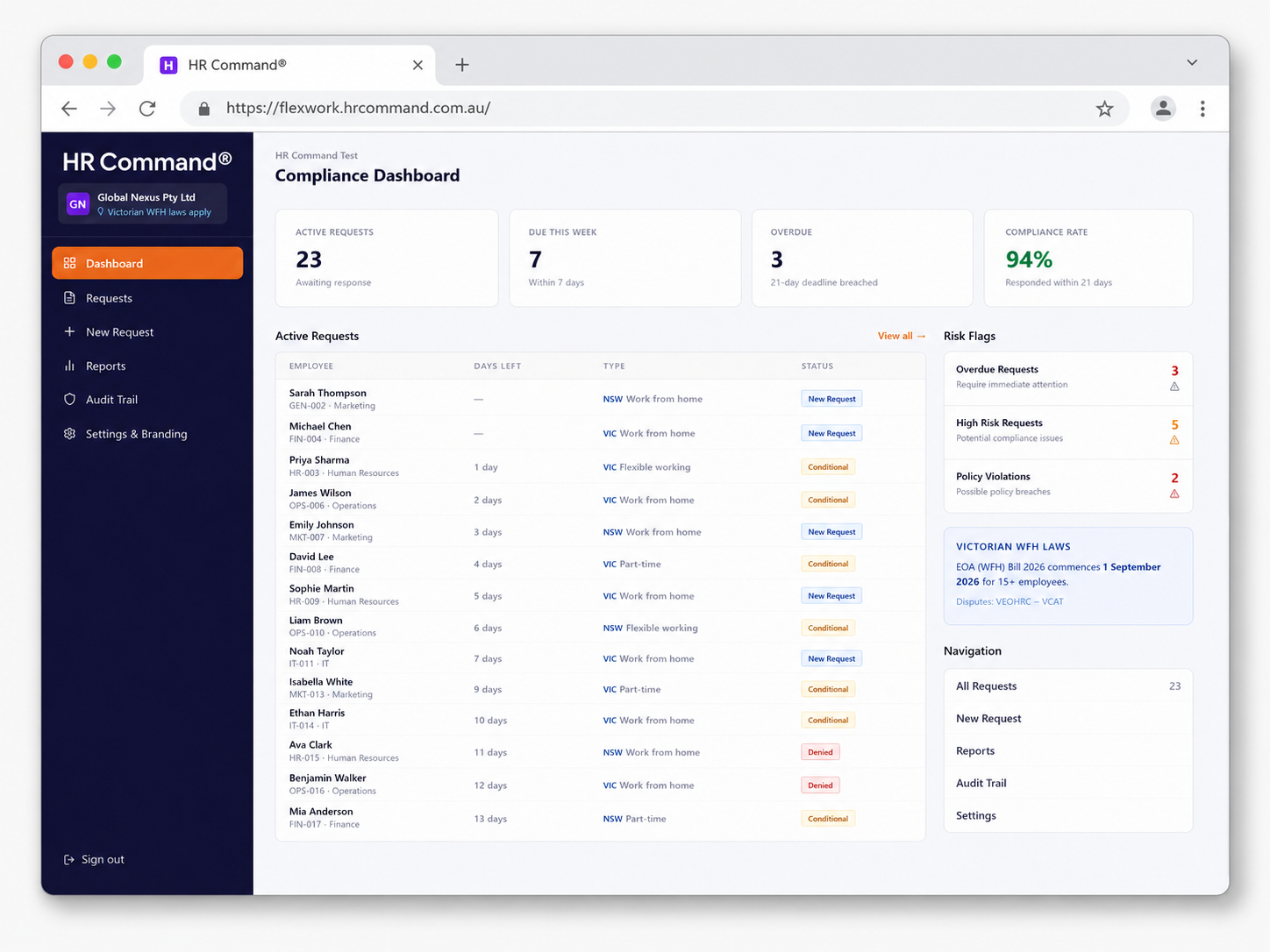
The clock runs from the moment it arrives. Every request is timestamped on submission. The 21-day deadline is tracked automatically. Automated reminders run at Day 7, 14 and 19. You do not miss a deadline because a request sat in someone’s inbox.

Managers are guided, not guessing. The platform walks your manager through consultation, impact assessment, the seven statutory factors, alternatives considered and the decision. Built-in gates prevent a legally deficient response from being issued.

The letter is generated, not drafted. Approval, conditional approval, or refusal. The platform generates a legally-framed written response referencing the correct Act, the correct statutory grounds and the correct dispute pathway. One click to send it to the employee.

Sensitive matters route correctly. Requests linked to domestic violence, disability or carer responsibilities are handled with the appropriate care and privacy. The process adapts to the pathway, Federal or Victorian, based on the request type.

The audit trail exists before you need it. Every action, submission, consultation note, decision, letter sent, is timestamped and locked. If a matter goes to the Fair Work Commission or VCAT, your file is already built.

Employees submit through a branded form. A single link goes to your team. They fill in a simple form on any device, no login, no app. The request lands in your dashboard the moment it is submitted.


Employee working from home at a standing desk with dual monitors, representing flexible work compliance software for Australian employers

How it works

Step 1

Employee submits.

Your team receives a link. They complete a simple form on any device, no login, no app. The request arrives in your dashboard immediately, with the 21-day clock already running.

Step 2

Consultation is documented.

The platform guides your manager through a structured consultation process. Notes, date, attendees, alternatives raised. All captured and attached to the request record before any decision is made.

Step 3

The assessment follows the law.

For Victorian requests, the seven statutory reasonableness factors are assessed one by one. For Federal requests, the specific business grounds required under s.65C are documented. The system will not let you skip the steps that matter.

Step 4

The decision is issued in writing.

A compliant outcome letter is generated from the documented assessment. Approval, conditional approval, or refusal. Each one references the correct legal framework and the correct dispute pathway. Sent directly to the employee from the platform or can be downloaded and sent separately.

Step 5

The file is closed and locked.

The full record, submission, consultation, assessment, decision, letter, is stored in an immutable audit trail. Exportable at any time. The documented proof a regulator or tribunal asks for, ready before they ask.

The right questions, handled the right way

Flexible work decisions are only defensible when the process behind them is consistent. One manager handling a request differently from another is not just an HR problem. It is a legal exposure.

HR Command means every request goes through the same documented process regardless of who handles it. The consultation happens. The statutory factors are assessed. The written response goes out on time. The file exists before anyone asks for it.

Employees get a fair process. Managers get a guided one. HR gets the audit trail.

HR and safety leader at her desk with planning notes and a whiteboard behind her, representing psychosocial hazard management software for Australian workplaces

Both pathways. One system.

The correct legal framework is applied automatically based on the request type.

Victorian

Equal Opportunity Amendment (Work from Home) Bill 2026


Applies to Victorian employees from 1 September 2026 for businesses with 15 or more employees. A statutory entitlement, not a right to request. HR Command assesses all seven prescribed reasonableness factors and generates the compliant written response.

Federal

Fair Work Act 2009 All states and territories


Applies to all Australian employers regardless of state. Mandatory consultation before refusal. Specific business grounds required under s.65C. HR Command walks the manager through the process and locks the evidence.

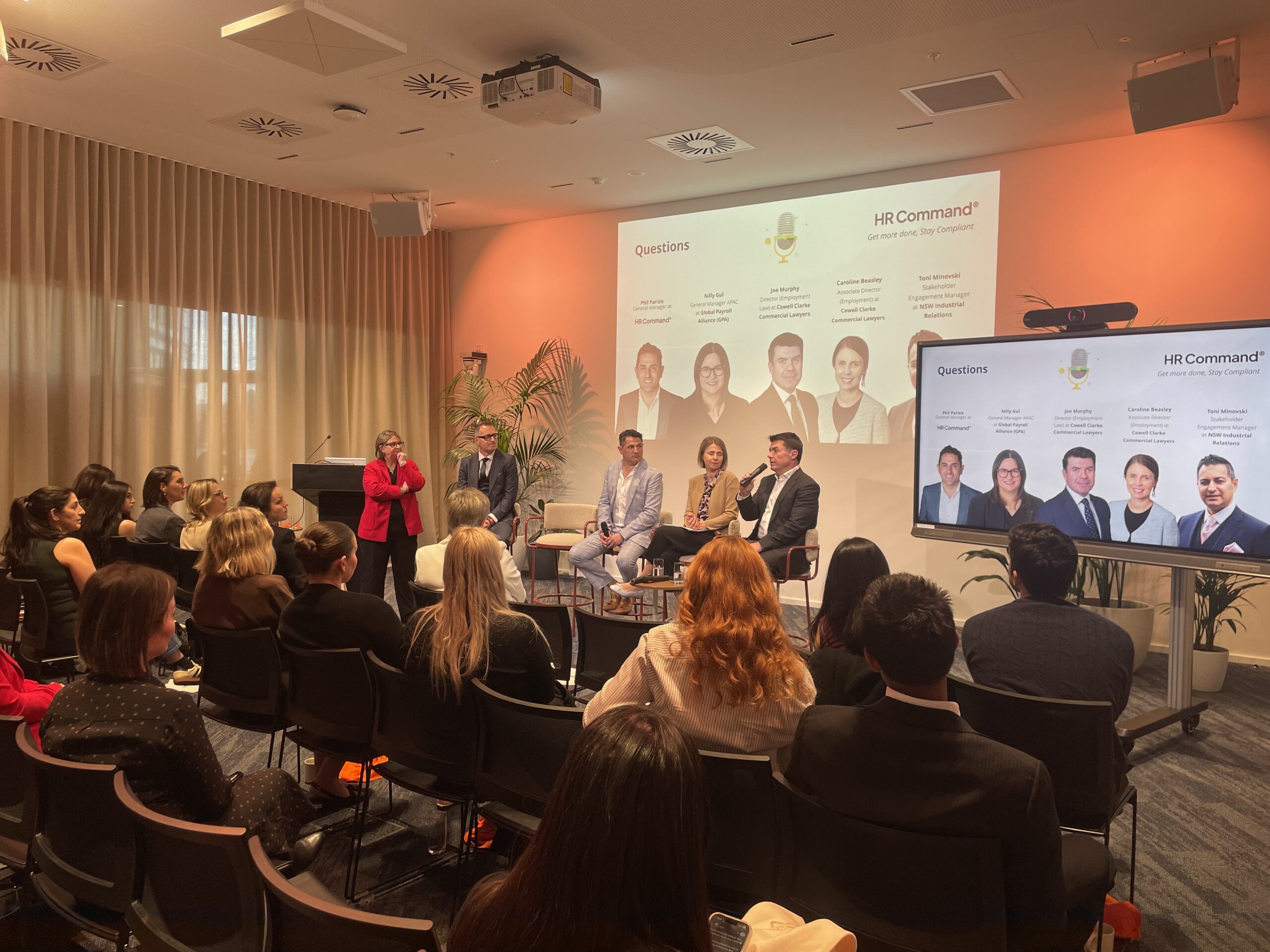
Meet Our Expert Team

With a collective experience spanning over a century in employment law, industrial relations, and HR technology, our team is uniquely positioned to support your business. Trust in our seasoned professionals to provide unparalleled expertise and innovative solutions tailored to your needs.

Click on a profile below for more information.

Todd Johnston

Client Success Partner

Thomas Lee

HR Industry Digital Marketing Specialist

Rhi Yeates

HR Industry Marketing Manager

Phil Parisis

General Manager

Backed by Cowell Clarke Commercial Lawyers

Rest assured that your documentation and advice is legally compliant, giving you peace of mind.

Founded over three decades ago, the multi-award-winning Cowell Clarke set out to revolutionise the traditional, reactive approach of commercial law firms. The firm prides itself on delivering exceptional personal service with a proactive and global outlook.

With a strong national presence and an expanding team, Cowell Clarke's commitment to innovation and client-centric solutions remains unwavering. The firm's strategic partnership with HR Command further demonstrates its dedication to supporting Australian businesses with workplace relations through its extensive employment team.

Cowell Clarke
Joe Murphy Director
Employment & Workplace Relations Team
Cowell Clarke
Caroline Beasley Associate Director
Employment & Workplace Relations Team
Cowell Clarke
Emma Thomson Senior Associate
Employment & Workplace Relations Team
HR, safety and risk leaders in a boardroom discussion with a safety manager in hi-vis, representing psychosocial hazard compliance for Australian leadership teams

Who it is for

People and Culture and HR leaders.

You already own the people side, bullying, harassment, workload, role clarity. It is now a WHS duty, not a wellbeing program. HR Command turns it into a documented process you can stand behind, instead of a spreadsheet that lands back on you.

WHS and safety managers.

Psychosocial has to sit in your safety system with the same rigour as a physical hazard. HR Command runs the identify, assess, control and review cycle and keeps it on the register, next to everything else you manage.

Risk and compliance managers.

Psychosocial now belongs on the risk register beside financial and operational exposure. HR Command gives you the ratings, the controls and the review dates in one view.

Owners and directors.

The due diligence duty is personal. You are expected to ensure a system exists, is resourced and is working. HR Command is the evidence you point to, and the register you can produce when someone asks when it was last reviewed.

HR and WHS consultants.

Deliver a defensible psychosocial process to every client from one place, keep an eye on it across your whole book, and put your own brand on it.

Industry associations.

Give your members a ready compliance answer, under your brand.

The bottom line

The businesses that come through a flexible work dispute well are not the ones with the best flexible work policy. They are the ones who can show the process behind every decision, the consultation that happened, the factors that were assessed, the alternatives that were considered, and the written response that was issued on time. HR Command is how you show it.
Book a walkthrough
HR Command Compliance Dashboard tracking flexible work requests, showing active and overdue requests, the 21 day deadline status, a 94 percent compliance rate, and Victorian and Federal work from home request outcomes
FAQs

Frequently Asked Questions

Does this only apply to Victorian businesses?

No. All Australian employers are covered by the Fair Work Act flexible work provisions. The Victorian WFH Bill adds additional obligations for Victorian employees from 1 September 2026. HR Command handles both.

What happens if we miss the 21-day deadline?

A missed deadline is a breach of the law, regardless of whether your decision was substantively correct. Employees can take an unresolved dispute to the Fair Work Commission or, for Victorian requests, to VEOHRC and VCAT. HR Command tracks the deadline from the moment of submission and escalates before it is breached.

Can we still refuse a request?

Yes. A refusal must be on reasonable grounds, documented against the statutory factors, preceded by genuine consultation, and issued in writing within 21 days. HR Command guides you through each of those steps and generates the compliant refusal letter.

What are the seven Victorian statutory factors?

Productivity, supervision, safety, customer and client interactions, confidentiality, cost, and practicality. HR Command assesses each one as part of the documented decision process.

Is training enough to control a psychosocial risk?

It must reference the specific business or statutory grounds, address the relevant factors, note any alternatives that were considered, and include the correct dispute pathway. HR Command generates this from the documented assessment. You do not write the letter from scratch.

What if the employee disputes the decision?

For Federal requests, disputes go to the Fair Work Commission under s.65B. For Victorian requests, disputes go to VEOHRC and then VCAT, which can order the arrangement be permitted. HR Command builds the file you need to respond to either.

Is employee data stored in Australia?

Yes. All data is hosted in Australian data centres and does not leave the country.

Can this be white-labelled for our clients?

Yes. HR consultants and associations can run the platform under their own brand. Contact us to discuss.