



Victorian workplace compliance
Victorian Work From Home Laws 2026: What Employers Need to Know
Victoria has introduced a Bill that gives eligible employees a right to work from home up to two days a week. Here is what it would require, how to respond to a request, and how to get ready.
Key takeaways
- The Equal Opportunity Amendment (Work from Home) Bill 2026 creates a right to work from home by inserting a new Part 6B into the Equal Opportunity Act 2010. It is not yet law.
- Eligible employees could work from home up to two days a week (38 hours or more), or a pro rata period below that, accessed by a written work from home notice.
- An employer must allow it unless it is not reasonable, judged against a closed list of matters, and must respond in writing within 21 days.
- Employers must pay the reasonable costs of working from home, including equipment and secure systems access.
- Start dates: 1 September 2026 for most employers, 1 July 2027 for small businesses with fewer than 15 staff.
If you employ people in Victoria, the way you handle requests to work from home is about to change. Rather than working from home sitting at the employer’s discretion, eligible employees would gain a right that an organisation can only displace by meeting a defined test. This article explains the proposed law in plain terms, walks through the obligations it would create, and gives you a free guide, templates, a role matrix and a register to put it into practice.
What is the Equal Opportunity Amendment (Work from Home) Bill 2026?
The Bill was introduced to the Victorian Legislative Assembly on 16 June 2026. Instead of creating a new industrial law, it amends the existing Equal Opportunity Act 2010, inserting a new Part 6B headed Right to work from home. That choice matters: it means the right operates as part of Victoria’s anti-discrimination framework, and disputes are handled by the Victorian Equal Opportunity and Human Rights Commission and the Victorian Civil and Administrative Tribunal, not the Fair Work Commission.
Because it is a Bill and not yet an Act, it remains subject to debate, possible amendment, passage and Royal Assent. Nothing below is in force yet. The sensible response is to prepare, not to overhaul contracts on the strength of a Bill. For the full clause-by-clause detail, see the clause companion.
When does it start?
The Bill sets a staggered commencement, with smaller employers given extra time to prepare.
| Milestone | Date |
|---|---|
| Commencement for most employers | 1 September 2026 |
| Commencement for small business (fewer than 15 employees) | 1 July 2027 |
| Independent review of the laws begins | On or after 1 July 2030 |
Who is eligible, and who is not?
The right applies to an eligible employee, across the public and private sectors. Eligibility turns mainly on the type of engagement and the role, not on the employee’s personal circumstances, which is a key difference from the federal flexible work regime. An eligible employee is any employee other than:
- an employee on probation;
- an employee undertaking an apprenticeship, traineeship, internship, graduate program, work experience program or similar program;
- a regulated worker or regulated business under the Fair Work Act, and certain parties to a services contract under that Act (broadly, some gig and contractor arrangements);
- an employee who is eligible to request flexible working arrangements under section 65 of the Fair Work Act and wishes to use that right because of a circumstance covered by it;
- a casual employee who is not engaged on a regular and systematic basis;
- an employee, or class of employee, prescribed by regulation.
Probationers, apprentices, trainees, interns and program participants are only excluded while that condition applies, so they become eligible once it ends. The section 65 carve-out keeps employees who can use the federal right to request, for example for caring responsibilities, disability, age 55 or over, pregnancy or family violence, within that federal process rather than the new Victorian notice.
How much can an employee work from home?
An eligible employee has a right to work from home for a period equal to or less than a specified period, provided it is reasonable. The specified period is two days a week for an employee who works 38 hours or more per week, and a pro rata period for an employee who works less than 38 hours. The entitlement is tied to hours, not to a full-time or part-time label.
The method for calculating the pro rata period is to be set in regulations under section 190 of the Equal Opportunity Act. Those regulations had not been made at the time of writing, and the pro rata period is expected to be set on a 2/5 basis, equivalent to two days of a five-day week. Confirm the method once the regulations are released.
The work from home notice
The right is framed as an entitlement the employee activates, not a request the employer grants. An eligible employee accesses it by giving a written work from home notice. Unless it is not practicable, the notice must set out the days, and any specific times, the employee intends to work from home, and any place other than the employee’s private residence. Where working days vary, the employee can state a proportion of the week instead of fixed days.
For an employer, a notice starts a formal statutory process with a deadline. It cannot be ignored or declined informally.
When can an employer refuse?
On receiving a notice, the employer must allow the employee to work from home as set out unless it is not reasonable. If the notice is not reasonable but an equivalent period on different days or times would be, the employer must allow that. If neither is reasonable, the employer must allow any lesser period of the week that is reasonable. The question is rarely all or nothing. It is how much working from home is reasonable.
New section 102L(4) sets out the only matters the employer may consider. They fall under two heads, plus any matters prescribed by regulation.
The inherent requirements of the role
Whether the role can be done on the requested days and times without in-person attendance at the workplace, without workplace-only equipment, and without in-person contact with the public, clients or customers.
The impact of working from home on the employer
Whether working from home, on the requested days and times, would:
- be likely to cause a significant decrease in productivity or efficiency;
- have an adverse impact on any person’s safety;
- have a significant adverse impact on supervision, training or professional development;
- have a significant adverse impact on building relationships with stakeholders, clients or customers;
- have a significant adverse impact on customer service outcomes;
- have a significant adverse impact on confidentiality or data protection;
- impose excessive financial costs on the employer;
- require impractical changes to working arrangements, or impractical new hires.
Two points matter. First, this is a closed list, so a reason that is not on it cannot support a refusal. A preference for office presence does not qualify. Second, most of the impact factors require a significant adverse impact, which is a high bar. Each notice is assessed on the specific role and the specific days requested, and treating comparable roles inconsistently is the single biggest litigation risk. The role assessment matrix lets you work through this for every role in advance.
Responding within 21 days
The employer must give a written response within 21 days. The response must state whether the employer considers working from home as set out in the notice reasonable. If it does not, the response must either allow an equivalent or lesser reasonable period, with reasons and the days and times allowed, or state that the employer will not allow working from home, with reasons. In short, any refusal in whole or in part must come with written reasons. The toolkit includes response letter templates for each outcome, and the notice register tracks the 21-day clock automatically.
Paying for the home office
Where an employer is required to allow working from home, it must pay the reasonable costs necessary to enable it. The Bill states these include essential equipment, such as hardware and software, and secure access to the employer’s information systems. The word reasonable is the limiter. The Bill does not set a dollar cap, and does not separately address ongoing running costs such as electricity or internet beyond that standard.
Work health and safety at home
When an employee works from home, the home becomes a workplace. The employer’s duty under the Occupational Health and Safety Act 2004 (Vic) to provide and maintain, so far as is reasonably practicable, a safe working environment extends to it. That duty already exists and is not created by the Bill, although the Bill reinforces it by requiring regard to legal requirements on safety, security, welfare and supervision when weighing a role’s inherent requirements. In practice it covers the physical setup, including workstation, ergonomics and electrical safety, and psychosocial risks such as isolation and unclear expectations about hours. The toolkit includes a home workplace safety self-assessment.
Disputes, remedies and penalties
Disputes run through the existing Equal Opportunity Act machinery. A person may bring a dispute to the Victorian Equal Opportunity and Human Rights Commission for conciliation, and may apply to the Victorian Civil and Administrative Tribunal. If an employer does not allow working from home as required, the Tribunal can order it to allow the employee to work from home for a specified period, or order it to do anything specified to comply. There is no separate fine, so enforcement runs through these orders. The Act’s victimisation protection also applies, so an employer should avoid any decision that could be seen as retaliation for a work from home matter. Genuine performance management is not affected.
How this interacts with the Fair Work system
Most private-sector employees in Victoria are covered by the federal Fair Work Act, and Victoria referred its industrial relations powers to the Commonwealth in the 1990s. A direct state industrial law on working from home would risk being invalid for inconsistency with federal law. The Bill is structured to manage that by placing the right in the Equal Opportunity Act, making it additive so it does not affect Fair Work, award or agreement rights, and carving out employees who can use the federal section 65 request. Whether the law can validly bind national-system employers is a question the Bill does not resolve, and a constitutional challenge has been widely flagged. This is the area to watch as the Bill progresses.
What employers should do now
- Work out whether you are a small business under the section 202 counting rule, which fixes your start date as 1 September 2026 or 1 July 2027. The count includes employees of associated entities, and casuals engaged on a regular and systematic basis.
- Assess every role, not every person, against the closed statutory list, and record the reasonable extent of working from home with a written reason.
- Update position descriptions so any genuine on-site, equipment or client-facing requirement is clear and evidence-based.
- Build a compliant written-response process and a 21-day workflow, and brief managers to assess each notice on its merits and document decisions consistently.
- Budget for home-office equipment, secure systems access and a home workplace safety check.
- If you employ across more than one state, decide between a single national policy and a Victoria-specific approach.
Get the complete work from home toolkit
We have built a complete, ready-to-use set for Victorian employers, all verified against the Bill as introduced. The whole set is available together on our resource page, free, after a short form. Here is what you get.
Guide
Employer guide
The plain-English overview of the law and your obligations.
Reference
Clause companion
A clause-by-clause breakdown of every section, with explainers.
Toolkit
Implementation toolkit
Roadmap, response letter templates, a manager worksheet and a safety check.
Spreadsheet
Role assessment matrix
Assess every role against the closed statutory list before notices arrive.
Spreadsheet
Notice register
Log every notice and evidence the 21-day response, with automatic flags.
Turn the 21-day deadline into a routine, not a risk
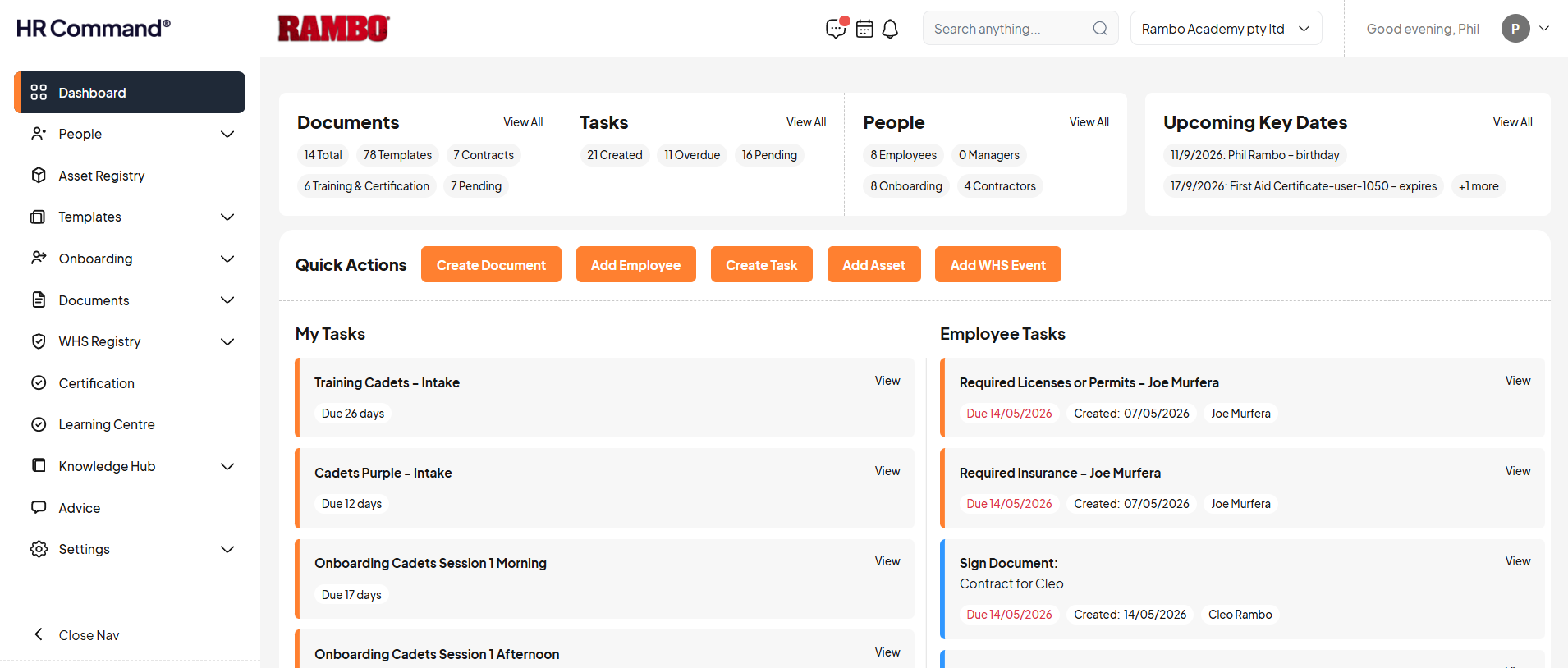
Every work from home notice starts a clock and needs a documented, defensible decision. HR Command gives Victorian employers the policies, workflows and records to handle them consistently, so compliance is built into how your team already works.
Book a demoFrequently asked questions
Is working from home now law in Victoria?
How many days a week can an employee work from home?
Can an employer refuse a work from home request?
How long does an employer have to respond?
Does the law apply to small businesses?
Who pays for home office equipment?
This article is general information only and is not legal advice. It describes the Equal Opportunity Amendment (Work from Home) Bill 2026 as introduced to the Victorian Parliament. The Bill is not yet law and may be amended during its passage, so confirm the position against the final Act once it receives Royal Assent. HR Command content is developed in partnership with Cowell Clarke Commercial Lawyers.