

Sexual Harassment · 15 October 2026
Sexual Harassment Payouts in Australia: What Courts Award and the 2 Mistakes That Cost Employers More
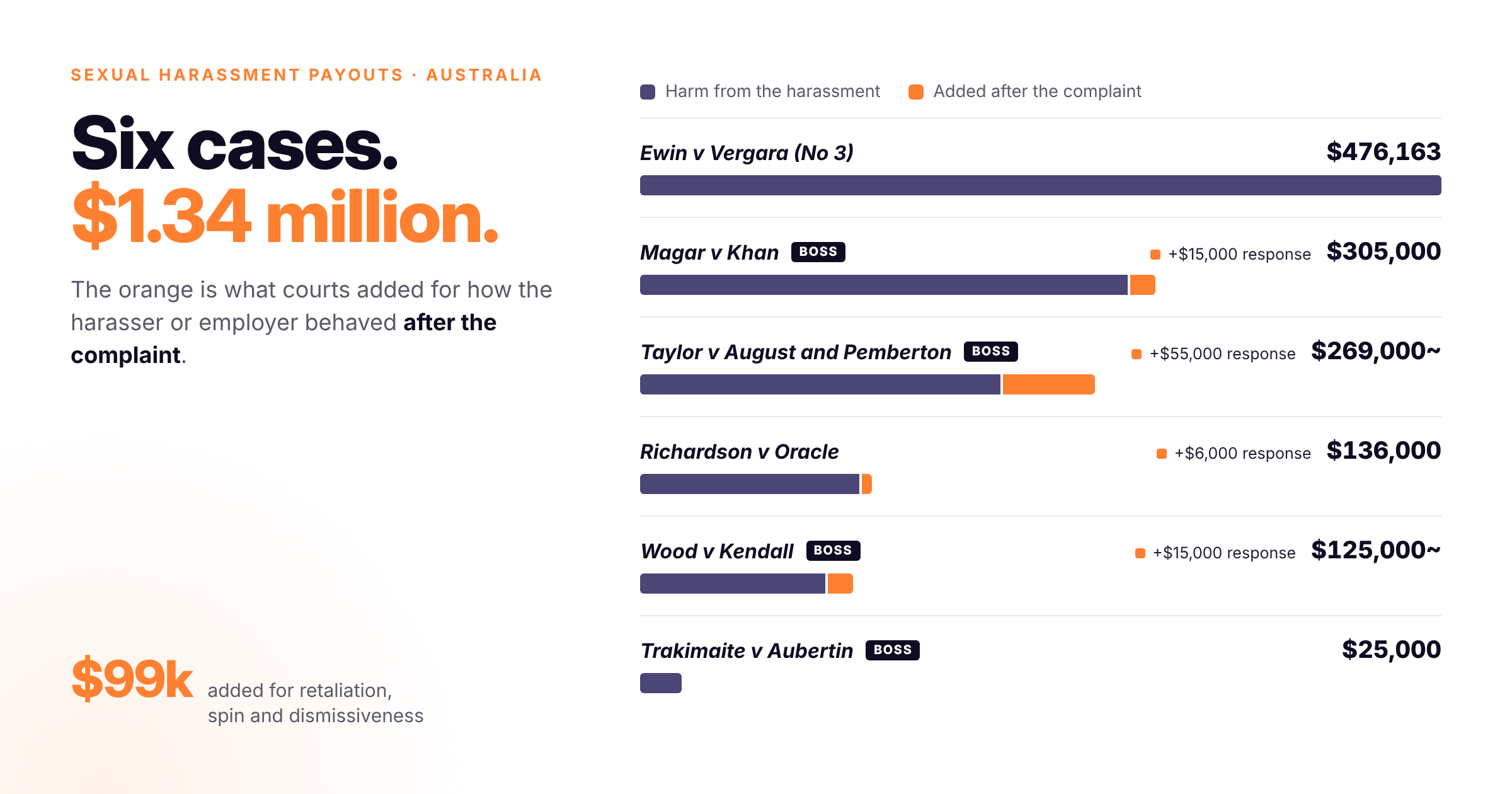
Six cases. More than $1.3 million in damages. And close to $100,000 of it came from what happened after the complaint was made. Here is what Australian courts are awarding, and the two things to avoid when a sexual harassment complaint lands on your desk.
In this article
Most employers know sexual harassment is expensive. Fewer know how much of the bill is self-inflicted. Courts add damages for retaliation, for public spin and for brushing a complaint off. Those extra amounts are entirely within your control. So is avoiding them.
Key takeaways
- General damages for workplace sexual harassment now regularly reach $100,000 to $160,000, before lost income is added.
- Retaliation is its own claim. Threatening criminal charges cost one employer $40,000 on top of everything else.
- How you respond is on trial too. Facebook posts, flippant replies, aggressive lawyers’ letters and public campaigns all attracted aggravated damages.
- Businesses are vicariously liable for harassment by their people unless they took all reasonable steps to prevent it.
- Since October 2024, an employer who loses usually pays the employee’s legal costs as well.
- The positive duty means you must take proactive steps to prevent harassment, not just respond when it happens.
What are courts awarding for sexual harassment in Australia?
The table below covers six workplace sexual harassment cases decided by the Federal Court and the Federal Circuit and Family Court. They run from a single incident to months of conduct, and from a $25,000 award to almost half a million dollars.
Look at the orange chips. Those are the damages awarded for what the employer or harasser did after the complaint was made. None of them had to happen.
Sexual harassment damages
- Harm from the harassment
- Added for conduct after the complaint
| Case | What happened | Damages awarded | Total |
|---|---|---|---|
| Ewin v Vergara (No 3)[2013] FCA 1311 | Four days of sexual advances and intimidation by a contract accountant who reported to her, ending in unwelcome sex while she was drunk.Why so high: chronic PTSD and adjustment disorder, two years of acute symptoms and a big hit to her earning capacity. | Economic loss $366,163General $110,000 |
$476,163 |
| Magar v Khan[2025] FCA 874Harasser was the boss | The franchisee’s sole director questioned a young worker about a hickey in front of staff, then on at least four Sundays showed her pornography and touched her sexually in his car. When she complained to the franchisor, he filed two defamation claims against her.Why so high: he knew she was vulnerable. She was bedridden for months and needed two years of intensive treatment. | General $160,000Economic loss $130,000Victimisation $10,000Aggravated $5,000 |
$305,000 |
| Taylor v August and Pemberton[2023] FCA 1313Harasser was the boss | The sole director slapped her on the buttocks, later declared feelings for her and raised it again months after that. After she complained, he threatened criminal charges claiming she stole company property.Why so high: a chronic psychiatric disorder, damage to her reputation, and lawyers’ letters that attacked her character. | General $140,000Economic loss ~$74,000Victimisation $40,000Aggravated $15,000 |
$269,000approx. |
| Richardson v Oracle Corporation Australia[2014] FCAFC 82 | A colleague subjected her to eleven separate sexual slurs and advances. Oracle was held vicariously liable. The harasser later posted on Facebook misrepresenting the case.Why it matters: the Full Court lifted general damages from $18,000 to $100,000 and reset the range for every case since. | General $100,000Economic loss $30,000Aggravated $6,000 |
$136,000 |
| Wood v Kendall[2026] FedCFamC2G 889Harasser was the boss | A new trainee in her first real shot at a permanent job was asked escalating questions by her employer about her relationship, her sexual fantasies and whether they would have sex if they were dating.Why so high: a clear power imbalance and a worsened mental health condition. His flippant response to her Human Rights Commission complaint added $15,000. | General $100,000Economic loss ~$10,000Aggravated $15,000 |
$125,000approx. |
| Trakimaite v Aubertin[2024] FedCFamC2G 1150Harasser was the boss | The drunk owner and sole director was in a consensual relationship with the employee. When she deflected his request for sex, he texted “your finished have a good night”. Axe Construction was held vicariously liable.Why lower: the evidence couldn’t separate harm caused by the harassment from other events in her life. | General $25,000 |
$25,000 |
| Total awarded across all six cases | $1,336,163 | ||
Damages are discretionary under s 46PO(4) of the Australian Human Rights Commission Act 1986 (Cth). “Approx.” means the judgment gives an approximate figure. Totals exclude interest and legal costs. Case research by Cowell Clarke Commercial Lawyers.
It’s not only harassment. Discrimination claims add up too.
The same Act covers discrimination on the grounds of sex, pregnancy, family responsibilities and gender identity. The biggest award in this group had nothing to do with the original harassment. It came from how the employer treated the employee afterwards.
Discrimination damages
- Harm from the discrimination
- Added for conduct after the complaint
| Case | What happened | Damages awarded | Total |
|---|---|---|---|
| Poniatowska v Hickinbotham[2009] FCA 680 | After several incidents of sexual harassment by co-workers, the employer hit her with sudden warning letters over three months on unrelated issues. The letters assumed her guilt and led to suspension and dismissal.Why so high: the dismissal process, not the harassment, caused a severe adjustment disorder lasting years. | Economic loss $343,000General $90,000 |
$433,000 |
| Commonwealth v Evans[2004] FCA 654 | Her manager criticised carer’s leave she was entitled to and downgraded her review. Her contract wasn’t renewed, while another analyst’s was. She was reassigned while on stress leave.Ground: family responsibilities. | Economic loss $22,000General $12,000 |
$34,000 |
| Giggle for Girls v Tickle[2026] FCAFC 64 | A transgender woman was removed from a women-only social networking app. Not an employment case, but the lesson carries over.Why aggravated damages: a campaign of public posts and interviews against her, and demeaning conduct in court. | General $12,000Aggravated $8,000 |
$20,000 |
| Rankilor v Jerome[2006] FMCA 922 | A customer complaining about a sofa bed was publicly abused with comments like “stupid woman”.Why low: most of her distress came from the consumer dispute itself. | General $2,000 |
$2,000 |
| Ho v Regulator Australia[2004] FMCA 62 | A pregnant accounts clerk was asked to change the towels in the men’s washroom, then called into a meeting about her maternity request and her performance since becoming pregnant.Why low: the towel request was discriminatory but trivial, and her extreme reaction to the meeting wasn’t reasonably foreseeable. | General $1,000 |
$1,000 |
Damages are discretionary under s 46PO(4) of the Australian Human Rights Commission Act 1986 (Cth). Older awards would likely be higher if decided today. Case research by Cowell Clarke Commercial Lawyers.
How are sexual harassment damages worked out?
There’s no fixed schedule. The court looks at the harm done to the person in front of it and builds the award from up to four parts.
| Type of damages | What it pays for | Highest in these cases |
|---|---|---|
| Economic loss | Lost wages and super, past and future, plus medical and treatment costs. | $366,163 (Ewin) |
| General damages | Hurt, humiliation, distress and psychiatric injury caused by the harassment. | $160,000 (Magar) |
| Aggravated damages | Extra hurt caused by how the respondent behaved, including after the complaint and during the case. | $15,000 (Taylor, Wood) |
| Victimisation | Detriment or threats aimed at someone because they complained or took action. | $40,000 (Taylor) |
Three things move the number most:
- Vulnerability. Courts take the victim as they find them. Youth, a first job, a power imbalance or an existing mental health condition all push damages up, especially when the harasser knew about it.
- Severity and duration of the harm. A diagnosed psychiatric injury that lasts years is worth far more than months of distress.
- Evidence. Damages drop when the evidence is thin or can’t separate the harassment’s impact from other causes. That’s why Trakimaite was $25,000 and Ho was $1,000.
What counts as sexual harassment at work?
Under the Sex Discrimination Act 1984 (Cth), sexual harassment is an unwelcome sexual advance, an unwelcome request for sexual favours, or other unwelcome conduct of a sexual nature, where a reasonable person would anticipate the possibility the person would be offended, humiliated or intimidated.
It doesn’t have to be physical, repeated or intended to offend. The cases above show the range:
- Questions about someone’s relationship or sexual fantasies (Wood).
- A comment about a hickey in front of colleagues (Magar).
- A slap on the buttocks, then a declaration of feelings months later (Taylor).
- Sexual slurs and advances spread across eleven incidents (Richardson).
Welcome conduct can become unwelcome
Consent at one point in time isn’t consent forever. Conduct that was welcome can become unwelcome, and from that moment it can be sexual harassment.
In Trakimaite v Aubertin [2024] FedCFamC2G 1150, the employee was in a consensual sexual relationship with the company’s owner and sole director. He asked her for sex over text at least twice. At first, those requests weren’t unwelcome. Their relationship had a significant sexual element, and the requests were part of the banter between them.
That changed when she deflected his second request. The banter stopped, and he replied: “your finished have a good night”. Under that pressure, she rang him and agreed to go to his home.
The court applied the three-step test from Hughes v Hill [2020] FCAFC 126:
- Was there a sexual advance, a request for sexual favours or other conduct of a sexual nature?
- Was it unwelcome?
- Would a reasonable person have anticipated the possibility the person would be offended, humiliated or intimidated?
The court found a reasonable person would have anticipated that, when she tried to put off sex, she would be intimidated by his reply. Intimidation alone was enough. She didn’t also need to be offended or humiliated.
Axe Construction was held vicariously liable under s 106 of the Act. The threat was to her job, made by the person running the business, so it was connected to her employment.
The lesson for employers: a relationship at work doesn’t make sexual conduct safe, especially when one person is the other’s boss. Once someone deflects or says no, what comes next is judged on its own. A threat tied to their job turns a request into harassment.
The Act also prohibits harassment on the ground of sex (demeaning conduct because of someone’s sex, even if it isn’t sexual) and subjecting someone to a workplace environment that is hostile on the ground of sex. Crude jokes, sexualised banter and offensive material on display can all qualify, even if no one is targeted directly.
Who pays: the harasser or the business?
Often both. The harasser is personally liable. The business is vicariously liable for harassment by its employees and agents in connection with their work, unless it can show it took all reasonable steps to prevent it. Oracle and Axe Construction both paid for conduct by their people.
Anyone who causes, instructs, induces, aids or permits sexual harassment can also be liable. That includes managers who see it and do nothing.
Now look at the tags in the table. In four of the six cases, the harasser was the owner, sole director or employer. In a small or mid-sized business there’s often no one above that person to complain to, and no one to stop them. It’s also why a sexual harassment policy has to apply to the people at the top, and why complaints about senior people need an independent pathway.
Mistake 1: Retaliating against the person who complained
When someone accuses you or a senior person of sexual harassment, the instinct is to hit back. Don’t.
Victimisation is unlawful under the Sex Discrimination Act. It covers subjecting someone to a detriment, or threatening to, because they made a complaint, gave evidence or asserted their rights. It’s also a criminal offence under the Act, and it can be adverse action under the general protections in the Fair Work Act 2009 (Cth). The courts consistently treat counter-allegations made in response to a complaint, especially unsubstantiated ones, as retaliation.
Threats of criminal charges: $55,000 extra
In Taylor v August and Pemberton [2023] FCA 1313, the director responded to the complaint by threatening criminal charges, claiming the employee had stolen company property. The court awarded $40,000 for victimisation. It pointed to the seriousness of the threat and the evidence of its effect: paranoia, one to two hours’ sleep a night and a worsening psychiatric condition.
Then came the lawyers’ letters. They called the claim frivolous and vexatious, said she was after money and described her as flirtatious. None of it was put to her in cross-examination. That added $15,000 in aggravated damages. All up, $55,000 on top of the $140,000 for the harassment itself.
Defamation threats: $10,000 extra
In Magar v Khan [2025] FCA 874, the harasser filed two defamation claims after the employee complained to the franchisor. The court awarded $10,000 for victimisation.
Arguably, he got off lightly. The notices were so confusing that she barely understood them, and her condition had already worsened before they arrived. The court can’t compensate harm the conduct didn’t cause. A clearer threat, landing at a worse time, would have cost a lot more.
Sudden performance management: $433,000
Poniatowska v Hickinbotham [2009] FCA 680 is the cautionary tale. After she was harassed by co-workers, the employee suddenly received a run of warning letters about unrelated issues, including one for taking a deposit her supervisor had approved. The letters assumed guilt. Suspension and dismissal followed. The court found the dismissal process itself caused a severe psychiatric injury, and the bill came to $433,000.
If you have genuine concerns about the complainant
Sometimes an employer has real conduct or performance concerns about someone who has also made a complaint. You can still deal with them. But how you do it matters.
- Keep it completely separate from the harassment complaint.
- Ask whether you’d raise it right now if there were no complaint. If the honest answer is no, wait.
- Have someone independent of the complaint make the decisions, never the alleged harasser.
- Follow your policies to the letter and document every step, including the evidence behind each concern.
- Keep the tone respectful. No threats, no legal posturing, no character attacks.
- Get advice before you act.
Mistake 2: Being dismissive, defensive or going public
Courts hold respondents accountable for how they behave once a complaint is made. That includes what they post, what they say, what their lawyers write and how they act in the courtroom. Arrogance, flippancy and spin all show up as aggravated damages.
Spinning the story on social media
In Richardson v Oracle Corporation Australia [2014] FCAFC 82, the harasser posted on Facebook in a way that misrepresented the facts and progress of the claim to protect his own reputation. That cost $6,000 in aggravated damages.
Brushing the complaint off
In Wood v Kendall [2026] FedCFamC2G 889, the employer’s dismissive and flippant conduct after the employee complained to the Australian Human Rights Commission caused further insult and humiliation. That added $15,000 in aggravated damages to the $100,000 awarded for the harassment.
Running a public campaign
Everyone’s conduct counts, not just the harasser’s. In the widely reported Giggle for Girls Pty Ltd v Tickle [2026] FCAFC 64, a gender identity discrimination case, the respondents ran a campaign of public posts and interviews, portrayed the applicant as a “predatory male”, misgendered her in the hearing and laughed at a demeaning caricature of her in court. The Full Court awarded $8,000 in aggravated damages.
What not to do once a complaint is made
- Post, comment or “set the record straight” on social media, or let anyone else do it for you.
- Talk about the complaint with staff, clients or industry contacts.
- Joke about it, minimise it or tell the complainant they’re overreacting.
- Let your lawyers attack the complainant’s character, motives or sex life.
- Contact the complainant directly to “sort it out” if you’re the person accused.
Why sexual harassment payouts are rising
Damages were modest for years. That changed in 2014, when the Full Federal Court in Richardson v Oracle said general damages should reflect community standards and lifted the award from $18,000 to $100,000. Six-figure general damages are now routine. Several other changes have raised the stakes for employers since.
| Change | When | What it means for employers |
|---|---|---|
| Positive duty | Since 13 December 2022 | You must take reasonable and proportionate measures to eliminate sexual harassment, sex-based harassment, hostile workplaces and victimisation, as far as possible. |
| Commission enforcement powers | Since 12 December 2023 | The Australian Human Rights Commission can run inquiries, issue compliance notices and accept enforceable undertakings, without waiting for anyone to complain. |
| Longer time to complain | Since December 2022 | Employees have 24 months to lodge a complaint with the Commission, up from six. |
| Fair Work sexual harassment jurisdiction | Since 6 March 2023 | Sexual harassment in connection with work is prohibited under the Fair Work Act. Workers can seek stop orders through the Fair Work Commission or pursue compensation. |
| Costs protection | Since 2 October 2024 | If an employee wins even part of their case, the court must generally order the employer to pay their legal costs. An employee who loses usually won’t pay the employer’s costs. |
Put together: claims are easier and cheaper to bring, there’s more time to bring them, and losing costs more. The award is only part of the bill. Your own legal fees, the employee’s legal fees, lost management time and reputational damage come on top.
The 24-month window isn’t a hard wall
In Roff v Peninsula Australia Pty Ltd [2026] FWC 3895, the Fair Work Commission made its first decision under s 527G of the Fair Work Act. That section lets the Commission dismiss a sexual harassment application made more than 24 months after the last alleged contravention. It doesn’t have to.
The applicant made allegations about three people, covering conduct from May 2023 to mid 2024. The allegations haven’t been tested. The Commission dismissed the application about two of them, whose alleged conduct fell outside the 24-month window, because the merits didn’t justify the time and cost of litigation. The application about the third went ahead, because his alleged comments ran to mid 2024 and may still have been in time.
The Commission weighs all the circumstances, including:
- how serious the allegations are and whether the conduct was continuing
- the length of the delay and its impact on evidence, conciliation and other remedies
- the explanation for the delay, such as embarrassment, a power imbalance, or mental distress or illness
- the factual basis for the claims.
For employers, late doesn’t mean dead. Keep complaint records, investigation notes and relevant messages well beyond 24 months, and don’t assume an old allegation will be thrown out.
What to do when a sexual harassment complaint lands on your desk
The first few days set the tone for everything that follows, including how a court will view your response if it gets that far.
| Step | What to do |
|---|---|
| 1. Listen and take it seriously | Thank the person for raising it. Don’t judge, minimise or promise outcomes you can’t guarantee. |
| 2. Make sure people are safe | Put interim measures in place, like changed reporting lines, rosters or locations. Make sure they don’t disadvantage the person who complained. |
| 3. Shut down retaliation early | Tell everyone involved, including the person accused, that victimisation won’t be tolerated and that the matter is confidential. |
| 4. Pick the right investigator | If the allegation is against an owner, director or senior manager, use someone independent. No one should investigate their own boss. |
| 5. Run a fair process | Put the allegations to the person accused, give them a real chance to respond and allow support people. Make findings on the evidence. |
| 6. Keep other issues separate | Park unrelated performance or conduct matters unless they’re urgent, and handle them through a separate, documented process. |
| 7. Watch what’s said and written | No social posts, no gossip, no aggressive letters. Assume every email will be read out in court. |
| 8. Document everything | Record what was reported, what you did, when and why. That record is your evidence that you acted reasonably. |
| 9. Get advice early | Before you respond formally, and before any disciplinary action on either side. HR Command clients can call the Workplace Advice Line and speak directly with employment lawyers. |
Prevention: meeting the positive duty
The cheapest sexual harassment claim is the one that never happens. Since December 2022, prevention has been a legal duty, not a nice-to-have. Employers must take reasonable and proportionate measures to eliminate sexual harassment, and the Commission can enforce that duty even if no one has complained.
The Commission’s guidelines set out seven standards to work towards:
- Leadership. Senior leaders model respectful behaviour and own the issue.
- Culture. A safe, respectful and inclusive workplace where people feel able to speak up.
- Knowledge. A clear policy, and training so everyone understands it.
- Risk management. Identify where harassment is likely to happen and control it.
- Support. Support for workers who experience or witness harassment.
- Reporting and response. Safe, accessible ways to report, and fair, timely responses.
- Monitoring, evaluation and transparency. Track what’s happening and whether your measures work.
Sexual harassment is also a psychosocial hazard under work health and safety laws, so it belongs in your WHS risk management too. HR Command’s Psychosocial Hazard Management module helps you identify, assess and control it.
Party season is high-risk season
Alcohol, after-hours venues and blurred lines between work and social time make end-of-year functions a common setting for harassment complaints. Set expectations before the event, not after. HR Command’s free Christmas Party Pack includes pre-event letters, reminder emails and SMS templates, plus a complimentary drug and alcohol policy.
How HR Command helps you prevent and respond to sexual harassment
HR Command gives Australian employers the documents, systems and legal support to meet the positive duty and respond properly when something goes wrong.
| What you need | How HR Command handles it |
|---|---|
| A clear policy | Sexual harassment, bullying, equal opportunity and grievance policies in the HR policies and document templates library, drafted with Cowell Clarke Commercial Lawyers and updated as the law changes. |
| Proof staff have read it | Bulk send policies with Collections and track every acceptance through Employee Self Service. |
| Training records | Deliver and record training through the Learning Centre. |
| New starters covered from day one | Give every new hire their contract and core policies in one flow with Employee Onboarding. |
| Risk management | Identify and control harassment as a psychosocial hazard with the Psychosocial Hazard Management module and WHS Management. |
| Advice when a complaint lands | Call the Workplace Advice Line and speak directly with employment lawyers before you respond. |
Sexual harassment payouts FAQ
How much compensation do you get for sexual harassment in Australia?
There’s no fixed amount. Courts award damages based on the harm caused. In recent Federal Court cases, general damages for hurt and psychiatric injury have ranged from about $25,000 to $160,000, with lost income, medical costs, aggravated damages and victimisation damages added on top. Total awards in the cases above ranged from $25,000 to more than $476,000.
Is an employer liable for sexual harassment by an employee?
Usually, yes. Under the Sex Discrimination Act, an employer is vicariously liable for sexual harassment by its employees or agents in connection with their work, unless it can show it took all reasonable steps to prevent it. A policy alone isn’t enough. You need training, reporting pathways and evidence you acted on risks.
What is victimisation in a sexual harassment complaint?
Victimisation is subjecting someone to a detriment, or threatening to, because they made a complaint, gave evidence or asserted their rights. Threats of legal action, counter-allegations, sudden performance management or dismissal can all be victimisation. Courts award separate damages for it, as high as $40,000 in Taylor v August and Pemberton.
What are aggravated damages?
Aggravated damages compensate for extra hurt and humiliation caused by the way a respondent behaved, including after the complaint and during the court case. Courts have awarded them for misleading Facebook posts, flippant responses, lawyers’ letters that attacked the complainant’s character and public campaigns against the applicant.
How long does an employee have to make a sexual harassment complaint?
An employee generally has 24 months from the conduct to lodge a complaint with the Australian Human Rights Commission. The Fair Work Commission can dismiss a sexual harassment application made more than 24 months after the last contravention, but it doesn’t have to. It weighs all the circumstances, including the reason for the delay.
Do employers have to pay the employee’s legal costs if they lose?
Generally, yes. Since 2 October 2024, if an applicant succeeds on any ground in a federal discrimination or sexual harassment case, the court must usually order the respondent to pay their costs. An unsuccessful applicant usually won’t be ordered to pay the respondent’s costs unless they acted vexatiously, without reasonable cause or unreasonably.
What is the positive duty to prevent sexual harassment?
Since 13 December 2022, employers have had a legal duty under the Sex Discrimination Act to take reasonable and proportionate measures to eliminate sexual harassment, sex-based harassment, hostile workplace environments and victimisation, as far as possible. The Australian Human Rights Commission has been able to enforce it since 12 December 2023.
Can I discipline an employee who has made a sexual harassment complaint?
You can deal with genuine, unrelated conduct or performance issues, but the risk of a victimisation claim is high. Keep the matter completely separate from the complaint, have an independent person make decisions, follow your policies, document the evidence and get legal advice before acting.
The bottom line
You can’t undo harassment once it’s happened. You can control what happens next. Across these cases, retaliation, public spin and dismissiveness pushed the payments higher every time.
If a complaint lands on your desk, pause. Don’t hit back, don’t post, don’t brush it off. Get proper advice, then act.
Ready before a complaint lands
HR Command gives Australian employers legally drafted policies, tools to send, track and train, psychosocial hazard management, and a Workplace Advice Line staffed by employment lawyers. Get More Done. Stay Compliant.
Book a demoThis article is general information only and is not legal advice. Damages figures are drawn from published judgments and may be rounded. You should obtain advice specific to your circumstances. HR Command content is developed in partnership with Cowell Clarke Commercial Lawyers.