


Employment contracts
Without written employment contracts, a handshake feels quick. It gets expensive the moment someone remembers the deal differently. Here’s why every role in your business needs a written contract, which contract fits which role, and what to put in it.
Key takeaways
- A written contract isn’t strictly required by law, but it’s your best evidence of what was agreed.
- Full-time, part-time, casual, fixed-term and contractor arrangements each need their own contract.
- No contract can offer less than the National Employment Standards or an applicable award.
- How the relationship works in practice matters more than the label on the contract.
- Contracts go stale. Review them when roles change and when the law changes.
Is a written contract legally required?
Not strictly. In Australia, an employment contract can be verbal, written, or implied from how both sides behave. It’s still binding.
The problem is proof. When a dispute lands, a verbal agreement comes down to two memories. They rarely match.
Some things are compulsory regardless of whether you have a written contract:
- Every new employee must get the Fair Work Information Statement.
- Casual employees must also get the Casual Employment Information Statement.
- Fixed-term employees must also get the Fixed Term Contract Information Statement.
- The National Employment Standards (NES) and any applicable modern award or enterprise agreement apply automatically.
- Payslips must be issued within one working day of payday, and employee records kept for seven years.
A written contract sits on top of those minimums. It records the things the law leaves to you: the role, the pay above minimums, the extra terms that protect your business.
What a written contract does for you
Most businesses hire in a hurry. A busy season hits, someone resigns, a big client signs. You need people now, and paperwork feels like a speed bump.
Skip it and you’re trading five minutes today for a problem later. A written contract:
- Spells out the working relationship and who reports to whom
- Confirms the type of engagement, so there’s no argument about it later
- Sets expectations on hours, duties and pay
- Explains entitlements and obligations on both sides
- Protects your confidential information, clients and intellectual property
- Gives you something to point to when performance or conduct becomes an issue
- Cuts down on disputes, because the answer is already written down
Without one, everyone fills the gaps with assumptions. Your assumptions and your employee’s will almost never be the same.
Choosing the right contract type
Most businesses run a mix of arrangements. Each needs a contract built for it. Using a full-time template for a casual, or an employee contract for a contractor, creates the exact risk the contract is meant to remove.
| Type | Ongoing? | Hours | Paid leave | Best for |
|---|---|---|---|---|
| Full-time | Yes | Usually 38 per week plus reasonable additional hours | Yes | Core, permanent roles |
| Part-time | Yes | Regular, agreed hours under 38 | Yes, pro-rata | Permanent roles with reduced hours |
| Casual | No firm commitment | As offered and accepted | No, casual loading instead | Irregular or unpredictable work |
| Fixed-term | Until an end date or event | Full-time or part-time | Yes | Projects, seasonal peaks, leave cover |
| Independent contractor | Per engagement | Set by the contractor | No, not an employee | Specialists running their own business |
Not sure which one fits? Browse the full HR Command contract library or book a demo and we’ll show you how the platform matches the right contract to the role.
Full-time employment contracts
Full-time employees are ongoing and work regular hours. What that looks like:
- No fixed end date
- Standard full-time hours, usually 38 per week
- Paid annual leave, personal/carer’s leave and the other NES entitlements
- Super paid on ordinary time earnings
A full-time contract confirms the role, pay, hours, leave, probation and notice. It also sets out performance standards and the policies the employee must follow. For senior or salaried roles, it’s where you deal with reasonable additional hours and how the salary covers award entitlements.
See the full-time employment contract.
Part-time employment contracts
Part-time employees are ongoing, just on fewer hours than full-time. What that looks like:
- Agreed minimum hours each week, and often agreed days and times
- Pro-rata leave entitlements
- Ongoing employment
The contract matters most here because it locks in the agreed hours. Many awards require part-time hours to be agreed in writing before work starts. Get it wrong and you’re exposed to overtime claims every time the roster changes.
See the part-time employment contract.
Casual employment contracts
Casuals suit work that is genuinely irregular: busy periods, events, peak season, covering gaps. What that looks like:
- No firm advance commitment to ongoing work
- Casual loading instead of paid leave
- Freedom on both sides to offer and accept shifts
Here’s the catch. Whether someone is really casual now depends on how the job works in practice, not just what the contract says. If a casual works regular, predictable hours over time, they may not be a casual at all. After six months (twelve months for small business), eligible casuals can also notify you that they want to move to permanent employment.
A clear casual contract, plus the Casual Employment Information Statement at the right times, shows how the relationship was set up from day one.
See the casual employment contract.
Fixed-term employment contracts
Fixed-term contracts are for work that ends on a set date or when a project wraps up. Common examples:
- Seasonal work
- Project-based roles
- Covering someone on parental or extended leave
The contract should spell out the start and end date (or the event that ends it), why the role is fixed-term, and how employment finishes.
There are strict limits. For most employees, a fixed-term contract can’t run longer than two years including extensions, and can’t be renewed more than once. Limited exceptions apply. Without a properly drafted contract, a fixed-term role can quietly become ongoing employment, with everything that comes with it.
See the fixed-term employment contract.
Independent contractor agreements
Not everyone who works for you is an employee. Freelance designers, installers, IT specialists and consultants are often engaged as contractors.
Contractors run their own business. You engage them to deliver a result, not to work as part of your team.
The test is the real substance and practical reality of the relationship, looked at as a whole. Calling someone a contractor doesn’t make them one. If they work set hours, under your direction, using your tools, in your uniform, a court may decide they’re an employee. Get it wrong and you could face:
- Back payment of wages and entitlements
- Unpaid super and the Superannuation Guarantee Charge
- Penalties for sham contracting
- Payroll tax and workers’ compensation exposure
A solid contractor agreement covers scope of work, deliverables, payment terms, responsibilities, insurance, and who owns the intellectual property.
See the independent contractor agreement.
Award and award-free contracts
Some roles are covered by a modern award. Others aren’t. Working out which is which is one of the most important steps in getting a contract right.
Where an award applies, the contract must:
- Name the correct award and classification level
- Pay at least the award minimum, including penalty rates, overtime and allowances
- Explain how pay and conditions are calculated
If you pay an above-award salary to cover things like overtime and penalties, say so. A properly drafted set-off clause shows which award entitlements the salary is meant to absorb. Even then, you need to check the salary actually covers what the employee would have earned under the award. Some awards also require annual reconciliations.
Award-free roles still need to meet the NES and clearly set out pay, leave and termination. They’re also where well-drafted terms on hours, duties and confidentiality do the most work, because there’s no award to fall back on.
Remember the super guarantee rate is 12% of ordinary time earnings. Make sure your contracts and payroll reflect the current rate.
What a good contract includes
A well-drafted contract will:
- Identify the employer and employee correctly, including ABN and legal entity names
- State the type of engagement
- Set out the position, duties, location and reporting line
- Confirm pay, pay frequency, super and any allowances
- Reference the applicable award and classification, or state that the role is award-free
- Set out hours of work, including reasonable additional hours
- Include probation terms, if you’re using them
- Explain notice and termination requirements
- Cover confidentiality, intellectual property and return of property
- Require compliance with your workplace policies, without making those policies part of the contract
Most importantly, it should match how the job actually works day to day. A perfect contract that describes a different job isn’t much help.
Probation doesn’t override the law. Notice under the NES still applies during probation, and unfair dismissal protection starts after the minimum employment period (six months, or twelve months for small business), whatever length your probation is.
Extra terms worth including
Beyond the basics, most businesses benefit from clauses that reflect how work really gets done. These are often left out, and they’re usually where disputes start.
Surveillance and monitoring
Most businesses use technology to manage work: email, CRMs, phone systems, GPS in vehicles, security cameras. Your contract, backed by a surveillance policy, should be upfront about:
- Whether emails, systems or devices may be monitored
- Use of CCTV or security systems
- Tracking of company vehicles or devices
Some states, including NSW and the ACT, have specific notice rules before surveillance can start. Being transparent reduces privacy complaints and keeps you on the right side of the law.
Confidentiality, IP and restraints
Your client list, pricing, margins, supplier terms and know-how are worth protecting. Consider clauses covering:
- Confidentiality of client, supplier and business information
- Ownership of intellectual property created on the job
- Protection of pricing and margin data
- Reasonable post-employment restraints, such as non-solicitation of clients and staff
Restraints must be reasonable and tailored to the role. Go too broad and they won’t hold up. The rules are also changing: the Federal Government has committed to banning non-compete clauses for employees earning under the high income threshold. Non-solicitation and confidentiality clauses are expected to remain available, so make sure your contracts lean on those.
Motor vehicle use
If employees get a company car, a vehicle allowance, or use their own car for work, the contract should cover:
- Permitted use, both work and private
- Who pays for fines, damage and maintenance
- Insurance and licence requirements
- How to report incidents
Clear vehicle terms avoid headaches, particularly in sales and field roles.
Communication, reporting and commissions
Sales-driven and client-facing roles usually have specific expectations. Contracts might cover:
- Reporting lines and management structures
- CRM use and who owns client data
- Expectations around client contact and follow-up
- Commission structures, backed by a separate commission plan you can update each year
Keep in mind that employees now have a right to disconnect outside working hours. Contact expectations should be reasonable and reflect the role and pay.
Additional benefits
If you offer more than the minimum, write it down. Examples:
- Bonuses or commissions
- Car allowances or reimbursements
- Phone or tech allowances
- Flexible work arrangements
- Training and professional development support
Make clear which benefits are contractual and which are discretionary. That way everyone knows where they stand, and you keep flexibility if arrangements change.
Keeping contracts current
A contract is accurate on the day it’s signed. After that, it starts to drift.
Review contracts when:
- Someone is promoted or changes role
- Pay, hours or location change
- A casual moves to part-time or full-time
- A fixed-term contract is extended
- Workplace laws change, which has happened a lot over the past few years
Record changes in a signed letter of variation. Don’t rely on an email or a chat in the kitchen. And check your templates at least once a year. A contract written five years ago may include terms that are no longer enforceable, or miss obligations that didn’t exist then.
Common contract mistakes
The issues we see most often:
- Relying on verbal agreements
- Using outdated or generic templates downloaded from the internet
- Not updating contracts when roles change
- Misclassifying contractors and casuals
- Getting award coverage or classification wrong
- Paying a salary with no set-off clause, or one that doesn’t cover award entitlements
- Including pay secrecy clauses, which are now prohibited
- Forgetting the Fair Work, Casual or Fixed Term information statements
- Overly broad restraints that won’t hold up
These problems usually surface only when there’s a dispute, a claim or a Fair Work inspection. By then it’s too late to fix the paperwork.
How HR Command helps
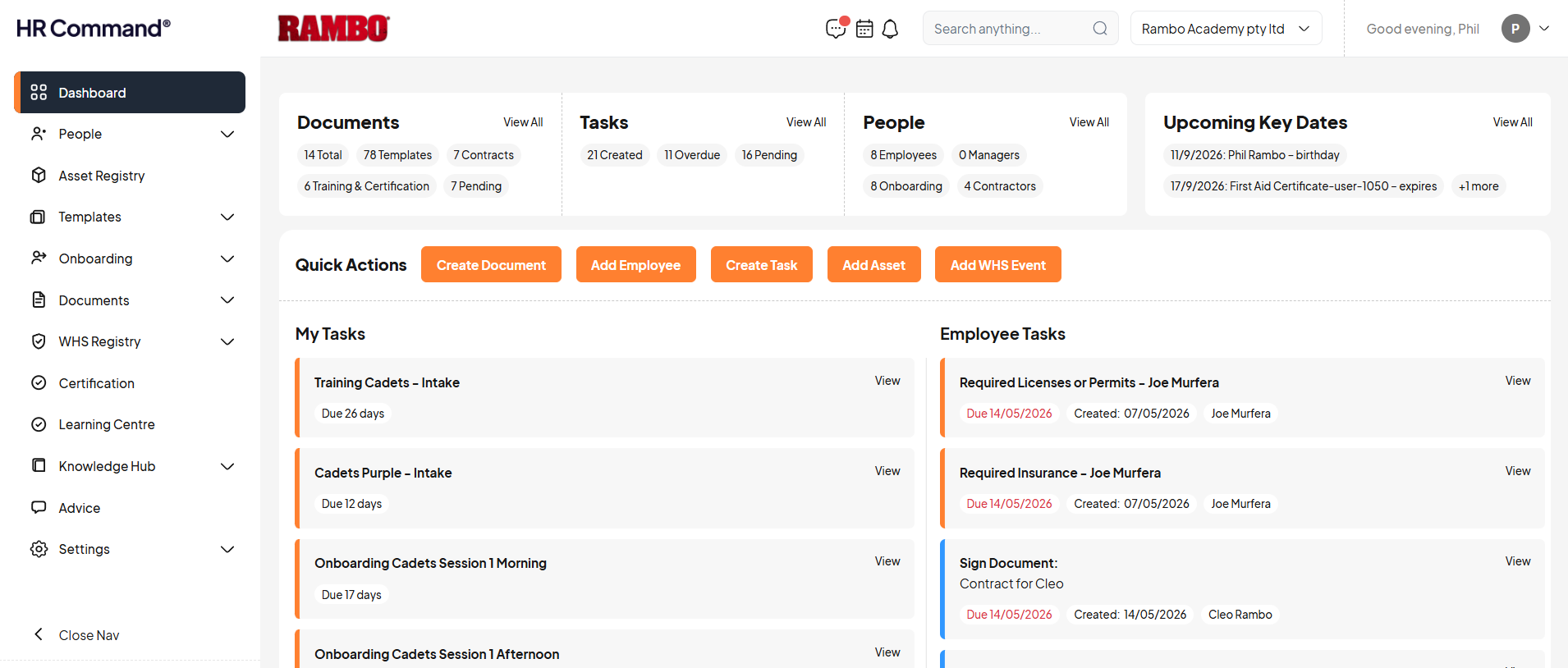
HR Command gives you a library of contracts drafted by Cowell Clarke Commercial Lawyers and updated when the law changes. You pick the right contract, answer a few questions, and the platform builds it. Send it for e-signature and store it securely, all in one place.
The library covers every engagement type:
- Full-time employment contract
- Part-time employment contract
- Casual employment contract
- Fixed-term employment contract
- Independent contractor agreement
Explore all HR Command employment contracts.
FAQs
Is a written employment contract legally required in Australia?
No. A contract can be verbal, written or implied. But without a written contract it’s hard to prove what was agreed, and you still have to give new employees the Fair Work Information Statement. A written contract is strongly recommended for every role.
Do casual employees need a written contract?
It’s not compulsory, but it’s highly recommended. A written casual contract shows there was no firm advance commitment to ongoing work when the relationship started. You must also give casuals the Casual Employment Information Statement.
Can an employment contract offer less than the award?
No. A contract can’t provide less than the National Employment Standards or an applicable modern award or enterprise agreement. Any term that tries to will have no effect, and underpaying can lead to back pay and penalties.
How often should I review employment contracts?
Review individual contracts whenever someone’s role, pay, hours or location changes. Review your templates at least once a year and whenever workplace laws change.
What’s the difference between an employee and an independent contractor?
A contractor runs their own business and is engaged to deliver a result. An employee works in your business, under your direction. The law looks at the real substance and practical reality of the whole relationship, not just what the contract calls it.
Get the right contract for every role
See how HR Command matches the right lawyer-drafted contract to your business, then builds, sends and stores it for you.
Book a demoThis article is general information only and isn’t legal advice. HR Command is developed in partnership with Cowell Clarke Commercial Lawyers. For advice about your situation, contact the HR Command Workplace Advice Line or speak with a qualified employment lawyer.