

Fair Work · 28 October 2026
Fair Work Commission Annual Report 2025-26: 6 Changes Australian Employers Can’t Ignore
Record claims. Dismissals making up more than half the caseload. AI-drafted applications. Big award wage changes. And a tribunal that is slower than it was a year ago. Here is what the FWC’s latest annual report means for your business.
In this article
The Fair Work Commission has just had the busiest year in its history. For employers, the message is simple. Claims are easier to make, more of them are being made, and each one takes longer to resolve. Getting an employment decision wrong now costs more time, more money and more management attention than it did five years ago.
Key takeaways
- Unfair dismissal claims hit 18,653, up 40% since 2020-21. General protections dismissal claims hit 9,024, up 123%.
- The FWC President says the growth has “broadly coincided” with popular generative AI tools, and AI-generated language is showing up in application documents.
- Pay rises have flowed through 5 care and health awards after the gender undervaluation review.
- Adult juniors in Fast Food, General Retail and Pharmacy are set to move to the full adult rate after 6 months’ experience, phased in from 1 December 2026 (provisional).
- Newer rights are being used: 477 flexible work disputes, 569 unfair deactivation claims and the first right to disconnect matters.
- The Commission is slower and changing its processes. Expect longer waits and new procedures, starting with general protections claims.
1. Dismissal claims are surging
The Commission received 53,666 applications in 2025-26. That is 22% more than the previous year and more than 80% more than five years ago.
Two categories drive it:
- 18,653 unfair dismissal applications, up 40% since 2020-21 and 35% of everything lodged.
- 9,024 general protections dismissal applications, up 123% over the same period.
Together they made up 52% of all applications. More than half of the national workplace tribunal’s work is now about someone losing their job.
The Commission also notes that most of the growth comes from self-represented applicants. Historically, dismissal claims rose and fell with the labour market. The President says that link has broken down over the past few years.
The exposure isn’t only compensation or legal fees. Responding to a claim takes management time, pulls people out of their roles for conferences and can damage your reputation, whatever the outcome.
What employers should do
Review your performance management, disciplinary and termination procedures. Make sure every manager who can hire or fire understands procedural fairness: a valid reason, a chance to respond, a support person and proper records. And make sure they know when to get advice before acting, not after.
2. AI is changing who makes claims
The most striking part of the report comes from Commission President Justice Adam Hatcher.
“It can now be reasonably inferred that the Commission has experienced a gradual and then sudden impact of the use of GenAI tools.”
Justice Adam Hatcher, President, Fair Work Commission Annual Report 2025-26The report notes widespread AI-generated language in application documents and says the extra workload is disrupting the Commission “in many ways”. The President’s own conclusion: “It is not sustainable for us to continue to do things in the way we have done them in the past.”
AI lowers the practical barriers to making a claim. Someone who once found the forms too hard or too expensive can now draft an application in minutes. Add free legal help on top: the Commission’s Workplace Advice Service delivered 6,495 pro bono legal appointments to prospective applicants and parties in 2025-26.
What AI doesn’t do is improve the merits of a claim. But a weak claim still has to be answered. You still prepare a response, attend a conciliation and put your managers through the process.
What employers should do
Strengthen your records. Document workplace decisions as they happen, and make sure managers can show the legitimate reasons behind disciplinary and termination actions. The best defence against an AI-assisted claim is still a well-run, well-documented process.
3. Major pay rises in female-dominated industries
The Commission has substantially finished its gender-based undervaluation review, which began in June 2024 off the back of the Annual Wage Review 2024. An expert panel for pay equity in the care and community sector looked at female-dominated occupations across five priority awards. The Commission calls the resulting minimum wage adjustments “historic”.
| Modern award | Who got a pay increase |
|---|---|
| Pharmacy Industry Award 2020 | Pharmacists |
| Children’s Services Award 2010 | Early childhood education and care employees |
| Aboriginal and Torres Strait Islander Health Workers and Practitioners and Aboriginal Community Controlled Health Services Award 2020 | Dental assistants and oral health therapists |
| Health Professionals and Support Services Award 2020 | Dental assistants, pathology collectors and health professionals |
| Social, Community, Home Care and Disability Services Industry Award 2010 (SCHADS) | Disability home care workers and other classifications |
If you run a childcare centre, pharmacy, health practice, disability service or community organisation, this goes beyond updating a pay table. It affects workforce budgets, classifications, enterprise agreement negotiations and how you price your services.
What employers should do
Check which of these awards apply to you, confirm every employee’s classification, and check the operative dates and any phasing. Then confirm your payroll system is paying the right rate from the right date. When increases arrive in stages, one pay review a year is no longer enough.
4. Junior rates are changing in retail, fast food and pharmacy
On 31 March 2026, a Full Bench decided the SDA’s junior rates case for three awards:
- General Retail Industry Award 2020
- Fast Food Industry Award 2020
- Pharmacy Industry Award 2020
Under those awards, adult junior employees (those aged 18 to 20) with six months’ experience will be paid the full adult rate. Rates for employees under 18 don’t change.
The Full Bench’s provisional view is a phased introduction from 1 December 2026 to 1 July 2029. The implementation process was still under way at 30 June 2026, so treat those dates as provisional until the final determinations are made.
This won’t stop at three awards. The Annual Wage Review 2026 decision foreshadowed a comprehensive reconsideration of junior rates for this age group across all other modern awards and the national minimum wage order.
What employers should do
List every employee aged 18 to 20 on a junior rate, record when they started and how much relevant experience they have, and model the cost of each phase. If you’re in another industry that relies on young workers, start budgeting now. Your award is likely to be next.
5. Flexible work and the newer workplace rights are being used
Flexible work is no longer just a matter of company policy. The report lists cases about working from home award provisions among the Commission’s major and complex matters for the year. The lodgment data shows employees are using the newer rights:
| Application type | Lodged 2025-26 |
|---|---|
| Flexible work disputes (s.65B, plus s.739 flexible work disputes) | 477 |
| Bullying (stop bullying orders) | 1,002 |
| Sexual harassment disputes and stop orders | 169 |
| Unfair deactivation claims (gig and platform workers) | 569 |
| Casual conversion disputes | 62 |
| Fixed term contract disputes | 59 |
| Right to disconnect matters | 14 |
The numbers on some of these are still small. But every one is an employer or platform answering to the Commission, and the new jurisdictions are only a few years old.
A blanket “no” to working from home requests is risky when employees have statutory rights to request flexible arrangements and can take a refusal to the Commission.
What employers should do
Review your flexible work policy, assess every request consistently, respond in writing within 21 days and record genuine operational reasons for any refusal. Make sure managers know the difference between statutory flexible work rights, award entitlements and discretionary arrangements. And don’t assume a policy written in 2023 still fits.
6. The Commission is slower, and it is changing how it works
Members and staff finalised a record 50,162 matters. It still wasn’t enough. Lodgments outpaced finalisations, and the clearance rate fell from 98% to 93%.
- 69% of matters were finalised within 8 weeks, down from 80%.
- 92% were finalised within 16 weeks, down from 95%.
- Positive user ratings for conciliation fell to 78%, from 85%.
- Ongoing Commission staff fell from 359 to 333.
The Commission has responded with significant reforms:
- A review of case management for general protections dismissal matters, with new application and response forms and new conference procedures. Unfair dismissal is next, during 2026-27.
- More early intervention and staff-led dispute resolution.
- The MyFWC portal, launched in August 2025, now the main way to lodge unfair dismissal and general protections claims. The target is 90% of all applications lodged through it within two years.
- A new case management system, plus an AI-based checklist assistant to help staff check enterprise agreements before approval.
For employers, slower outcomes mean a claim hangs over the business for longer. Faster dispute resolution helps, but avoiding the dispute in the first place is still the better commercial result.
FWC Annual Report 2025-26: the numbers at a glance
| Measure | 2025-26 | Comparison |
|---|---|---|
| Total lodgments | 53,666 | 44,075 in 2024-25 (+22%) |
| Matters finalised | 50,162 | 43,053 in 2024-25 |
| Clearance rate | 93% | 98% in 2024-25 |
| Unfair dismissal applications | 18,653 | +40% since 2020-21 |
| General protections dismissal applications | 9,024 | 4,102 in 2020-21 (+123%) |
| Finalised within 8 weeks | 69% | 80% in 2024-25 |
| Median time to approve an enterprise agreement | 14 days | 15 days in 2024-25 |
| Workplace Advice Service appointments | 6,495 | Free pro bono legal advice |
| Calls to the FWC helpline | 110,991 | Total calls in 2025-26 |
What this means for Australian businesses
The report points to three broader trends.
Claims are easier to make. Generative AI, free legal help and an online portal have lowered the barriers. Expect more claims, including ones with little merit that still need a response.
Minimum conditions keep moving. Gender undervaluation increases, junior rate changes, the annual wage review and new flexible work provisions mean award compliance needs ongoing attention, not a once-a-year check.
Decisions face more scrutiny. Whether it’s performance, dismissal, pay or flexible work, every decision needs a defensible process, accurate records and the right advice behind it.
For growing businesses these risks multiply. More employees, more managers, more awards and more arrangements mean more places for a compliance gap to hide.
How HR Command helps you stay ahead of it
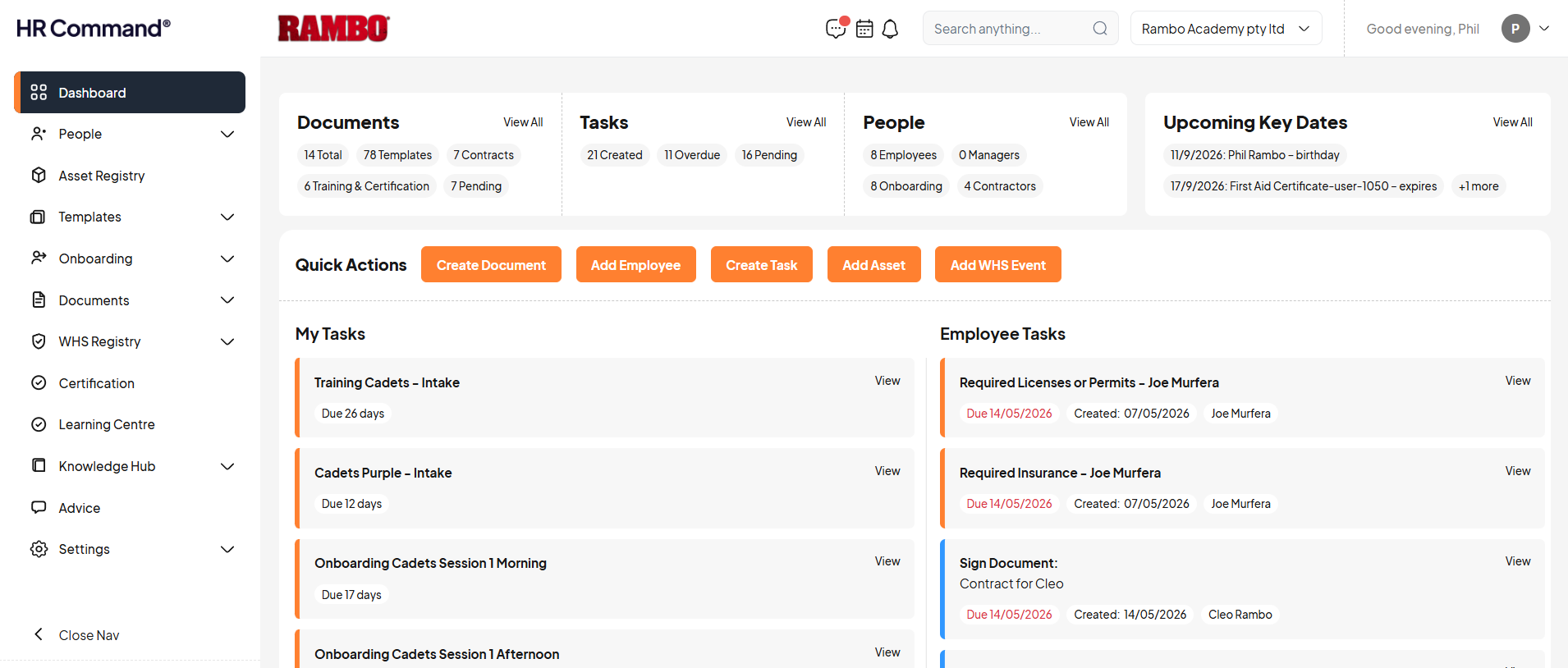
Compliance shouldn’t be something you discover in the middle of a dispute. HR Command brings the pieces together so your managers get it right the first time:
- Lawyer-drafted employment contracts, policies and templates.
- A Workplace Advice Line staffed by award winning employment lawyers, for the termination, performance issue or flexible work request you’re not sure about.
- Compliance tools and training, so policies are sent, signed and tracked, with a record to prove it.
FWC Annual Report 2025-26 FAQ
How many unfair dismissal claims were lodged with the Fair Work Commission in 2025-26?
18,653 unfair dismissal applications were lodged in 2025-26, 35% of all lodgments and 40% more than in 2020-21. A further 9,024 general protections dismissal applications were lodged, up 123% since 2020-21.
Why are Fair Work Commission claims increasing?
The Commission says the growth is mostly in self-represented individual claims, especially dismissals. The President says the old link between dismissal claims and the labour market has broken down, the increase has broadly coincided with popular generative AI tools, and AI-generated language is now widespread in application documents.
How long does the Fair Work Commission take to resolve a claim?
In 2025-26, 69% of matters were finalised within 8 weeks of lodgment and 92% within 16 weeks. Half of all matters were finalised within 7 weeks and 90% within 15 weeks. Both figures are slower than the year before.
What did the Fair Work Commission decide about junior rates?
On 31 March 2026 a Full Bench decided that adult junior employees with six months’ experience under the General Retail, Fast Food and Pharmacy Industry awards will be paid the full adult rate. Rates for under 18s don’t change. The provisional view is a phase-in from 1 December 2026 to 1 July 2029, with implementation still being worked through.
Which awards got pay rises from the gender undervaluation review?
The Pharmacy Industry Award, Children’s Services Award, Aboriginal and Torres Strait Islander Health Workers and Practitioners and Aboriginal Community Controlled Health Services Award, Health Professionals and Support Services Award, and the SCHADS Award.
What is MyFWC?
MyFWC is the Fair Work Commission’s online portal, launched in August 2025. It is now the main way to lodge unfair dismissal and general protections dismissal applications. The Commission’s target is for 90% of all applications to be lodged through it within two years.
The bottom line
The Fair Work Commission’s report is a clear warning. Claims are cheaper and easier to make, wages and conditions keep moving, and the tribunal is under more pressure than ever. The businesses that come through it are the ones whose process was right before anyone lodged a claim.
Find the gaps before a claim does
HR Command gives Australian employers lawyer-drafted contracts and policies, tools to send, track and train, and a Workplace Advice Line staffed by employment lawyers. Get More Done. Stay Compliant.
Book a demoSource: Fair Work Commission, Annual Report 2025-26, in particular pages 5 to 11 (President’s introduction and General Manager’s overview), 22 to 26 (operational highlights and service delivery), 31 to 38 (performance results) and 111 to 115 (Appendix C, lodgments by matter type). This article is general information only and is not legal advice. You should obtain advice specific to your circumstances. HR Command content is developed in partnership with Cowell Clarke Commercial Lawyers.