

HR News · 19 September 2026
AI at Work Is Getting a Rulebook: What Employers Should Do Before It Lands
The Government has started consulting on best practice guidance for AI in the workplace. It is guidance, not law. But the obligations it will lean on already apply. Here is what they are and what to put in place now.
In this article
On 17 September 2026 at HR Essentials Over Breakfast, the room kept coming back to one question: how do you bring AI into the business without walking into a legal or people problem?
This week, Canberra started answering it.
Key takeaways
- The Government is developing best practice guidance for AI in the workplace, shaped by government, business and unions together.
- An employer roundtable has been held. Five more consultations follow with unions, small business, employer peak bodies and academics.
- The APS is considering restrictions on smart glasses. Wearables and AI recording tools are on the radar.
- It is guidance, not law. But guidance tends to become the benchmark for a reasonable employer.
- Consultation, redundancy, psychosocial and surveillance obligations already apply to AI rollouts.
- Businesses usually get the AI decision right. They get the process wrong.
What happened
Employer roundtable held Five more consultations to come
Workplace Relations Minister Amanda Rishworth convened a roundtable with some of the country’s biggest employers to shape a practical guide on AI in the workplace. It’s the first of six consultations. Unions, small businesses, employer peak bodies and academics will be consulted over the coming months.
The discussion covered four areas:
- sharing the benefits of AI between workers and employers
- managing the change
- lessons from businesses already using AI
- building workers’ AI skills
Rishworth said the guidance needs to reflect the realities of modern workplaces. Her framing was clear. Workers should be confident AI will improve how they work, not train their replacement.
The guide sits under the tripartite AI Workplace and Employment Forum set up in April. Tripartite means government, business and unions all at the table. That tells you where this is heading. The guidance will expect consultation, shared benefit and transparency.
Separately, the Australian Public Service is looking at restricting smart glasses. Wearable cameras and AI tools that record, transcribe or analyse what’s around them are now on the government’s radar.
Guidance, not law. Yet.
Nothing announced this week changes your obligations tomorrow. But best practice guidance has a habit of becoming the benchmark. When a dispute lands in the Fair Work Commission or a regulator comes knocking, “what would a reasonable employer have done?” gets measured against exactly this kind of document.
And the obligations that already exist are doing plenty of work.
| Obligation | How AI triggers it |
|---|---|
| Consultation | Most modern awards and enterprise agreements require you to consult when you introduce major change likely to have significant effects on employees. Rolling out AI that changes roles, workloads or headcount can trigger that duty. |
| Redundancy | A redundancy is only genuine if you’ve met your consultation obligations and looked at redeployment. “The AI does it now” is not a process. Skip the steps and you’re exposed to unfair dismissal claims. |
| Psychosocial hazards | Poorly managed organisational change is a recognised psychosocial hazard under WHS laws. So is job insecurity. Announcing an AI rollout with no plan for the people affected is a risk you have to manage, not just a comms problem. |
| Surveillance | In NSW, the Workplace Surveillance Act requires written notice before camera, computer or tracking surveillance starts. AI tools that monitor output, record meetings or capture video can fall squarely inside that. The APS smart glasses discussion is a reminder that wearables are a live issue too. |
What we heard at breakfast
Caroline Beasley from Cowell Clarke walked through AI-driven restructuring, redundancy and the psychosocial impact of organisational change. The theme was consistent. Businesses usually get the decision right. They get the process wrong.
This week’s announcement points the same way. The government isn’t trying to stop AI adoption. It wants it done with workers, not to them.
The blunt version
AI adoption isn’t the risk. Doing it to your people instead of with them is.
What to do now
Don’t wait for the guide. Get the basics in place.
| What to do | Why it matters |
|---|---|
| Have an AI policy | Set out what tools staff can use, what data can go into them, and who approves new tools. Shadow AI is already in your business whether you’ve sanctioned it or not. |
| Map where AI touches roles | If a tool changes how a job is done, flag it early. That’s your consultation trigger. |
| Consult properly | Tell staff what’s changing, why, and how it affects them. Give them a genuine chance to respond. Keep records. |
| Check your surveillance notices | If an AI tool monitors, records or tracks, confirm your notices cover it. |
| Assess the psychosocial risk | Treat major AI change like any other WHS risk. Identify it, control it, review it. |
| Invest in skills | Training is on the government’s list for a reason. It’s also your best argument that AI is building your people up, not replacing them. |
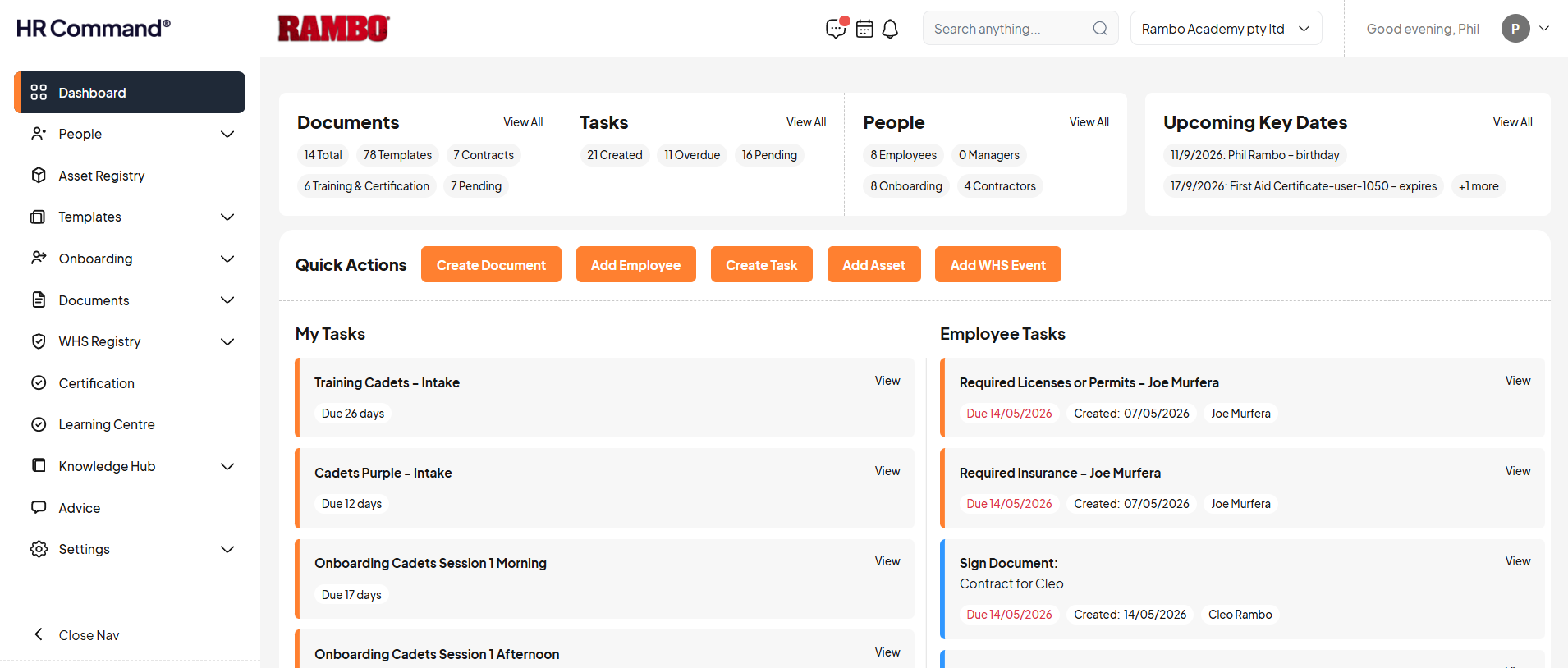
HR Command has the policies and templates to set up AI use properly, from acceptable use policies to consultation and change documentation.
AI workplace guidance FAQ
Is the AI workplace guidance law?
No. It is best practice guidance being developed through consultation with employers, unions, small business, employer peak bodies and academics. But guidance like this tends to become the benchmark for what a reasonable employer should have done.
Do I have to consult staff before introducing AI?
Often, yes. Most modern awards and enterprise agreements require consultation when you introduce major change likely to have significant effects on employees. AI that changes roles, workloads or headcount can trigger that duty.
Can I make a role redundant because AI now does the work?
Only if the redundancy is genuine. That means meeting your consultation obligations and considering redeployment. Skip those steps and you’re exposed to unfair dismissal claims.
Is an AI rollout a WHS issue?
It can be. Poorly managed organisational change and job insecurity are recognised psychosocial hazards under WHS laws. Treat major AI change like any other WHS risk: identify it, control it and review it.
Do AI monitoring tools count as workplace surveillance?
They can. In NSW, the Workplace Surveillance Act requires written notice before camera, computer or tracking surveillance starts. AI tools that monitor output, record meetings or capture video can fall inside that, so check your notices cover them.
The bottom line
The Government isn’t trying to stop AI adoption. It wants it done with workers, not to them. The obligations that make that happen already exist. The guide will simply make the expectation harder to ignore.
Get your AI policy in place, consult before you change roles, and check your surveillance notices. It’s far cheaper to get the process right up front than to defend it later.
Planning an AI rollout or a restructure?
Call the HR Command Workplace Advice Line before you announce anything. HR Command gives Australian employers legally drafted employment contracts, policies and letters, compliance training, WHS and psychosocial hazard tools, and a workplace advice line staffed by employment lawyers. Get More Done. Stay Compliant.
Book a demoThis article is general information only and is not legal advice. It reflects the Government’s consultation on best practice AI workplace guidance as at 19 September 2026, which remains in development. You should obtain advice specific to your circumstances. HR Command content is developed in partnership with Cowell Clarke Commercial Lawyers.