


HR Policies · 23 September 2026
Workplace Policies and Procedures: Why They Matter and How to Get Them Right
Workplace policies and procedures aren’t paperwork. They’re the rules you point to when something goes wrong. Here’s how to write them, roll them out and back them up so they hold up in front of Fair Work, a WHS regulator or a court.
In this article
- What are workplace policies and procedures?
- Why workplace policies matter
- Workplace policy legal requirements
- Types of workplace policies
- How to write a workplace policy
- How to roll out HR policies
- How to enforce workplace policies
- When to review policies and procedures
- HR policy software
- Workplace policies FAQ
Every business has rules. The question is whether they’re written down, whether staff know about them, and whether you apply them the same way every time. Get those three things right and your policies protect you. Get them wrong and they can be used against you.
Key takeaways
- A workplace policy sets the rule. A procedure explains how to follow it.
- Most policies aren’t legally required to be written down, but WHS, anti-discrimination and Fair Work obligations make written policies the only practical way to prove you’ve met your duties.
- A policy only protects you if staff have seen it, understood it and acknowledged it. Keep the records.
- Apply policies the same way every time. Inconsistent enforcement is one of the fastest ways to lose an unfair dismissal claim.
- Keep policies out of the employment contract so you can update them without renegotiating.
- Review policies at least once a year and whenever the law, your award or your operations change.
What are workplace policies and procedures?
A workplace policy is a written rule that tells employees what you expect, what’s allowed and what isn’t. A procedure is the step-by-step process for carrying that rule out.
Take leave. Your leave policy says employees must give notice before taking annual leave. Your leave procedure says how: submit the request through the system at least two weeks ahead, and your manager approves or declines within five working days.
Policies answer what and why. Procedures answer how, who and when. You need both. A policy without a procedure leaves people guessing. A procedure without a policy has no authority behind it.
| Policy | Procedure | |
|---|---|---|
| Answers | What is the rule and why does it exist? | How, when and by whom is it carried out? |
| Changes | Rarely. Usually when the law or strategy shifts. | More often. Whenever systems or people change. |
| Example | Staff must report workplace incidents. | Report within 24 hours using the incident form, notify your manager, and HR logs it in the register. |
Why are workplace policies important?
Policies do three jobs at once. They set expectations, they drive consistent decisions, and they protect the business when things go wrong.
1. They make expectations clear
Most workplace problems start with someone not knowing the rule. Clear policies remove that excuse. Employees know what good conduct looks like, what’s off limits and what happens if they cross the line.
2. They make decisions consistent
When a manager in Sydney and a manager in Brisbane face the same issue, they should reach the same answer. Policies make that happen. Consistency cuts claims of favouritism, bias and discrimination, and it builds trust in leadership.
3. They protect you in a dispute
This is the big one. When an employee brings an unfair dismissal, general protections or WHS claim, the first question is usually: what was the rule, and did they know about it?
Under the Fair Work Act, the Commission looks at whether there was a valid reason for dismissal and whether the process was fair. A breach of a clear, communicated and consistently applied policy can support a valid reason. A breach of a policy nobody saw, or one you’ve ignored for years, usually can’t.
4. They turn values into behaviour
Policies are where values become action. A code of conduct turns “we treat people with respect” into specific standards staff can follow and managers can enforce.
5. They save management time
Without policies, every question becomes a one-off decision. With them, managers have a reference point. That means fewer escalations, faster answers and less time reinventing the wheel.
What does Australian law expect from employers?
No single law says “you must have an HR policy manual”. But several laws place duties on employers that are almost impossible to prove you’ve met without written policies and records.
| Obligation | What it requires | Policies that help you meet it |
|---|---|---|
| Work health and safety laws | Provide information, training, instruction and supervision so work is safe. Consult workers on health and safety matters. | WHS policy, incident reporting, first aid, drug and alcohol, working alone |
| Psychosocial hazard regulations | Identify and control psychosocial risks such as bullying, harassment, excessive workload and poor support. | Bullying and harassment, workload and fatigue, psychosocial risk management |
| Positive duty (Sex Discrimination Act) | Take reasonable and proportionate steps to eliminate sexual harassment and related conduct, not just respond to complaints. | Sexual harassment policy, complaints procedure, training records |
| Anti-discrimination laws | Prevent discrimination and victimisation on protected attributes. | Equal opportunity, anti-discrimination, grievance handling |
| Fair Work Act | NES entitlements, flexible work requests, the right to disconnect and a fair dismissal process. | Leave, flexible work, right to disconnect, performance and discipline |
| Privacy and surveillance laws | Handle personal information properly. Some states, including NSW, require written notice before workplace surveillance starts. | Privacy, workplace surveillance, IT and email, social media |
The pattern is clear. Regulators and tribunals want evidence. A written policy, a record showing each employee received it, and training records are that evidence.
Keep policies out of the contract
Your employment contracts should say that policies are lawful directions from the employer but do not form part of the contract. That lets you update policies without renegotiating every contract, and stops employees arguing a policy gives them a contractual entitlement.
It matters more than ever. In Elisha v Vision Australia (2024), the High Court found an employer liable for damages, including for psychiatric injury, after it failed to follow disciplinary procedures that had become part of the employment contract. HR Command’s employment contracts are drafted with Cowell Clarke Commercial Lawyers to handle this properly.
Which workplace policies does my business need?
Every business is different. Your industry, award coverage, locations and how your people work all shape what you need. Here’s the core set most Australian employers should have.
| Category | Core policies |
|---|---|
| Conduct and culture | Code of conduct; equal opportunity and anti-discrimination; bullying, harassment and sexual harassment; grievance and complaints handling; conflict of interest |
| Health and safety | Work health and safety; incident and hazard reporting; drug and alcohol; psychosocial risk management; first aid and emergency; smoking and vaping |
| Working arrangements | Leave (annual, personal, carer’s, compassionate, parental, long service, family and domestic violence); flexible work; working from home; right to disconnect; attendance |
| Technology and information | IT, email and internet use; social media; privacy and confidentiality; workplace surveillance; artificial intelligence use; intellectual property; use of company property and vehicles |
| Employment lifecycle | Recruitment and selection; probation; performance management; discipline and termination; offboarding and return of property; expenses; dress code |
A few need special attention right now:
- Sexual harassment. The positive duty means a policy on its own isn’t enough. You need training, a safe reporting pathway and evidence you’ve taken proactive steps.
- Psychosocial risk. Regulators now expect you to manage mental health risks with the same rigour as physical ones.
- Flexible work. Refusing a request now carries more risk than it used to. HR Command’s flexible work arrangements guide explains the rules, and the Flexible Work Compliance Module manages requests end to end.
- Artificial intelligence. Staff are already using AI tools. Without a policy, you have no control over what business or client data goes into them.
You don’t have to write these from scratch. HR Command’s HR policies and document templates library includes over 100 contracts, policies, letters and checklists, drafted with Cowell Clarke Commercial Lawyers and kept up to date as the law changes.
How do you write a workplace policy?
Good policies are short, specific and realistic. Follow these seven steps.
Step 1: Start with the problem
What risk or behaviour is this policy meant to manage? If you can’t answer that in one sentence, the policy isn’t ready.
Step 2: Fit it to your business
A policy written for a head office won’t work on a construction site or in a café. Adapt every template to your operations, locations, award and the way your people actually work. A copied policy that doesn’t match reality does more harm than none at all. The Custom Template Builder lets you tailor HR Command templates, or upload and adapt your own.
Step 3: Use plain English
Write for the least experienced person who has to follow it. Short sentences. Everyday words. No jargon. If an apprentice can’t understand it, rewrite it.
Step 4: Be realistic
Don’t promise what you can’t deliver. A policy that commits to things your business can’t resource sets managers up to fail and gives employees ammunition in a dispute.
Step 5: Consult before you finalise
Talk to managers, employees and health and safety representatives. For WHS matters, consultation is a legal duty, not a courtesy. It also flushes out problems early and builds buy-in.
Step 6: Check it against the law and your contracts
Make sure the policy lines up with the NES, your modern award or enterprise agreement, and your employment contracts. Conflicts create confusion and risk.
Step 7: Get it reviewed
Have someone with employment law knowledge check it before it goes live. HR Command’s Document Reviews feature lets you send a draft through a one-click link so reviewers can comment, suggest changes or simply view it before you publish.
Workplace policy checklist
Every policy you write should include these eight elements.
| Element | What it covers |
|---|---|
| Purpose | Why the policy exists and the risk it manages. |
| Scope | Who it covers: all staff, managers only, contractors, volunteers. |
| The rules | Acceptable and unacceptable behaviour, stated clearly. |
| The procedure | The steps to follow, or a link to a separate procedure. |
| Responsibilities | Who does what, including managers and HR. |
| Consequences | What happens if the policy is breached, up to and including termination. |
| Related documents | Other policies, forms and laws that connect to it. |
| Version control | Approval date, version number and next review date. |
How do you roll out a new policy?
Writing the policy is the easy part. Rolling it out properly is what makes it stick, and what makes it defensible.
Put everything in one place
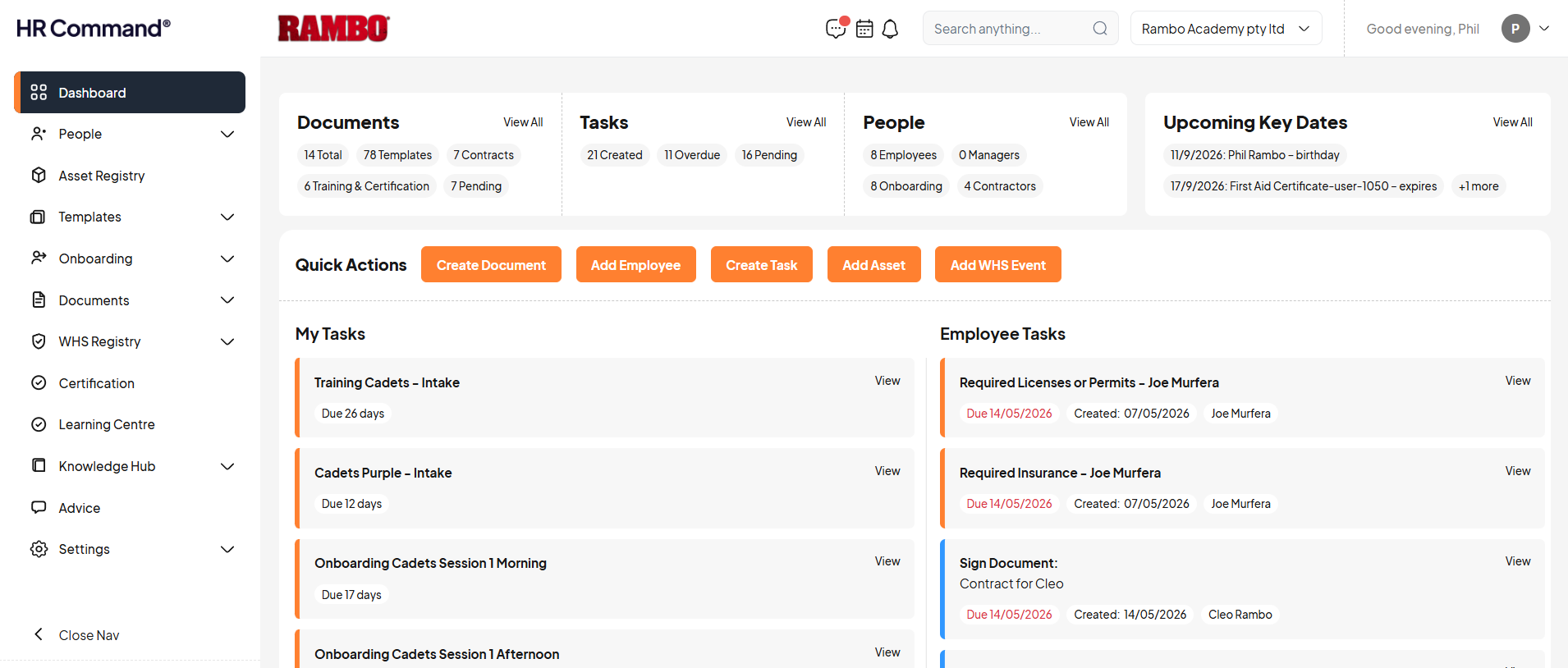
Staff shouldn’t have to hunt through shared drives and email chains. Keep all current policies in a single, central location that every employee can reach. HR Command’s Employee Self Service gives staff one place to view documents, read policies and record their acceptance.
Send it and track acknowledgement
Every employee who’s covered should receive the policy and confirm they’ve read it. That acknowledgement is your proof if the rule is ever challenged. With HR Command Collections, you can bulk send policies and task packs to one person or your whole workforce, with acceptance and signature options and full tracking of who has and hasn’t responded.
Build it into onboarding
New starters should receive your core policies before or on day one. Employee Onboarding in HR Command bundles contracts, policies and forms into one flow, so nothing gets missed.
Train your people
Sending a document isn’t the same as training. Under WHS laws you must provide information, instruction and training. For high-risk policies such as safety, harassment, drug and alcohol, and IT security, run training and keep records. HR Command’s Learning Centre lets you deliver and track training alongside the policies themselves.
Brief your managers first
Managers enforce policies day to day. Make sure they understand the rules, the reasons behind them and how to handle breaches before the policy goes out to everyone else.
Keep talking about it
Raise key policies in team meetings, toolbox talks and one-on-ones. Policies that only get mentioned at induction get forgotten.
How do you enforce a workplace policy fairly?
A policy you don’t enforce is worse than useless. It tells staff the rule doesn’t really matter, and it can be used against you later.
Apply it the same way every time
If one employee is warned for a breach and another gets away with the same thing, you’ve created an inconsistency a tribunal will notice. Treat like cases alike.
Lead from the top
Managers and owners must follow the same rules. If leadership ignores a policy, it becomes very hard to discipline anyone else for breaching it.
Follow a fair process
When a breach happens, investigate, put the allegations to the employee, give them a real chance to respond and let them bring a support person to meetings. Document every step. HR Command’s HR Guides walk you through situations like misconduct and performance issues step by step, with the right documents at each stage.
Get advice on the hard calls
Some breaches are clear cut. Many aren’t. Before you take serious disciplinary action or dismiss someone for a policy breach, talk to someone who knows the law. HR Command clients can call the Workplace Advice Line and speak directly with employment lawyers.
The blunt version
A policy protects you only if you can prove three things: it existed, the employee knew about it, and you apply it to everyone. Miss any one and you’re arguing from a weak position.
How often should you review workplace policies?
At least once a year. You should also review a policy straight away when:
- employment or WHS laws change
- your modern award or enterprise agreement changes
- you change how you operate, such as new locations, remote work or new technology
- an incident or complaint shows the policy didn’t work
- a tribunal or court decision changes how a rule is interpreted.
Recent years show how fast things move. The positive duty on sexual harassment, psychosocial hazard regulations, the right to disconnect and new rules on flexible work have all landed in quick succession. Policies that were fine three years ago may now leave gaps.
When you update a policy, tell staff what’s changed, why it changed and how it affects them. Then collect fresh acknowledgements.
HR Command keeps its template library current as legislation changes, so your starting point is always up to date. The HR Calendar with Outlook and Google Calendar sync puts review dates in front of you without logging in, and workflow tasks let you assign reviews to the right person with a deadline.
How HR Command helps you manage workplace policies
HR Command is an Australian HR compliance platform that covers the full policy lifecycle in one place.
| Stage | How HR Command handles it |
|---|---|
| Write | 100+ contracts, policies and HR documents drafted with Cowell Clarke Commercial Lawyers. Customise them, upload your own and apply your branding with the Custom Template Builder. |
| Review | Send drafts for comment or approval through Document Reviews. |
| Distribute | Bulk send policies with Collections and track who has accepted or signed through Employee Self Service. |
| Onboard | Give new starters their contract, policies and forms in one flow with Employee Onboarding. |
| Train | Deliver and record policy training through the Learning Centre. |
| Manage safety | Log incidents, hazards and inspections with WHS Management. Add the Psychosocial Hazard Management module to manage mental health risks. |
| Automate | Assign policy reviews and follow-ups with Workflow Tasks and Workflow Automation. |
| Enforce | Follow step-by-step HR Guides and call the Workplace Advice Line to speak with employment lawyers when a situation gets tricky. |
| Stay current | Templates updated as the law changes, with review dates synced to Outlook or Google Calendar. |
Workplace policies FAQ
What is the difference between a policy and a procedure?
A policy states the rule and why it exists. A procedure sets out the steps to follow that rule. For example, a grievance policy says employees can raise complaints safely. The grievance procedure explains who to contact, how the complaint is investigated and how long it takes.
Do workplace policies have to be in writing in Australia?
Most policies aren’t legally required to be written down. In practice, written policies are essential. Without them, it’s very hard to prove employees knew the rules, or that you met your WHS, anti-discrimination and positive duty obligations. Some laws, such as workplace surveillance laws in NSW, do require written notice.
Are workplace policies legally binding on employees?
Employees must follow lawful and reasonable directions, and a well-drafted policy is a direction. Policies usually shouldn’t form part of the employment contract, though. If they do, you may be bound by them too, and changing them becomes harder. Your contract should make this clear.
Who is responsible for workplace policies?
The employer is ultimately responsible. In a smaller business that’s usually the owner or general manager. In larger businesses, HR typically drafts and maintains policies, managers enforce them and every employee must follow them.
How often should workplace policies be reviewed?
At least every 12 months, and straight away after any change to the law, your award or enterprise agreement, or your operations. Also review a policy after any incident that shows it didn’t work.
What are the most important workplace policies for Australian businesses?
The core set is a code of conduct, WHS policy, bullying and harassment policy (including sexual harassment), anti-discrimination and equal opportunity policy, grievance procedure, leave policy, IT and social media policy, privacy policy, and discipline and termination policy. Your industry and award may call for more.
Can I use a template for my workplace policies?
Yes, as long as it’s drafted for Australian law, kept up to date and tailored to your business. A generic overseas template or an outdated document can create more risk than it removes. HR Command’s templates are drafted with Cowell Clarke Commercial Lawyers and updated as legislation changes.
What happens if an employee breaches a workplace policy?
It depends on how serious the breach is and what your policy says. Options range from a conversation or training through to a formal warning or, for serious misconduct, dismissal. Always follow a fair process: investigate, put the allegations to the employee, let them respond and document everything. Get advice before you act on serious matters.
The bottom line
Workplace policies and procedures are only as strong as the evidence behind them. Write them in plain English, fit them to how your business really works, get every employee to acknowledge them, and apply them the same way every time.
Do that and your policies become your first line of defence. Skip it and they’re just documents in a folder.
Get your policies in order
HR Command gives Australian employers legally drafted contracts and policies, tools to send, track and train, WHS and psychosocial hazard management, and a Workplace Advice Line staffed by employment lawyers. Get More Done. Stay Compliant.
Book a demoThis article is general information only and is not legal advice. You should obtain advice specific to your circumstances. HR Command content is developed in partnership with Cowell Clarke Commercial Lawyers.