

Workplace discrimination | November 2026
Pregnancy discrimination at work hasn’t gone away. A new Australian Human Rights Commission report says the gap between what the law promises working parents and what actually happens is still wide, and it wants the law tightened. Here’s what it found, what you already have to do, and where the risk sits for your business.
Key takeaways
- The AHRC’s Balancing Act report (October 2026) finds pregnancy, breastfeeding and family responsibilities discrimination is still common in Australian workplaces, despite a decade of reform.
- The riskiest moments are disclosure, the start of leave, the return to work and the first flexible work request.
- “Sham” redundancies, sudden performance management and disappearing shifts were the patterns stakeholders raised most.
- The law already protects these workers. Under the Fair Work Act, if an employee claims you acted because of pregnancy or leave, you have to prove you didn’t.
- The report sets out 18 areas for reform, including protection against indirect family responsibilities discrimination and putting the onus on employers to prove a parental leave redundancy is genuine.
- Fix it now: write down your reasons, consult before you restructure, run flexible work requests by the book and train your managers.
What the Balancing Act report is
Balancing act: Supporting working parents and carers was released by the Australian Human Rights Commission (AHRC) in October 2026. It was led by Sex Discrimination Commissioner Dr Anna Cody.
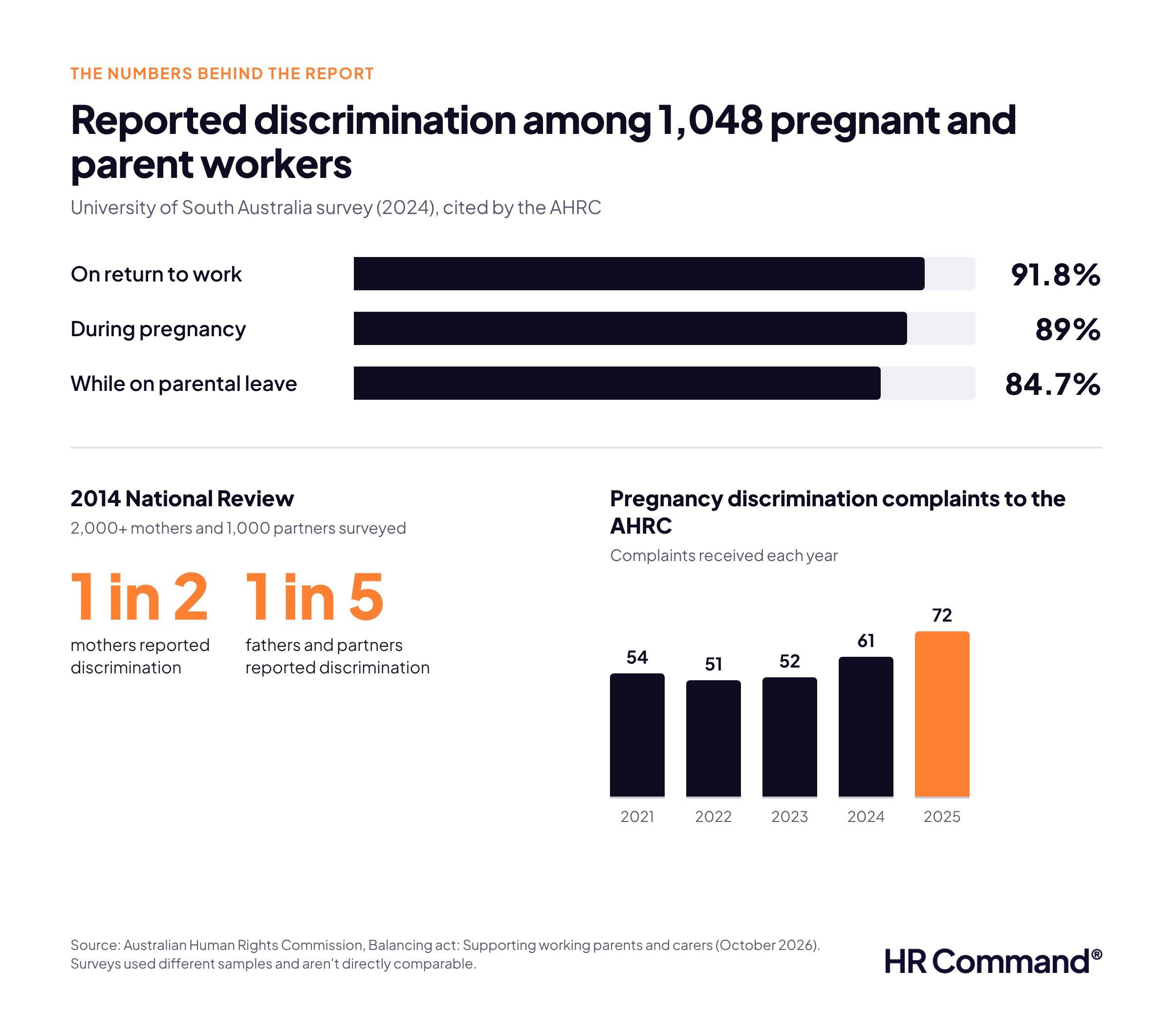
It builds on the Commission’s 2014 National Review into discrimination related to pregnancy, parental leave and return to work. That review found nearly 1 in 2 mothers (49%) reported discrimination at some point during pregnancy, parental leave or on their return. One in 5 fathers and partners (20%) reported discrimination when they asked for or took parental leave.
For the new report, the Commission ran five roundtables and 13 one-on-one meetings between March and April 2026, hearing from 84 stakeholders across unions, community legal centres, advocacy groups, academia and industry. Four roundtables focused on people with disability, culturally and racially marginalised communities, First Peoples and LGBTIQA+ communities. It also drew on a literature review.
The headline finding is blunt. Strong legal protections exist on paper, but workers’ everyday experience doesn’t match them.
“You have people being told by their managers not to have children because it’s a career ender.”Cross-sector roundtable, AHRC Balancing Act report
Pregnancy discrimination statistics in Australia
The report puts the 2014 findings alongside a 2024 University of South Australia survey of 1,048 pregnant and parent workers. Among those respondents:
The detail is more useful than the headline. In the same survey, 45.7% said they were given work below their level of competence, 35.9% said their work was monitored excessively, and 23.3% said they got hints that they should quit because of their pregnancy.
Read the numbers properly. The 2014 review and the 2024 survey used different samples, and the 2024 survey was about half the size, so they aren’t a like-for-like trend line. The AHRC’s point is the direction: a decade of reform hasn’t closed the gap.
Formal complaints tell the same story. Pregnancy discrimination complaints to the AHRC have climbed since 2022:
| Year | 2021 | 2022 | 2023 | 2024 | 2025 |
|---|---|---|---|---|---|
| AHRC pregnancy discrimination complaints | 54 | 51 | 52 | 61 | 72 |
Complaints are only the tip. In 2014, 91% of mothers who experienced discrimination never lodged a formal complaint. Victorian service JobWatch also reports that calls about pregnancy and breastfeeding discrimination doubled between 2022 and 2025.
For employers, that underreporting cuts both ways. Low complaint numbers inside your business don’t mean you’re clear. They can just mean people left quietly.
How pregnancy and parental discrimination shows up at work
Few managers say “we’re letting you go because you’re pregnant”. The report describes something quieter, and much harder to defend once it’s in front of a tribunal.
| Pattern | What stakeholders described | Why it’s a risk |
|---|---|---|
| “Sham” redundancy | A role disappears during pregnancy or parental leave, often right after a flexible work request. | Adverse action because of pregnancy or leave is unlawful, and the employer carries the burden of proof. |
| Performance management after disclosure | Sudden performance improvement plans and close monitoring once a pregnancy is announced. | Timing is evidence. A first PIP weeks after disclosure looks like a reason, not a coincidence. |
| Role changes on return | Lost duties, shifts or responsibilities, or a different role, without prior discussion. | Breaches the return to work guarantee and the duty to consult during leave. |
| Disappearing shifts | Casual or part-time hours quietly dry up after a request for flexibility. | Reducing hours is adverse action, even with no formal decision. |
| Misused fitness to work assessments | Assessments used to push pregnant workers out or onto lower pay, instead of adjusting duties. | Pregnant employees are entitled to a safe job, not exclusion. The report wants this practice stopped. |
| Withdrawn development | Pulled from client work, training, mentoring or big projects. | Denying opportunities is discrimination, and it’s how careers stall without a single dismissal. |
| Questions in recruitment | Job offers withdrawn after candidates mention upcoming leave or a partner’s due date. | Protection covers prospective employees too. |
Male-dominated industries came up repeatedly. Women make up only 13% of the construction workforce, and many are the first in their organisation to take parental leave. Stakeholders described women being pushed to disclose pregnancies early, then removed from client-facing work and high value projects.
Insecure work makes it worse. Casuals, contractors and visa holders told the Commission they stay quiet because speaking up could cost them the job, or their visa.
What employers already have to do
None of the reforms are law yet. You don’t need them to be. The obligations below already apply.
| Obligation | Source | What it means in practice |
|---|---|---|
| No discrimination because of pregnancy, potential pregnancy, breastfeeding or family responsibilities | Sex Discrimination Act 1984 (Cth), Fair Work Act 2009 (Cth), state and territory laws | Covers recruitment, pay, duties, training, promotion, rostering and dismissal. |
| No adverse action for pregnancy, carer’s responsibilities or taking leave | Fair Work Act general protections | If an employee alleges you acted for one of these reasons, the law presumes you did unless you prove otherwise. |
| Positive duty | Sex Discrimination Act | You must take reasonable and proportionate steps to eliminate sex discrimination. The AHRC says preventing pregnancy and breastfeeding discrimination is part of this duty. |
| Return to work guarantee | Fair Work Act | Employees return to their pre-leave role, or the nearest available role in status and pay if it no longer exists. |
| Consultation during unpaid parental leave | Fair Work Act | If a decision will significantly affect the status, pay or location of their role, you must take reasonable steps to tell them and let them discuss it. |
| Safe job | Fair Work Act and WHS laws | Pregnant employees can move to a safe job where needed. If none is available, eligible employees get paid no safe job leave. |
| Flexible work requests | Fair Work Act | Written response within 21 days, genuine discussion, and refusal only on reasonable business grounds. Disputes can go to the Fair Work Commission. |
| Breastfeeding breaks and facilities | Discrimination laws and WHS laws | Appropriate breaks and a suitable space to express and store milk. |
The positive duty matters most here. It shifts the question from “did we discriminate?” to “what did we do to stop it happening?”. The AHRC is the regulator for that duty and can open an inquiry into businesses that don’t comply.
Redundancy during parental leave
This is the decision the report targets hardest. Unions and community legal centres told the Commission the right to return exists “in theory only”.
“Many, many women who we see, their positions have been made redundant over the course of their parental leave.”Cross-sector roundtable, AHRC Balancing Act report
The report suggests limiting redundancies where someone has taken, applied for, or is likely to take parental leave, for example by making the employer establish the redundancy is genuine. Under the Fair Work Act’s general protections, employers already carry the burden of proving the reason for their decision. A redundancy that lands during leave starts on the back foot.
A role can still be made redundant while someone is on leave. It has to stand up. Before you act:
- Test the reason. Is the job genuinely no longer needed because of operational change, and would you make the same call if the person weren’t on leave?
- Consult. Meet any consultation obligations in the award or agreement, and tell the employee on leave what’s proposed. Don’t wait until they return.
- Look for redeployment. Consider every reasonable alternative role across the business and associated entities.
- Check the return guarantee. If the role is changing rather than disappearing, they’re entitled to come back to the nearest equivalent.
- Write it down. Record the business reasons at the time you make the decision. Reasons reconstructed later carry far less weight.
Flexible work requests from returning parents
The report found a common trigger for discrimination: a parent comes back from leave, asks for flexibility, and suddenly there are “performance issues” or a restructure.
Several stakeholders want flexible work to become a presumptive right, so employers would find it harder to say no. Under current law, the process for handling a flexible work arrangement request is already strict:
- Respond in writing within 21 days.
- Discuss the request with the employee and genuinely try to reach agreement.
- Consider the consequences of a refusal for the employee.
- Refuse only on reasonable business grounds, and explain them in writing.
- Set out any alternative changes you’d agree to, and explain the dispute options.
Attitude counts as much as process. Stakeholders described employers who approved part-time hours or a private room for expressing, but made it plain they weren’t happy. That kind of resentment is what turns into a claim later.
Breastfeeding at work
The report calls breastfeeding discrimination a significant and overlooked barrier. In the 2024 survey, 26.9% of respondents weren’t given appropriate facilities to breastfeed or express at work.
A room isn’t enough on its own. One case study describes a worker at a tech start-up with a clean, secure parents’ room, in a culture of long uninterrupted hours where nobody took lactation breaks. She stopped breastfeeding earlier than she wanted to.
Practical steps: a private, lockable space that isn’t a toilet, somewhere to store milk, breaks built into the roster, and managers who make it normal to use them.
Carers beyond the nuclear family
The report found family responsibilities stretch well beyond the definitions in parts of Australian law and most workplace policies. Workers are caring across extended families, kinship networks, chosen families, disability support arrangements and across borders.
The federal Sex Discrimination Act limits family responsibilities to immediate family and only prohibits direct discrimination on that ground. Some states go further. South Australia, the ACT and the Northern Territory explicitly protect kinship care, and Queensland has legislated a broader “family, carer or kinship responsibilities” ground, though commencement has been delayed.
Transnational care came up often. A worker supporting a sick parent overseas through late-night phone calls is still a carer. Repeatedly quizzing that person about why they’re tired or on their phone can add up to discrimination.
Check how your leave and flexible work policies define family. If they only say “spouse and children”, they’re behind how your people actually live.
Dads, partners and shared care
Care in Australia is still lopsided. HILDA data in the report shows that after a first child, women’s share of paid work falls from 39% to 16%, while their share of care rises to 71%. The pattern holds for 10 to 15 years.
Men told the Commission stigma stops them using leave and flexibility. One example: a mining worker asked for two years for a work car that could take a child seat. The answer was no, so he couldn’t do school pick-ups he drove past every day.
It can change. One industry employer said 51% of its people who took parental leave in the last 12 months were men, after it moved to equal parental leave for both parents.
Government paid parental leave is now 26 weeks, including 4 weeks reserved for a partner, with super paid on top. It’s still paid at the national minimum wage, and the report says Australia remains well behind OECD and EU averages.
The 18 reforms on the table
The report groups 18 areas for reform raised by stakeholders. They aren’t law. They show where pressure on employers is heading.
| Area | Proposals | What it would mean for employers |
|---|---|---|
| Discrimination law | Prohibit indirect discrimination on the basis of family responsibilities under the Sex Discrimination Act and Fair Work Act. Limit parental leave-linked redundancies, with the onus on employers. Real penalties for non-compliance. | Rigid rosters, full-time-only roles and “always available” expectations could be challenged directly, by men and women. |
| Paid parental leave | Up to 52 weeks at wage replacement, more “use it or lose it” leave for each parent, no work test or residency limits, and cover for foster, kinship and grandparent carers. | More partners taking longer leave, and more pressure on employer-funded schemes to match. |
| Fair Work Act entitlements | Flexible work as a presumptive right. No 12-month service requirement for unpaid parental leave. Stop fitness to work assessments being used against pregnant workers. | New starters with leave rights from day one, and a higher bar to refuse flexibility. |
| Definitions of family | Recognise kinship, cultural, disability, transnational and chosen-family care. | Leave and flexibility policies written around a wider idea of family. |
| Flexibility and job design | Flexible shifts and start times, more employee control of rosters, paid disability-related leave, flexibility for casuals to attend pregnancy appointments. | Job design, not just policy, becomes part of compliance. |
| Access to justice | More AHRC funding to cut conciliation delays, more legal aid, changes to Fair Work Commission conciliations. | Claims resolved faster, and more workers able to bring them. |
| Data | A funded national review of pregnancy, breastfeeding and family responsibilities discrimination. | Better evidence, and more scrutiny of industries with poor results. |
Two of these aren’t new. A 2008 Senate inquiry recommended broadening the family responsibilities ground and a positive duty to reasonably accommodate flexible work requests. The AHRC repeated both in 2014. Neither has been implemented, and they’re back.
Employer checklist
- Map the risk points. Disclosure, leave start, time away, return and the first flexible work request. Each needs a process, not a manager’s instinct.
- Update your policies. Parental leave, flexible work, breastfeeding and carer’s leave, with a definition of family that reflects your workforce.
- Train managers. Most claims start with what a manager said or did. Use your training program to cover disclosure conversations, flexible work requests and fair performance management.
- Stay in touch during leave. Offer keeping in touch days (up to 10 during unpaid parental leave, and only by agreement), and tell people about changes that affect their role.
- Stress-test restructures. Any change touching a role held by someone pregnant, on leave or recently returned gets a second look before it goes ahead.
- Document decisions as you make them. Reasons for refusals, roster changes, performance concerns and redundancies, recorded at the time.
- Check casual and shift rosters. Watch for hours that quietly fall away after a disclosure or a request.
- Get the basics right for breastfeeding. A suitable room, storage and protected breaks.
- Review it against the positive duty. Be ready to show what you’ve done to prevent discrimination, not just respond to it.
How HR Command helps
HR Command puts the whole parental leave journey, from announcement to return, in one place.
- Policies and documents: policy templates and employment contracts built by award winning employment lawyers.
- Flexible work: handle flexible work requests through a documented process.
- Workflows and tasks: set up tasks for leave start, keeping in touch and return to work planning, so nothing gets missed.
- Training: the Learning Centre for manager training, with completion records.
- Advice: the Workplace Advice Line, backed by award winning employment lawyers, for the decisions you shouldn’t make alone.
FAQs
Can you make someone redundant while they’re on parental leave?
Yes, but only if the redundancy is genuine and has nothing to do with the leave. Under the Fair Work Act’s general protections, if the employee claims the decision was because of their pregnancy or leave, you must prove it wasn’t. You also need to consult them during leave, consider redeployment and meet the return to work guarantee.
Can you refuse a flexible work request from a parent returning to work?
Yes, on reasonable business grounds, after you’ve discussed the request, genuinely tried to reach agreement and considered the impact on the employee. You must respond in writing within 21 days and explain your reasons. The employee can take a dispute to the Fair Work Commission.
Do employers have to provide breastfeeding facilities?
Discriminating against someone because they’re breastfeeding is unlawful, and work health and safety laws require appropriate breaks and facilities for expressing milk. In practice that means a private, suitable space, somewhere to store milk and protected break time.
Does family responsibilities discrimination cover kinship carers and grandparents?
It depends on the law. The federal Sex Discrimination Act is limited to immediate family. South Australia, the ACT and the Northern Territory explicitly protect kinship care. The AHRC report recommends broader definitions everywhere, so writing policies around a wider idea of family is the safer approach.
Is the AHRC Balancing Act report law?
No. It sets out 18 areas for reform raised by stakeholders. The protections against pregnancy, breastfeeding and family responsibilities discrimination already exist under the Sex Discrimination Act, the Fair Work Act and state and territory laws.
Does the positive duty cover pregnancy discrimination?
Yes. The AHRC says that because pregnancy and breastfeeding are closely related to a person’s sex, preventing discrimination on these grounds forms part of the positive duty. Every employer has to take reasonable and proportionate steps to eliminate it.
Get parental leave right, start to finish
Policies, contracts, workflows, training and advice from award winning employment lawyers, all in one HR platform.
Book a demoSources
- Australian Human Rights Commission, Balancing act: Supporting working parents and carers, October 2026
- Australian Human Rights Commission, Balancing Act report summary
- Australian Human Rights Commission, Supporting Working Parents: Pregnancy and Return to Work National Review, 2014
This article is general information only and isn’t legal advice. HR Command is developed in partnership with Cowell Clarke Commercial Lawyers. Get advice specific to your circumstances before acting.