

Manage psychosocial risk. Prove you did.

One system to report and spot the hazards, act on them, and hold the evidence. Built and backed by employment lawyers. The documented process the code now demands, for your workforce or your clients’.

goodhands

Backed by Cowell Clarke
Commercial Lawyers

Australian Data Hosting
and Support

ISO 27001
Certified

Built for Australian
Employers

The Shift, in plain terms

The psychosocial duty is not new. What changed on 1 July 2026 is that the code of practice became an enforceable standard. A regulator no longer has to prove harm occurred. Falling short of the code is enough. You either follow it, or you show you did better.

HR advisor and small business owner reviewing a Fair Work compliant employment contract template together at a desk

See it. Act on it. Prove it.

Most businesses have a wellbeing policy. Very few can show a systematic process behind it, and that is the gap that now bites.

The code asks for four things, done in consultation with workers, and documented: identify the hazards, assess the risk, put controls in place, and review whether they work. A prevention plan is the document. It is not proof that you are running the process. When an inspector asks, the question is not “do you have a policy”. It is “show me the evidence”.

The duty applies across Australia. The enforceable benchmark is a NSW change. HR Command is built to work either way, so you are not left exposed on the state line.

Why HR and safety leaders choose HR Command

See the risk early
Confidential reporting and anonymous check-ins surface hazards before they become claims.

Controls that hold up
You are guided through the hierarchy of control, so you fix the work first. Training on its own is flagged as not enough, exactly as the regulation requires.

Sensitive matters stay private

Bullying, harassment and sexual harassment are restricted to HR and Legal, never the line manager who might be the subject.

Evidence in one click

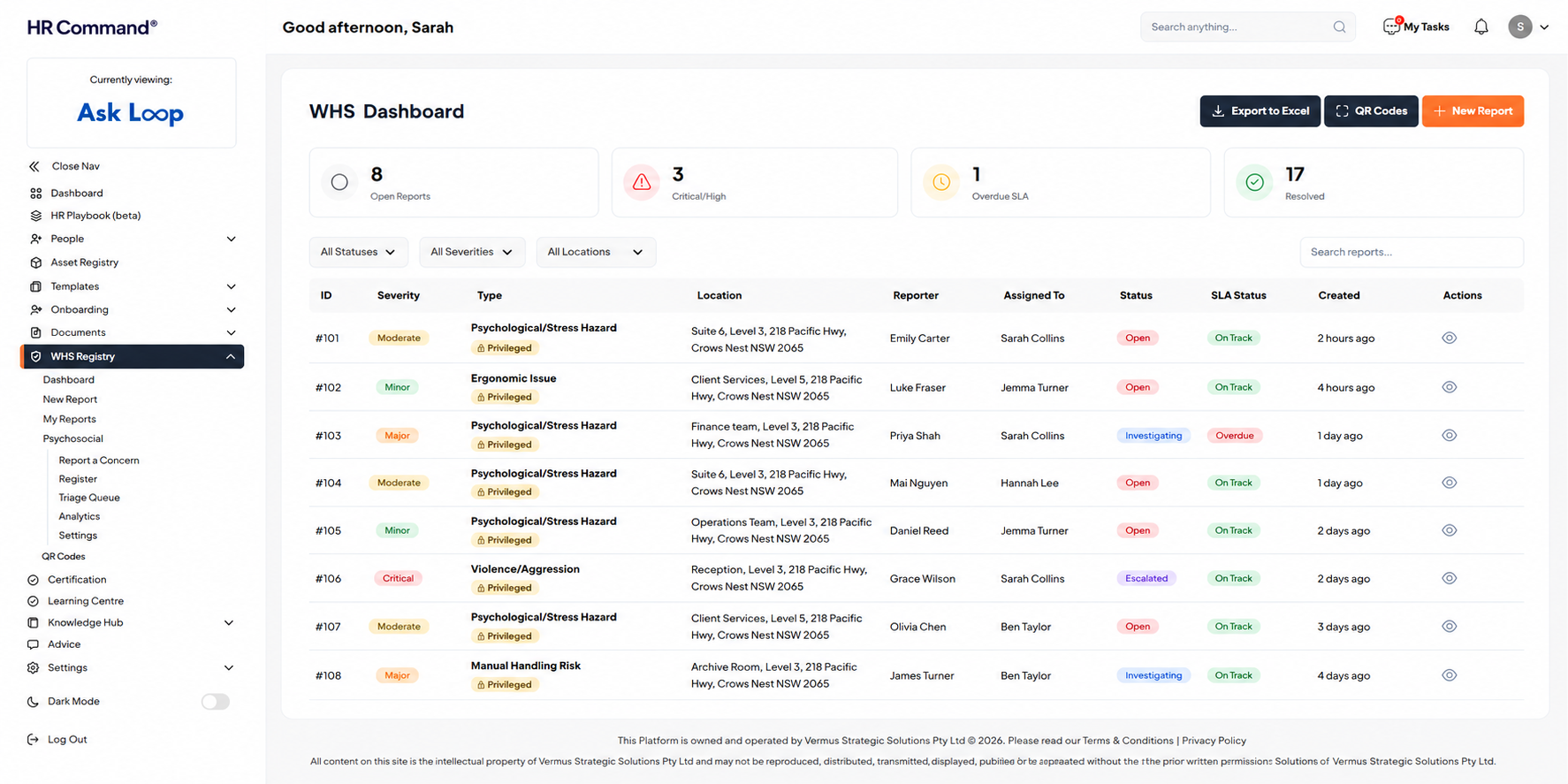
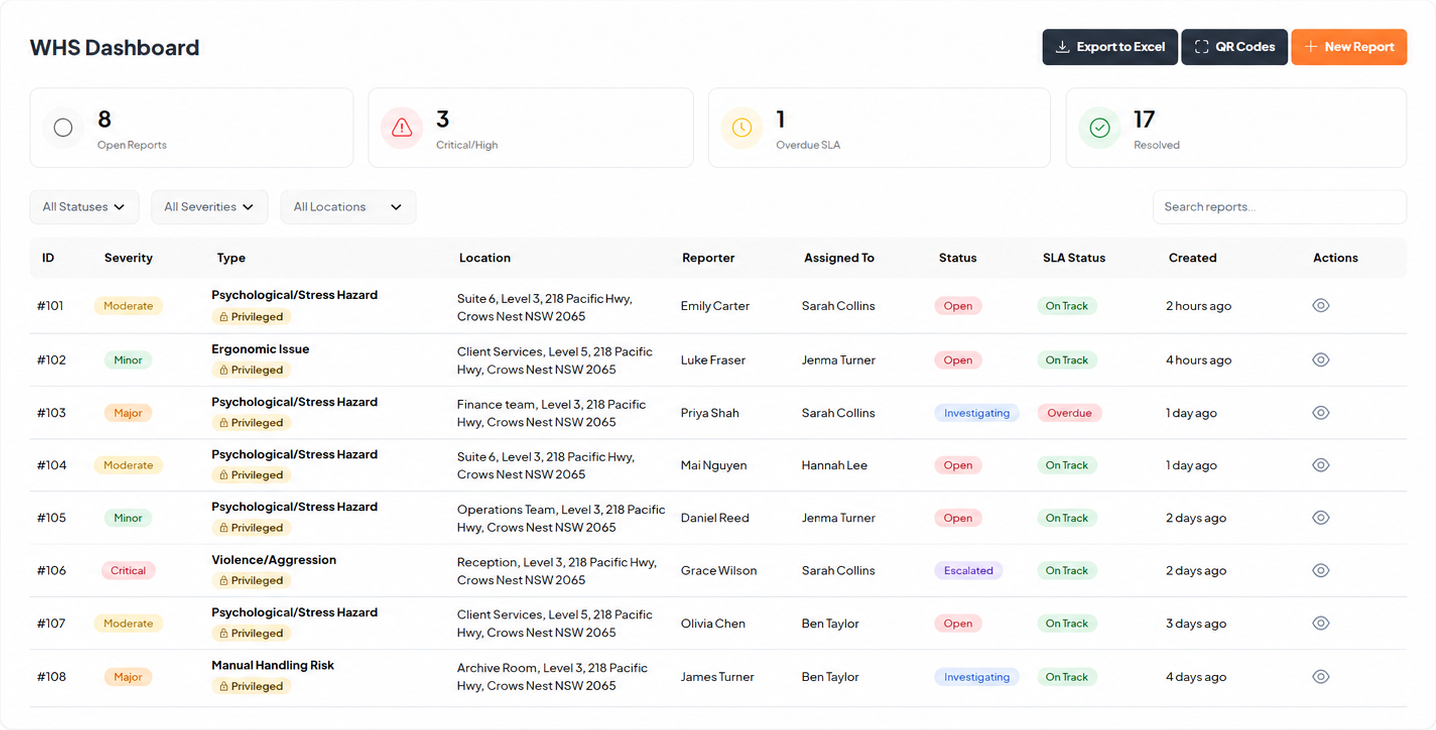
The register, the assessments, the controls, the consultation records and the review history export as a single, watermarked, inspector ready pack.

Lawyers on call

Employers get the Workplace Advice Line, direct access to employment lawyers when a matter needs a steady hand. Not generic support. Real legal help, from the firm behind the platform.

On its own, or part of the platform

Run it as a standalone psychosocial module, no full platform needed. Or use it inside HR Command, where it connects to the policies, prevention plans and templates you already hold, so nothing sits in a silo.


Employee sitting withdrawn at her desk while two colleagues talk quietly behind her, illustrating workplace bullying as a psychosocial hazard

How it works

Step 1

People raise concerns safely.

Staff report through a private form that adapts to what they are raising. A bullying or harassment concern is confidential and never goes to the line manager. A workload or role clarity concern goes to the manager who can help fix it. A violence or aggression report starts with a safety step and routes by source. The right questions, handled the right way.

Step 2

Nothing reaches the register unassessed.

Reports and survey results land in a triage queue. A trained reviewer confirms it is a genuine hazard, not reasonable management action, then completes the risk assessment. Severity is set by the reviewer, not guessed by the person reporting.

Step 3

Controls follow the hierarchy.

The system steers you to fix the work first and treats training alone as insufficient, which is exactly what the strengthened regulation requires. Controls link to the prevention plan and templates you already hold.

Step 4

Reviews are scheduled and tracked.

Every hazard carries a review date. Overdue reviews are surfaced, so controls do not quietly go stale.

Step 5

Evidence comes out in one click.

The whole register, the assessments, the controls, the consultation records and the review history export as a single, watermarked pack. It is the documented proof a regulator asks for, ready before they ask.

The right questions, handled the right way

Psychosocial reporting only works if people trust it. HR Command is built so they can.
Bullying, harassment and sexual harassment are confidential and restricted to HR and Legal, hidden from the line manager who may be the subject.

Sexual harassment is handled under the employer’s positive duty and linked to your prevention plan. Where your business has an Employee Assistance Program, staff are pointed to it for support. And the whole system is confidential by design, from a platform built and backed by a commercial law firm.

HR and safety leader at her desk with planning notes and a whiteboard behind her, representing psychosocial hazard management software for Australian workplaces

Meet Our Expert Team

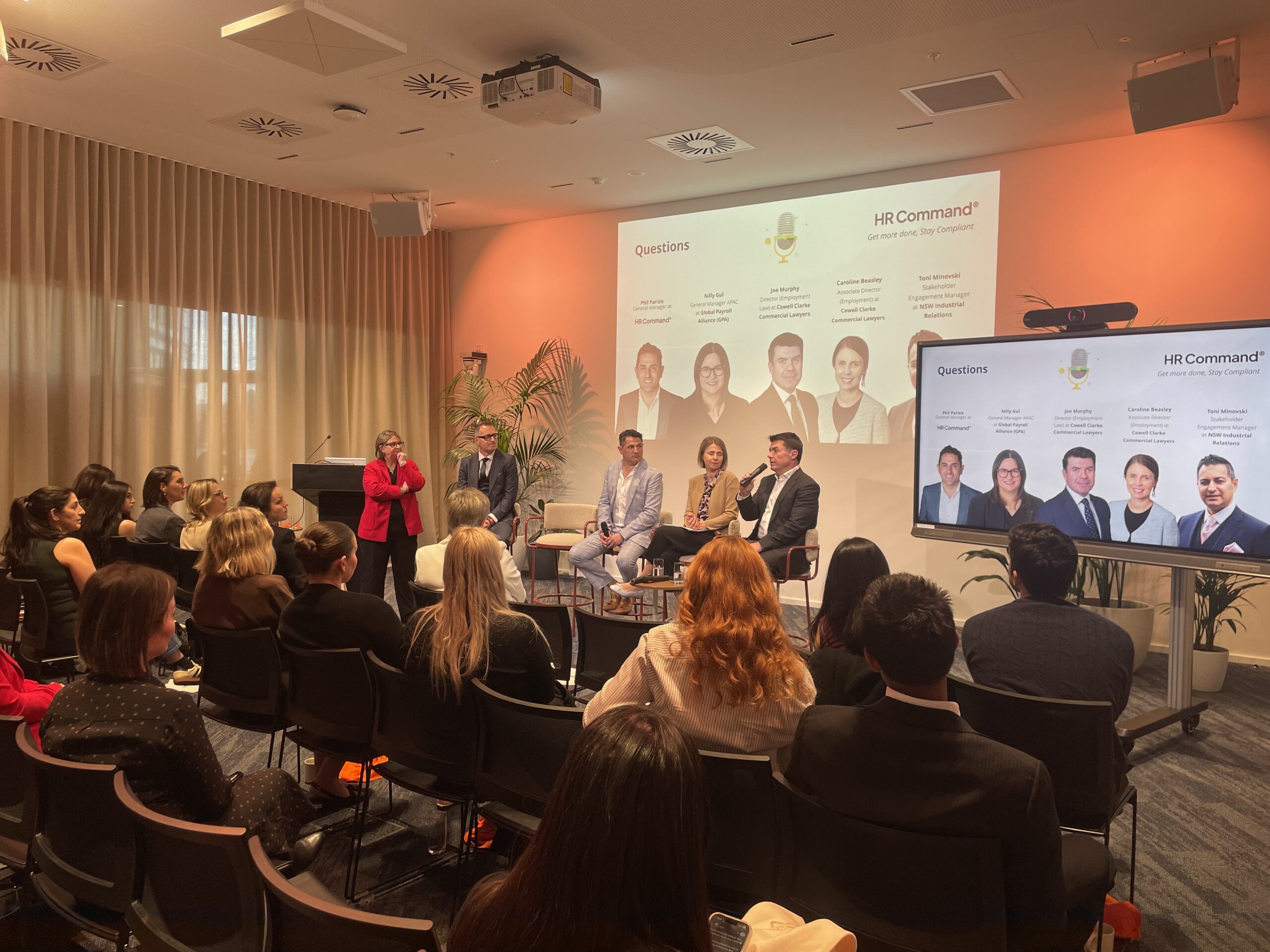
With a collective experience spanning over a century in employment law, industrial relations, and HR technology, our team is uniquely positioned to support your business. Trust in our seasoned professionals to provide unparalleled expertise and innovative solutions tailored to your needs.

Click on a profile below for more information.

Todd Johnston

Client Success Partner

Thomas Lee

HR Industry Digital Marketing Specialist

Rhi Yeates

HR Industry Marketing Manager

Phil Parisis

General Manager

Backed by Cowell Clarke Commercial Lawyers

Rest assured that your documentation and advice is legally compliant, giving you peace of mind.

Founded over three decades ago, the multi-award-winning Cowell Clarke set out to revolutionise the traditional, reactive approach of commercial law firms. The firm prides itself on delivering exceptional personal service with a proactive and global outlook.

With a strong national presence and an expanding team, Cowell Clarke's commitment to innovation and client-centric solutions remains unwavering. The firm's strategic partnership with HR Command further demonstrates its dedication to supporting Australian businesses with workplace relations through its extensive employment team.

Cowell Clarke
Joe Murphy Director
Employment & Workplace Relations Team
Cowell Clarke
Caroline Beasley Associate Director
Employment & Workplace Relations Team
Cowell Clarke
Emma Thomson Senior Associate
Employment & Workplace Relations Team

Who it is for

Psychosocial risk does not sit with one person. It straddles HR, safety and risk, and the duty lands personally on directors. HR Command gives each of them the same system.

HR leader holding an HR Command folder in a Sydney boardroom with the Harbour Bridge behind her, representing Australian HR compliance leadership

People and Culture and HR leaders.

You already own the people side, bullying, harassment, workload, role clarity. It is now a WHS duty, not a wellbeing program. HR Command turns it into a documented process you can stand behind, instead of a spreadsheet that lands back on you.

WHS and safety managers.

Psychosocial has to sit in your safety system with the same rigour as a physical hazard. HR Command runs the identify, assess, control and review cycle and keeps it on the register, next to everything else you manage.

Risk and compliance managers.

Psychosocial now belongs on the risk register beside financial and operational exposure. HR Command gives you the ratings, the controls and the review dates in one view.

Owners and directors.

The due diligence duty is personal. You are expected to ensure a system exists, is resourced and is working. HR Command is the evidence you point to, and the register you can produce when someone asks when it was last reviewed.

HR and WHS consultants.

Deliver a defensible psychosocial process to every client from one place, keep an eye on it across your whole book, and put your own brand on it.

Industry associations.

Give your members a ready compliance answer, under your brand.

The bottom line

The psychosocial code is now the standard you are held to. The businesses that come through an inspection well will not be the ones with the best policy. They will be the ones who can show the process behind it. HR Command is how you show it.
Book a walkthrough
FAQs

Frequently Asked Questions

What are psychosocial hazards?

They are aspects of work that can harm mental health. The code includes high job demands, low job control, poor support, lack of role clarity, poor change management, traumatic content, remote or isolated work, and workplace violence, bullying, harassment and sexual harassment.

Did the law change on 1 July 2026?

The duty to manage psychosocial risk already existed. What changed is that the psychosocial code of practice became an enforceable minimum standard in NSW. You now follow the code, or demonstrate an approach that provides an equal or higher standard of protection.

Is this only relevant in NSW?

No. The duty to manage psychosocial risk applies across Australia under the model WHS laws. The enforceable code benchmark from 1 July 2026 is a NSW change. HR Command is built to work nationally.

What does a systematic process actually require?

Four steps, done in consultation with workers and documented: identify the hazards, assess the risk, implement controls, and review whether they are working. HR Command runs and records all four.

Is training enough to control a psychosocial risk?

Generally no. Controls must follow the hierarchy, with changes to the design of work coming before training. Training on its own is not accepted as a primary control. HR Command flags a training only response as insufficient.

What does an inspector want to see?

Evidence, not intentions. A documented register of hazards, risk assessments, the controls you applied, records of worker consultation, and your review history. HR Command produces all of this as a single export.

Does it cover sexual harassment and the positive duty?

Yes. Sexual harassment is handled confidentially, under the employer's positive duty, and linked to your sexual harassment prevention plan.