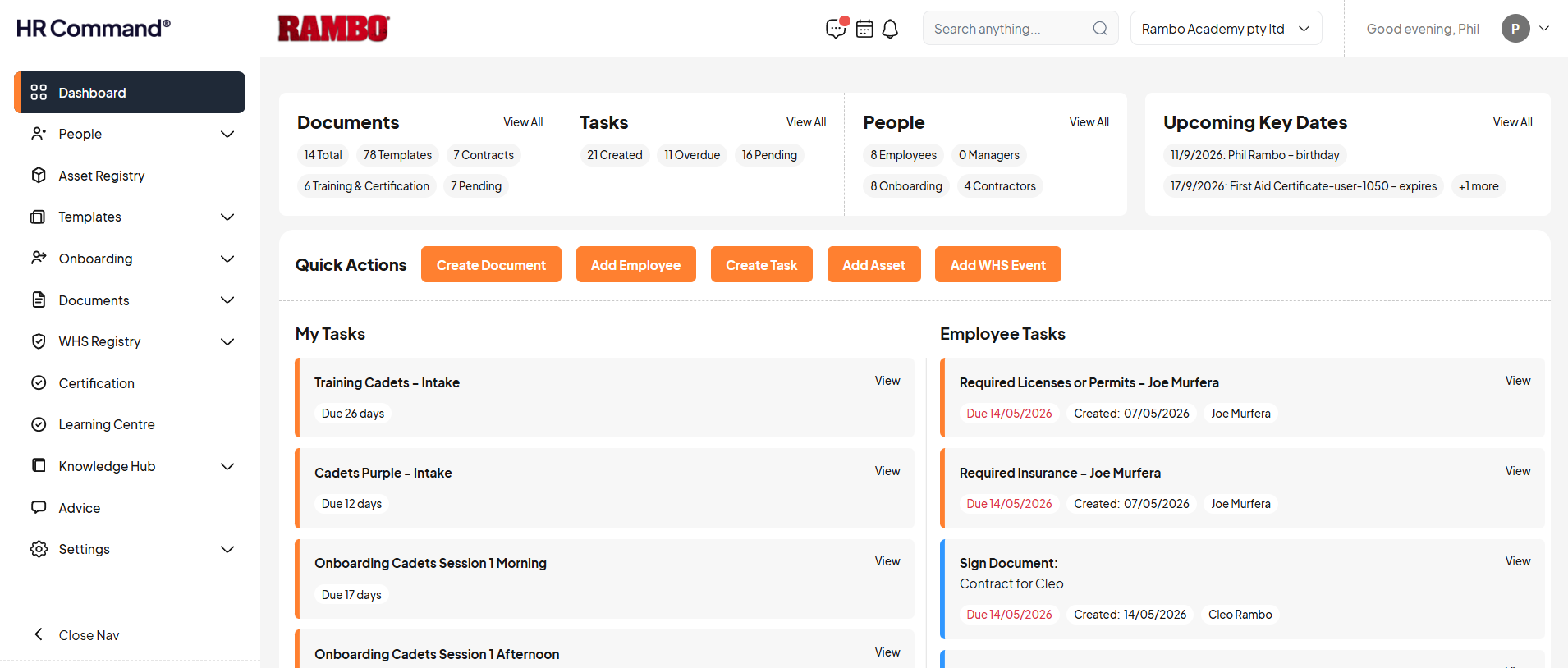
What if everything you’ve ever wanted in HR support landed in one powerful platform? Compliance sorted. Documents done. Advice on tap. Finally, HR made easy.
Take the headache
out of HR.
Manage contracts, policies, training, certification, letters and correspondence all in one easy to use platform. Take (HR) Command today.

Product Features
Crafted by HR professionals, backed by legal experts, and powered by human-centric technology Discover more today.

Who We Serve
Small Business Owners & Managers
Simplify compliance and free up time with HR Command’s easy-to-use software, designed specifically for small businesses.
Find out more
HR Managers in Growing Businesses
Access the tools and expert advice you need to ensure compliance and focus on strategic HR initiatives.
Discover how
Workforce Specialists & HR Professionals
Enhance your service with a full suite of HR tools, empowering your clients with your expertise and our software.
Explore your options
Associations & Member-Based Organisations
Elevate your brand with customisable, white-labelled HR software that delivers value to your members.
Learn more
Crafted by HR professionals, backed by legal experts, and powered by human-centric technology Discover more today.

About Us
Our Mission
HR Command is a leading force in Australia’s Human Resources Management software, dedicated to empowering Australian SMBs.
Learn more about our mission
Proven Excellence
Recognised for our strategic innovation, reliability, and top-tier customer service (with accolades to show for it).
Discover our award-winning approach
Secure and Trusted
At HR Command, trust is our foundation. We prioritise the protection of your data and keep it local.
See how we keep your data safe
Partner with Us
Join our journey to make HR simpler and more effective for everyone.
Explore partnership opportunities
Missed our last breakfast?
100+ HR and Payroll leaders joined us in September. Get on the list for the next one.

Knowledge Hub
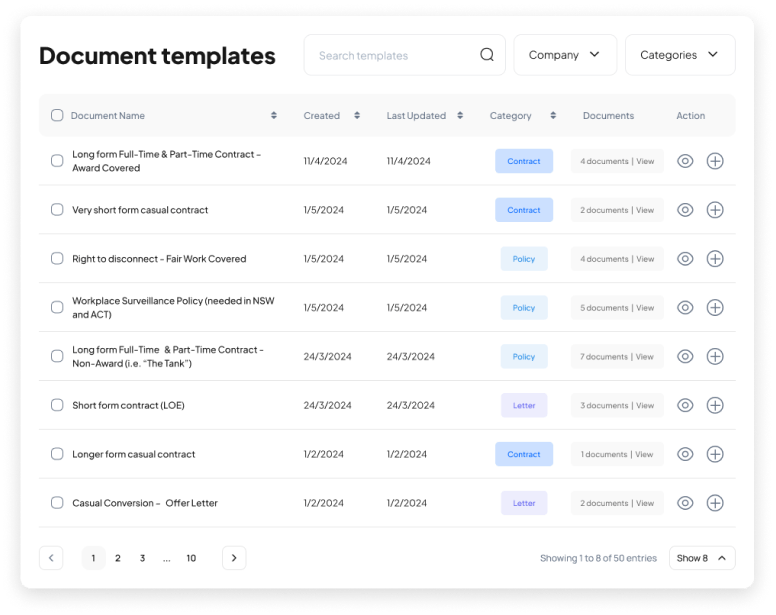
HR and WHS Documentation including high-quality policies, letters, checklists and more with the click of your mouse.
Staying compliant has never been so easy. Generate essential HR and WHS documents effortlessly, share them organisation-wide or to individual groups with a single click, and maintain compliance with ever-changing regulations.


good hands
Our Employment Legal team are
consistently updating and adding
documents which ensures that your policies
are always up-to-date and accessible.
Documents
Every policy, procedure, checklist and letter below is lawyer drafted, kept current with legislative change, and generated in minutes. Open any document to see what it covers and who needs it.
Workplace Health & Safety
10 documentsMeet your WHS duties, including the psychosocial hazard obligations now enforced in every state and territory.
- Psychosocial Hazards Policy
- WHS Policy
- Sexual Harassment Prevention Plan Required in QLD
- Alcohol and Other Drugs Policy
- Driving and Motor Vehicle Policy
- Ladder Policy
- Hot Weather and Wet Weather Policy
- First Aid Policy
- Injury Management & Return to Work Policy
- Fitness for Work Policy
Also in the library: Emergency Procedures, First Aid Officer Appointment, Psychosocial Hazard Training Record, Incident Investigation Report, and a separate OHS Policy for Victoria.
Psychosocial hazard duties now apply in every state and territory, and regulators are actively enforcing them. Not sure what yours look like? Talk to an adviser
Conduct & Behaviour
9 documentsSet clear standards, meet your positive duty under Respect@Work, and cover the grey areas before they become disputes.
- General Code of Conduct
- Anti-Bullying & Harassment Policy
- Anti-Sexual Harassment Policy
- Anti-Discrimination Policy
- Conflict of Interest Policy
- Employee Fraternisation Policy
- Out of Hours Events Policy (Xmas)
- Dress Code & Personal Presentation Policy
- Modern Slavery Policy
Also in the library: Children in the Workplace, Attendance and Absenteeism, and Entertainment and Expenses.
The positive duty means having a policy is no longer enough. You need to show you took reasonable steps. Talk to an adviser
Leave, Hours & Flexibility
6 documentsLeave entitlements, flexible work and the right to disconnect, aligned to the Fair Work Act and modern awards.
- Leave Policy (annual, parental, personal and LSL)
- Parental Leave Policy
- Flexible Work & WFH Policy
- Individual Flexibility Arrangement
- Right to Disconnect – Fair Work Covered
- Right to Disconnect – Awards Covered
Also in the library: Time Off In Lieu, Family and Domestic Violence Leave, and long service leave built to each state and territory.
Which version you need depends on whether your people are award covered, and getting it wrong leaves the policy unenforceable. Talk to an adviser
Technology & Information
8 documentsFrom AI use to workplace surveillance, govern how your people use technology and how your business handles information.
- IT Policy
- AI Usage Policy
- Social Media Policy
- Cyber Security Policy
- Data Breach Response Policy
- Confidential Information and IP Policy
- Employee Privacy Policy
- Workplace Surveillance Policy Required in NSW & ACT
Also in the library: Work From Home, Employee Personal Information, and Credit Card Use with its employee acknowledgement form.
Most teams are already using AI at work without a policy in place, and the exposure sits with the employer. Talk to an adviser
Performance, Grievances & Exits
5 documentsManage underperformance, complaints and redundancy with procedures that stand up at the Fair Work Commission.
- Performance, Counselling and Discipline Policy
- Broad Grievance Procedure
- Whistle-blower Policy
- Redundancy Policy
- Workplace Investigation Procedure
Also in the library: Workplace Investigation, Medical Incapacity, and the supporting investigation report templates.
Managing someone out right now? Get the process wrong and it becomes an unfair dismissal claim. Talk to an adviser
Onboarding & Offboarding
4 documentsStart and end employment cleanly, with nothing missed and everything documented.
- Recruitment & Equal Opportunity Policy
- New Employee Onboarding Checklist
- Departing Employee – Return of Equipment Checklist
- Departing Employee – Offboarding Checklist
Also in the library: Pre-existing Injury Declaration for Victoria, employee acknowledgement forms, and probation review templates.
New starters need a contract, the right policies and their details on file from day one. Talk to an adviser
Letters & Correspondence
8 documentsLawyer drafted letters for the moments that matter, generated with your details already merged in.
- Offer of Employment Letter
- Probation Confirmation & Extension Letters
- Letter of Variation
- First & Final Warning Letters
- Show Cause Letter
- Termination Letter
- Redundancy Letters
- Post-Employment Obligations Letter
Also in the library: abandonment of employment, stand down, resignation acknowledgement and reference request letters.
Every letter pulls your company details, the employee record and the right clauses automatically. No blank page, no copy and paste. Talk to an adviser
Looking for employment contracts? Full time, part time, casual, fixed term and contractor agreements. All lawyer drafted, all built in minutes.
View employment contractsAnd this is just a sample
The full library runs past 100 documents, updated by our Employment Legal team whenever the law changes. See it working with your business details in it.
Request a demoWhat this policy does
A psychosocial hazards policy sets out how your business identifies, assesses and controls the things at work that can cause psychological harm. Job demands, low job control, poor support, role conflict, bullying, harassment, exposure to traumatic content and remote or isolated work all sit inside its scope.
Who needs one
Every business with workers. WHS regulations across the harmonised jurisdictions now impose an express duty to manage psychosocial risk, and Victoria carries equivalent obligations under its own OHS framework. Regulators have moved from education to enforcement, and psychosocial complaints are now a routine trigger for inspector attendance.
What the policy covers
- How psychosocial hazards are identified, including the consultation steps with workers and HSRs
- Risk assessment and the hierarchy of controls applied to psychological risk
- Reporting pathways for workers, and what happens after a report is made
- Manager and officer responsibilities
- Review triggers and record keeping
Why it matters
A policy on its own is not a defence. What regulators look for is evidence that you identified the hazards specific to your workplace, put controls in place and reviewed them. This policy gives you the framework and the paper trail that sits behind it.
How it works in HR Command
Select the policy, confirm your business details, and it generates with your entity name, sites and contacts merged in. Publish it to the whole organisation or a single team, track who has read it, and receive an updated version whenever the legislation moves.
What this policy does
A work health and safety policy is the anchor document for your whole safety system. It states your commitment, allocates responsibility from officers down to workers, and sets out how hazards are reported, assessed and controlled.
Who needs one
Every person conducting a business or undertaking. The primary duty of care applies regardless of size, industry or whether you employ anyone directly, and it extends to contractors, labour hire workers, volunteers and visitors.
What the policy covers
- The primary duty of care and what it means in practice
- Officer due diligence obligations
- Worker and contractor responsibilities
- Consultation arrangements, including health and safety representatives
- Hazard identification, risk assessment and the hierarchy of controls
- Incident reporting and notifiable incident escalation
- Training, induction and review
Why it matters
Officers carry a personal due diligence duty that cannot be delegated. A documented policy, with evidence it has been issued and understood, is the starting point for demonstrating that duty has been met.
How it works in HR Command
Generate it with your details, publish it across the business, and track acknowledgements against each employee record so you can show who received what and when.
What this document does
A prevention plan is different from a policy. A policy states your standards. A plan documents the risk assessment you carried out, the control measures you chose, and how you will review them. It is the working document that shows what you actually did.
Who needs one
Queensland employers. Since 1 March 2025, section 55H of the Work Health and Safety Regulation 2011 (Qld) requires every PCBU to prepare, implement and review a written prevention plan wherever a risk of sexual harassment or sex or gender-based harassment has been identified. Queensland is currently the only jurisdiction with this specific requirement, and it captures workers located in Queensland even where the business is based elsewhere.
Beyond Queensland, the positive duty under the Sex Discrimination Act applies nationally, and a documented plan is the clearest way to evidence the reasonable and proportionate measures it requires.
What the plan covers
- Identification of the risk factors present in your workplace, including power imbalances, isolated work, customer-facing roles and alcohol at work events
- The control measures selected and who is responsible for each
- Consultation with workers
- Reporting and response procedures
- Review timing and triggers
Why it matters
In Queensland, not having a compliant plan is itself a breach, with penalties available even where no harassment has occurred. Nationally, the Australian Human Rights Commission has compliance and enforcement powers in relation to the positive duty. Regulators and complainants alike will ask what you did before an incident, not just how you handled it afterwards.
How it works in HR Command
Generate the plan with your details, work through the risk factors with your team, and pair it with the Anti-Sexual Harassment Policy and your reporting procedure so the whole set stays consistent.
What this policy does
This policy sets the rules for alcohol and other drugs in relation to work: what is prohibited, when testing may occur, how prescription medication is handled, and what happens when someone is unfit for work.
Who needs one
Any business with safety-sensitive work, vehicles, machinery, heights or client sites. It is also worth having in office environments, where the practical issues are usually work functions, client entertainment and prescription medication rather than site testing.
What the policy covers
- Prohibited conduct and the standard expected
- Testing circumstances, methods and cut-off levels, where testing applies
- Prescription and over the counter medication disclosure
- Self-disclosure and support pathways, including EAP referral
- Refusal to test and disciplinary consequences
- Privacy and handling of test results
Why it matters
Testing without a clear, communicated policy is where employers come unstuck at the Fair Work Commission. The method you use, the notice you give and the consistency of your response all get scrutinised. Dismissals have failed on the policy, not the positive result.
How it works in HR Command
Generate the version that matches your risk profile, publish it to the relevant sites or teams, and keep acknowledgements on file against each employee.
What this policy does
This policy governs who may drive for work, in what vehicles, and on what terms. It covers company vehicles, private vehicles used for work, and the grey area of commuting.
Who needs one
Any business where employees drive for work, including in their own cars. Driving is one of the most common causes of workplace fatality in Australia, and a vehicle is a workplace under WHS law.
What the policy covers
- Eligibility, licence verification and ongoing checks
- Authorised and private use, and who else may drive
- Fatigue, mobile phone use and speed
- Infringements and who bears the cost
- Accident and incident reporting
- Damage recovery, and the strict limits on deducting from wages
- Maintenance, logbooks and telematics where used
Why it matters
Recovering vehicle damage from an employee is heavily restricted. Deductions must be authorised in writing and be principally for the employee’s benefit, which damage recovery rarely is. Getting this clause right is the difference between an enforceable term and an underpayment claim.
How it works in HR Command
Generate the policy with your details, issue it to drivers, and pair it with an acknowledgement so each driver signs off on the terms before they take a vehicle.
What this policy does
This policy sets out when a ladder is the right tool, when it is not, and how ladders must be selected, inspected and used.
Who needs one
Trades, construction, maintenance, cleaning, warehousing, retail and hospitality. Anywhere a ladder is used regularly, which is most workplaces.
What the policy covers
- The hierarchy of controls for working at height, and when a ladder is appropriate
- Ladder selection, load ratings and industrial rating requirements
- Pre-use inspection and tagging out damaged equipment
- Safe setup, angle, footing and three points of contact
- Prohibited practices, including working from the top rungs and carrying loads
- Training and competency
Why it matters
Falls from height remain one of the highest causes of serious workplace injury in Australia, and a large share involve ladders under three metres. Regulators expect to see that you considered alternatives before defaulting to a ladder.
How it works in HR Command
Generate it with your details, issue it to the teams that use ladders, and keep it alongside your WHS policy and site risk assessments.
What this policy does
This policy sets out how work is managed in extreme heat and in wet or inclement conditions: when work continues, when it stops, what controls apply, and how people are paid.
Who needs one
Outdoor and semi-outdoor workplaces. Construction, landscaping, civil, agriculture, transport, warehousing without climate control, and any business with workers in vehicles or on roofs.
What the policy covers
- Heat illness recognition, prevention and first response
- Trigger points for rest breaks, rotation and stopping work
- Hydration, shade, PPE and scheduling controls
- Wet weather stoppages and safe alternatives
- Pay and entitlements during stoppages, including award inclement weather clauses
- Communication and who makes the call
Why it matters
Several modern awards contain specific inclement weather and hot weather clauses that dictate pay and stand down. A generic policy that contradicts the applicable award creates an underpayment exposure, so the award position needs to be checked first.
How it works in HR Command
Generate the policy, align it against the award covering your workforce, and publish it before the season rather than during it.
What this policy does
This policy sets out your first aid arrangements: what equipment is provided, who is trained, where facilities are located and how first aid incidents are recorded.
Who needs one
Every business. WHS regulations require adequate first aid equipment, facilities and trained personnel, with what counts as adequate scaling to your size, hazards and location.
What the policy covers
- First aid kit contents, locations and restocking
- First aid officer appointment, training and currency
- Facilities and rooms, where required
- Remote and isolated work arrangements
- Recording first aid treatment and the privacy of those records
- Escalation to emergency services and notifiable incidents
Why it matters
First aid records are often the first evidence pulled in an injury claim or a regulator inspection. Having a consistent recording process, and knowing where the boundary sits between a first aid record and a notifiable incident, protects the business.
How it works in HR Command
Generate it with your site details, track first aid officer certifications against employee records, and get reminders before qualifications expire.
What this policy does
This policy sets out what happens after a workplace injury: how the claim is managed, how suitable duties are identified, and how the return to work is planned and reviewed.
Who needs one
Every employer. Workers compensation schemes are state and territory based, and most impose return to work obligations on employers, with some requiring a written program once you pass a wages threshold.
What the policy covers
- Injury reporting and claim lodgement timeframes
- Roles: the return to work coordinator, treating practitioner, insurer and manager
- Certificates of capacity and how they translate into duties
- Identifying and offering suitable duties
- Return to work plans, review points and graduated hours
- Handling non-work related injuries and the interaction with personal leave
- Privacy of medical information
Why it matters
Return to work obligations sit alongside general protections and disability discrimination law. Terminating an injured worker, or failing to consider reasonable adjustments, is a well travelled path to a claim. A documented process keeps decisions defensible.
How it works in HR Command
Generate the policy for your jurisdiction, store injury documentation against the employee record, and keep the return to work plan and reviews in one place.
What this policy does
This policy defines what it means to be fit for work and what happens when someone is not. It covers fatigue, illness, injury, medication, stress and any condition affecting a person’s capacity to work safely.
Who needs one
Any business with safety-critical work, shift work, long hours, driving or machinery. It is also useful in office environments as the framework for handling capacity concerns properly rather than informally.
What the policy covers
- The fitness for work standard and inherent requirements of roles
- Fatigue management, including hours, rest breaks and rostering limits
- Self-disclosure obligations and manager observations
- When a medical assessment may be directed, and how it is arranged
- Reasonable adjustments and the consultation that goes with them
- Confidentiality and handling of health information
Why it matters
Directing a medical assessment is lawful only where the direction is reasonable, which usually turns on genuine safety or capacity concerns tied to the inherent requirements of the role. A documented policy is what makes the direction reasonable rather than arbitrary.
How it works in HR Command
Generate it with your details, apply it consistently across roles, and use the advice line before directing an assessment in a contested case.
What this policy does
A code of conduct sets the behavioural standard for your whole workforce. It is the document every disciplinary process eventually points back to, which is why it needs to be broad enough to cover the unexpected and specific enough to be enforceable.
Who needs one
Every business. Without a code, a dismissal for misconduct rests on unwritten expectations, and the Fair Work Commission will ask what the employee was told and when.
What the policy covers
- Expected standards of behaviour, at work and at work-related events
- Honesty, fair dealing and use of company property
- Conflicts of interest and secondary employment
- Confidentiality and representing the business externally
- Compliance with lawful and reasonable directions
- Reporting concerns, and protection for those who report
- What constitutes misconduct and serious misconduct, and the consequences
Why it matters
Serious misconduct allows summary dismissal, but only where the conduct genuinely meets the threshold and the process is fair. A code that defines the categories clearly gives you the foundation for both the decision and the procedure.
How it works in HR Command
Generate it with your details, issue it at onboarding, track acknowledgements, and reissue automatically when it is updated.
What this policy does
This policy defines bullying and harassment, tells people how to report it, and sets out what the business will do in response.
Who needs one
Every business. Bullying is a psychosocial hazard under WHS law, which means managing it is a safety duty, not just an employee relations issue.
What the policy covers
- The legal definition of bullying: repeated unreasonable behaviour creating a risk to health and safety
- The distinction between bullying and reasonable management action carried out reasonably
- Harassment and victimisation
- Informal and formal reporting pathways
- Investigation process, support and confidentiality
- Outcomes, and the protection of everyone involved
Why it matters
The reasonable management action carve-out is the most misunderstood part of bullying law. Performance management is not bullying, but it stops being reasonable when the process is unfair. A policy that explains the line protects managers as much as workers, and applications to the Fair Work Commission for stop bullying orders make the distinction live.
How it works in HR Command
Generate the policy, publish it with the grievance procedure, and use the advice line when a report comes in and you need a second opinion before acting.
What this policy does
This policy prohibits sexual harassment and sex-based harassment, explains what those terms actually mean, and sets out how reports are made and handled.
Who needs one
Every business. The positive duty under the Sex Discrimination Act requires employers to take reasonable and proportionate measures to eliminate sexual harassment, sex-based harassment and hostile workplace environments. That is a proactive obligation, not a duty to respond after the fact.
What the policy covers
- Definitions of sexual harassment, sex-based harassment and a hostile environment on the ground of sex
- Where the policy applies, including work events, travel, client sites and online
- Multiple reporting pathways, including one that bypasses a direct manager
- Support for the person reporting, and for the respondent
- Investigation, outcomes and victimisation protections
- Bystander responsibilities and manager obligations
Why it matters
Sexual harassment is also a workplace right issue under the Fair Work Act and a WHS hazard. The exposure runs across three regimes at once, and vicarious liability means the business is on the hook unless it can show it took all reasonable steps.
How it works in HR Command
Generate it, pair it with training and your prevention plan, and keep acknowledgement records so you can evidence the reasonable steps you took.
What this policy does
This policy commits the business to a workplace free of discrimination and explains what discrimination looks like in practice, including the indirect kind that is rarely intentional.
Who needs one
Every business. Discrimination obligations come from federal legislation, state and territory anti-discrimination acts, and the adverse action provisions of the Fair Work Act, all operating at once.
What the policy covers
- Protected attributes across federal and state law
- Direct and indirect discrimination, with practical examples
- Where discrimination risk arises: recruitment, promotion, rostering, redundancy selection
- Reasonable adjustments and the consultation process
- Vilification and victimisation
- Complaint pathways and external options
Why it matters
General protections claims under the Fair Work Act carry a reverse onus. Once an employee shows adverse action and a protected attribute, the employer must prove the attribute played no part in the decision. Contemporaneous records and a clear policy are what discharge that burden.
How it works in HR Command
Generate it with your details and issue it alongside your recruitment and performance policies, since those are where the risk concentrates.
What this policy does
This policy requires employees to identify and disclose conflicts between their personal interests and their duty to the business, and sets out how those conflicts are then managed.
Who needs one
Any business where employees make purchasing decisions, hire, manage suppliers, handle confidential information, or work in an industry small enough that everyone knows everyone. Which is most of Australia.
What the policy covers
- Actual, potential and perceived conflicts, and why perception counts
- Secondary employment and side businesses
- Personal relationships in reporting lines
- Gifts, benefits and hospitality, with thresholds
- Related party transactions and supplier relationships
- The disclosure process, the register, and management strategies
Why it matters
The employment relationship carries an implied duty of fidelity, but relying on an implied term is weak ground for discipline. A written disclosure obligation converts a vague duty into a specific, enforceable requirement, and the register becomes your evidence.
How it works in HR Command
Generate the policy, collect disclosures at onboarding and annually, and store them against employee records.
What this policy does
This policy sets out how personal and romantic relationships between colleagues are handled: what must be disclosed, what will be adjusted, and what conduct is expected at work.
Who needs one
Any business with more than a handful of staff. Workplace relationships are common and mostly unremarkable, but they become a genuine problem when one party manages the other, or when the relationship ends badly.
What the policy covers
- What must be disclosed, and to whom
- Relationships within a reporting line, and how they are managed
- Conflicts in recruitment, performance reviews, pay decisions and promotions
- Expected conduct during work hours and at work events
- Confidentiality and non-judgemental handling of disclosures
- The boundary between a consensual relationship and sexual harassment
Why it matters
Power imbalance is a recognised risk factor for sexual harassment, and consent is a fraught concept where one person controls the other’s pay and progression. A relationships policy is a genuine control measure, not just a governance nicety.
How it works in HR Command
Generate the policy and issue it alongside your code of conduct and anti-sexual harassment policy so the three read as one consistent standard.
What this policy does
This policy sets the expectations for work-related social events: the standard of behaviour, alcohol service, transport home, and where the official event ends.
Who needs one
Any business that holds a Christmas party, client entertainment, conferences, offsites or team drinks. The end of year period is where most of the risk concentrates.
What the policy covers
- That the code of conduct applies at work events
- Responsible service and consumption of alcohol
- Defined start and finish times, and the status of after-parties
- Transport arrangements and driving
- Social media and photography at events
- Reporting incidents, and how they will be handled
Why it matters
Work functions are a recurring source of Fair Work Commission decisions, and the outcomes turn heavily on whether the employer had a policy, communicated it beforehand, and defined when the event finished. Employers who sent a clear reminder before the event have consistently fared better than those who did not.
How it works in HR Command
Generate it, and send it out as a reminder in the fortnight before the event rather than filing it and hoping.
What this policy does
This policy sets the standard for dress, uniform and personal presentation, and explains how it varies by role and setting.
Who needs one
Client-facing businesses, businesses with uniforms or PPE requirements, and any workplace where the standard has been assumed rather than stated and is now inconsistently applied.
What the policy covers
- Standards by setting: office, client site, remote work and video calls
- Uniform provision, laundering and return
- PPE requirements and the interaction with safety obligations
- Grooming, jewellery, visible tattoos and piercings
- Religious and cultural dress, and adjustments
- Consequences of non-compliance
Why it matters
Dress codes create discrimination risk when they impose different standards by sex, or fail to accommodate religious or cultural dress. Drafting to a safety or client-facing rationale, rather than personal taste, is what keeps the policy defensible.
How it works in HR Command
Generate it with your details, issue it at onboarding, and pair it with your uniform issue records where uniforms are supplied.
What this policy does
This policy states your position on modern slavery and sets out how you assess and address the risk in your operations and supply chains.
Who needs one
Entities above the consolidated revenue threshold under the Modern Slavery Act 2018 must lodge an annual statement. Below that threshold, a growing number of businesses need a policy because their customers require one as a condition of supply, particularly in government, construction, retail and manufacturing supply chains.
What the policy covers
- What modern slavery covers: forced labour, debt bondage, human trafficking, the worst forms of child labour
- Risk assessment across operations and supply chain tiers
- Supplier due diligence and contractual requirements
- Reporting concerns, including anonymously
- Remediation where risk is identified
- Training and annual review
Why it matters
Even where you are not a reporting entity, larger customers pass their due diligence obligations down the chain. Not having a policy increasingly costs you tenders.
How it works in HR Command
Generate it with your details and pair it with your supplier onboarding process so the policy has something to attach to.
What this policy does
This policy brings every leave type into one document: how leave accrues, how it is requested and approved, what evidence is required, and how it is paid.
Who needs one
Every employer. Leave is the single most common source of underpayment and dispute, usually because practice drifted from entitlement over years without anyone checking.
What the policy covers
- Annual leave: accrual, approval, excessive balances, cashing out and leave loading
- Personal and carer’s leave: accrual, evidence requirements and unpaid carer’s leave
- Compassionate leave
- Family and domestic violence leave, including the pay slip restrictions
- Community service and jury duty leave
- Long service leave, which differs in every state and territory
- Unpaid leave and the effect on accruals
- Public holidays and reasonable refusal of a request to work
Why it matters
Family and domestic violence leave carries specific pay slip rules designed to protect the employee’s safety, and getting those wrong is a compliance breach in itself. Long service leave is state legislation, so a national employer needs the right position for each jurisdiction.
How it works in HR Command
Generate the policy for your jurisdictions, publish it, and keep leave documentation stored against each employee record.
What this policy does
This policy explains parental leave entitlements, how to apply, what happens during leave, and what the return to work looks like.
Who needs one
Every employer. Parental leave is one of the most heavily prescribed areas of the National Employment Standards, and one of the easiest to get wrong through informal arrangements.
What the policy covers
- Eligibility, including the 12 month service requirement and casual eligibility
- Unpaid parental leave, notice requirements and the extension request
- Flexible unpaid parental leave days
- Interaction with the government Paid Parental Leave scheme, including superannuation on government payments
- Any employer-funded paid parental leave you offer
- Keeping in touch days
- Return to work: the right to the pre-parental leave position, and consultation if the role has changed
- Safe job transfer and no safe job leave during pregnancy
Why it matters
Return to work is where the disputes happen. The entitlement is to the pre-parental leave position, and where that role no longer exists the consultation obligation is strict. Discrimination claims on the ground of pregnancy or family responsibilities frequently start here.
How it works in HR Command
Generate the policy, set your employer-funded entitlement if you offer one, and manage notice periods and return dates from the employee record.
What this policy does
This policy covers both halves of flexibility: the statutory right to request flexible working arrangements, and the practical rules for working from home.
Who needs one
Every employer. The right to request applies under the National Employment Standards, and the response obligations are strict. Separately, any business with remote or hybrid work needs the WHS side documented.
What the policy covers
- Who can make a flexible work request and on what grounds
- The written response requirement and the 21 day deadline
- Genuine discussion, and what counts as reasonable business grounds for refusal
- The Fair Work Commission dispute pathway
- Home workstation safety, self-assessment and equipment
- Hours, availability and the right to disconnect
- Data security, confidentiality and insurance
- Trial periods, review and ending an arrangement
Why it matters
Refusing a flexible work request without discussing it first, without written reasons, or outside the 21 day window is a breach regardless of how reasonable the refusal was on its merits. The process is where employers fail, not the decision.
How it works in HR Command
Generate the policy, run requests through a consistent workflow, and keep the written response on the employee record.
What this document does
An IFA is a written agreement between an employer and an individual employee that varies specified terms of a modern award or enterprise agreement to suit their circumstances.
Who needs one
Employers who want to vary award or agreement terms for an individual, most often around hours of work, overtime rates, penalty rates, allowances or leave loading.
What the document covers
- The terms being varied, and the flexibility term that permits it
- How the arrangement leaves the employee better off overall
- The genuine agreement requirement, free of coercion or duress
- Commencement and termination, including the notice period
- Signature blocks, and the requirement for a parent or guardian where the employee is under 18
Why it matters
An IFA that does not leave the employee better off overall is not valid, and the underlying award entitlement continues to apply. That means back pay for the difference, and potentially penalties. The better off overall assessment needs to be documented at the time it is made, not reconstructed later.
How it works in HR Command
Generate the IFA with the employee’s details merged in, get it signed, and store it against the employee record with the award reference.
What this policy does
This policy sets out how the right to disconnect operates in your business: what contact outside working hours is reasonable, what is not, and how disagreements are resolved.
Who needs one
Employers whose employees rely on the right to disconnect under the Fair Work Act rather than a more favourable term in an enterprise or registered agreement. Use this version where the Act is the operative source.
What the policy covers
- The right under section 333M to refuse to monitor, read or respond to contact outside working hours, unless the refusal is unreasonable
- The factors that determine reasonableness, including the reason for contact, the employee’s role and level of responsibility, and whether they are compensated for availability
- Practical expectations for managers sending after-hours messages
- Emergency and on-call contact
- Dispute resolution, internally and through the Fair Work Commission
- That the right is a workplace right, so adverse action for exercising it is prohibited
Why it matters
An employer cannot contract out of the right or vary it to be less favourable. The right commenced on 26 August 2024 for employers with 15 or more employees and on 26 August 2025 for small business employers, so it now applies across the board. Associated entity employees count towards the 15, and casuals count where engaged on a regular and systematic basis.
How it works in HR Command
Generate it, brief your managers on it, and issue it alongside your hours of work and flexible work policies.
What this policy does
This version of the right to disconnect policy is built for workforces covered by a modern award, where the award’s own terms on availability, on-call and roster changes interact with the statutory right.
Who needs one
Award covered employers, particularly in industries with on-call arrangements, emergency roster changes, shift swaps or availability allowances.
What the policy covers
- The statutory right, as incorporated into modern awards
- How award terms on on-call, availability and recall to work sit alongside it
- Where an allowance is paid for availability, and what that means for reasonableness
- Roster change notification and contact about shifts
- Manager guidance on out of hours contact
- Dispute resolution under the award and through the Fair Work Commission
Why it matters
If you pay an availability or on-call allowance, refusing contact during that period is much less likely to be reasonable. Getting this wrong in either direction creates exposure, either an unlawful direction or an unstaffed roster.
How it works in HR Command
Confirm the award covering your workforce, generate the matching version, and issue it with your rostering documentation.
What this policy does
This policy sets the rules for using company technology: devices, email, internet, systems and data, along with what personal use is permitted.
Who needs one
Every business that issues devices or accounts. Without an acceptable use policy, disciplining someone for misuse of company IT is difficult, and monitoring their use may be unlawful.
What the policy covers
- Acceptable and prohibited use of company systems
- Reasonable personal use, and its limits
- Passwords, multi-factor authentication and account security
- Software installation, shadow IT and unapproved cloud services
- Personal devices used for work, and what the business can access
- Data storage, transfer and removable media
- Monitoring, and notice of it
- Return of equipment and access revocation on exit
Why it matters
Monitoring employee computer use is regulated, and in some jurisdictions requires specific written notice before it starts. An IT policy that authorises monitoring without meeting the notice requirements does not protect you.
How it works in HR Command
Generate the policy, issue it at onboarding with device allocation, and track acknowledgements against the employee record.
What this policy does
This policy sets the rules for how your people use generative AI at work: which tools are approved, what can and cannot be entered into them, and who is accountable for the output.
Who needs one
Any business where staff have internet access. AI use is already widespread in most workplaces, usually ahead of any policy, and the exposure sits with the employer when confidential information, client data or personal information ends up in a public model.
What the policy covers
- Approved and prohibited tools, and how to request a new one
- What must never be entered into a public model: personal information, client data, confidential material, source code, health records
- Disclosure requirements for AI assisted work
- Mandatory human review, and accountability for accuracy
- Bias and fairness, particularly in recruitment and performance decisions
- Intellectual property and ownership of outputs
- Record keeping and consequences for breach
Why it matters
Using AI in recruitment or performance decisions imports discrimination risk that the employer wears, not the vendor. And once confidential information is in a public model, it cannot be retrieved, so the controls have to be preventative. There is also a hard date attached: from 10 December 2026, privacy policies must disclose the kinds of decisions made using automated systems and the personal information they use. If software is making or materially assisting decisions about your people, that disclosure obligation is close.
How it works in HR Command
Generate the policy, publish it across the business, and reissue it as your approved tool list changes.
What this policy does
This policy covers social media in both directions: how employees represent the business online, and how their personal posting can affect it.
Who needs one
Every business. This is one of the most litigated policy areas in Australia, because the line between an employee’s private life and their employment is genuinely contested.
What the policy covers
- Official use of business accounts, and who is authorised
- Personal accounts, and the requirement not to imply you speak for the business
- Confidential information, client details and workplace photography
- Conduct that damages the employer’s reputation or relationships
- Harassment and bullying of colleagues online
- Responding to negative reviews and complaints
- Where the policy applies out of hours, and where it does not
Why it matters
Out of hours conduct is only a valid ground for discipline where there is a sufficient connection to employment. Policies that claim to control everything an employee posts have been read down by the Fair Work Commission. The enforceable version is narrower and better drafted.
How it works in HR Command
Generate the policy and issue it with your code of conduct so the standards read consistently.
What this policy does
This policy sets the security behaviours expected of every employee, from password practices to what to do when they realise they clicked the wrong link.
Who needs one
Every business. Most breaches in Australia start with a person, not a system, which makes this an employment control as much as a technical one.
What the policy covers
- Password standards and multi-factor authentication
- Phishing, business email compromise and invoice fraud
- Payment verification procedures for changes to bank details
- Device security, screen locking and physical security
- Public wifi, remote access and travel
- Access control, least privilege and offboarding revocation
- Incident reporting without blame, and escalation timeframes
Why it matters
Invoice redirection fraud regularly costs Australian businesses six figures, and it is almost always defeated by a verification procedure rather than software. Fear of blame is the main reason incidents get reported late, so the policy needs to make reporting safe.
How it works in HR Command
Generate it, issue it at onboarding and annually, and pair it with your data breach response policy.
What this policy does
This policy sets out what happens in the hours and days after a suspected data breach: who is told, who decides, what gets assessed, and when notification is required.
Who needs one
Any entity covered by the Privacy Act, plus businesses that hold tax file numbers, health information or credit information regardless of turnover. The Notifiable Data Breaches scheme has a tight assessment window, which is unworkable without a plan prepared in advance.
What the policy covers
- Recognising and reporting a suspected breach internally
- The response team and decision maker
- Immediate containment steps
- Assessing whether serious harm is likely, within the statutory timeframe
- Notification to the OAIC and to affected individuals, and what the statement must contain
- Remediation and post-incident review
- Record keeping, including for breaches assessed as not notifiable
Why it matters
The assessment clock starts when you become aware there are reasonable grounds to suspect a breach, not when you finish investigating. Businesses without a prepared process routinely run out of time.
How it works in HR Command
Generate the policy with your response contacts, and run a tabletop exercise against it before you need it.
What this policy does
This policy defines what the business treats as confidential, how it must be handled, and who owns the intellectual property created during employment.
Who needs one
Any business with client lists, pricing, methodologies, software, designs, formulations or supplier terms. Which is effectively every business.
What the policy covers
- What constitutes confidential information, with examples
- Handling, storage, transmission and disposal
- Ownership of intellectual property created in the course of employment
- Moral rights and consents
- Pre-existing IP the employee brings with them
- Obligations that continue after employment ends
- Return of information and materials on exit
Why it matters
The default position on IP ownership is not always what employers assume, particularly for work created outside duties or by contractors. Contractors generally retain ownership unless it is expressly assigned. Relying on the default is a common and expensive mistake.
How it works in HR Command
Generate the policy, pair it with the IP and confidentiality clauses in your employment contract, and issue the post-employment obligations letter at exit.
What this policy does
This policy explains what personal information the business collects about employees, why it collects it, how it is stored, who it may be disclosed to, and how employees can access it.
Who needs one
Every employer. The employee records exemption in section 7B(3) still exists, but it is narrower than most employers assume and it does not apply to the statutory tort for serious invasions of privacy, which has been available to individuals since 10 June 2025. Recruitment data is outside the exemption entirely, since it only covers current and former employees.
What the policy covers
- What is collected, from recruitment through to exit
- Sensitive information, including health information, and the consent required
- Purposes of collection and use
- Storage, security and retention periods
- Disclosure to third parties, including payroll providers, insurers and overseas recipients
- Access and correction requests
- Complaints, internally and to the OAIC
Why it matters
Health information collected in return to work, fitness for work and leave processes is sensitive information, and the handling rules are stricter. Two changes matter most right now. Individuals can sue directly for a serious invasion of privacy, and the employee records exemption is no defence to that action. And from 10 December 2026, businesses must disclose in their privacy policy the kinds of decisions made using automated systems and the personal information those systems use, which reaches recruitment screening, performance analytics and rostering software.
How it works in HR Command
Generate it, issue it at onboarding, and keep employee records in one secure place rather than scattered across drives and inboxes.
What this policy does
This policy gives employees notice that surveillance occurs, what kind, where, and how the information is used.
Who needs one
Employers in New South Wales and the Australian Capital Territory have specific statutory notice obligations before surveillance can lawfully begin. Outside those jurisdictions, notice is still strongly advisable, and other states regulate particular forms of surveillance such as optical and listening devices.
What the policy covers
- Camera surveillance: locations, visibility of cameras and signage
- Computer surveillance: email, internet, keystroke and software monitoring
- Tracking surveillance: vehicles, devices and telematics
- The notice period required before surveillance commences
- Prohibited surveillance locations, including bathrooms and change rooms
- How surveillance records are stored, accessed and used
- Covert surveillance, and the authority required for it
Why it matters
In New South Wales the Workplace Surveillance Act 2005 requires at least 14 days written notice before surveillance starts, specifying the kind of surveillance, how it will be carried out, when it begins, and whether it is continuous and ongoing. Where surveillance is already running, a new employee must be notified before they start work, which is why the notice usually sits in the onboarding pack or the contract. Covert surveillance requires a magistrate’s authority.
Surveillance conducted without that notice can be unlawful, and the material it produces has been ruled inadmissible in unfair dismissal proceedings. Employers have lost dismissal cases on exactly this point.
How it works in HR Command
Generate the policy for your jurisdiction, issue it before surveillance begins, and include it in the onboarding pack so new starters are covered from day one.
What this policy does
This policy sets out how underperformance and misconduct are managed, from the first informal conversation through to warnings and, where necessary, termination.
Who needs one
Every employer. This is the document the Fair Work Commission will ask for when an unfair dismissal claim is filed, and the process it describes is the process you will be measured against.
What the policy covers
- The difference between underperformance and misconduct, and why they follow different paths
- Informal counselling before formal steps
- Performance improvement plans, with clear measures and review dates
- Formal warnings, and what each must contain
- Procedural fairness: notice of the allegations, the opportunity to respond, and the right to a support person
- Serious misconduct and summary dismissal
- Stand down or suspension during investigation
- Record keeping at every step
Why it matters
Most unfair dismissal findings turn on process rather than substance. Failing to notify the employee of the reason, failing to give a genuine chance to respond, or refusing a support person will sink an otherwise valid dismissal. Small business employers have a separate code to follow.
How it works in HR Command
Generate the policy, run each step with the matching letter template, and keep the full chain on the employee record.
What this document does
A grievance procedure gives employees a defined way to raise a concern and gives the business a defined way to respond, rather than complaints escalating externally because nobody knew what to do with them.
Who needs one
Every employer. Most modern awards and enterprise agreements also contain a dispute resolution term, and your internal procedure needs to work with it rather than against it.
What the procedure covers
- What can be raised as a grievance
- Informal resolution as a first step, where appropriate
- Formal complaint: how to lodge it and what to include
- Alternative pathways where the grievance concerns a direct manager
- Assessment, investigation and timeframes
- Support persons, confidentiality and welfare
- Outcomes, communication and appeal
- Protection against victimisation
- External options, including the Fair Work Commission
Why it matters
A complaint handled badly internally becomes a general protections claim, a bullying application or a safety regulator notification. Timeframes and a genuine alternative reporting pathway are the two features that most often distinguish a procedure that works from one that exists on paper.
How it works in HR Command
Generate it, publish it with your bullying and harassment policies, and use the advice line for a second opinion before you start an investigation.
What this policy does
This policy explains who can make a protected disclosure, what can be disclosed, who it can be made to, and the protections that follow.
Who needs one
Public companies, large proprietary companies and corporate trustees of registrable superannuation entities are required to have a compliant policy and make it available to officers and employees. Smaller businesses often adopt one voluntarily, because the protections apply to the discloser regardless of whether the company has a policy.
What the policy covers
- Who is an eligible whistleblower, including former employees, contractors, suppliers and relatives
- What qualifies as a disclosable matter, and what does not
- Eligible recipients, including officers, senior managers, auditors and regulators
- Anonymous disclosures
- Confidentiality of the discloser’s identity, and the narrow exceptions
- Protection from detriment, and the compensation available if detriment occurs
- Investigation process and feedback to the discloser
- Public interest and emergency disclosures
Why it matters
Revealing a discloser’s identity outside the permitted exceptions is an offence. Personal work-related grievances generally fall outside the whistleblower regime and belong in the grievance procedure instead, so the boundary needs to be clear in both documents.
How it works in HR Command
Generate the policy, name your eligible recipients, and make it available to officers and employees as required.
What this policy does
This policy sets out how the business manages redundancies: the consultation it will undertake, how positions are selected, what redeployment is considered, and what is paid.
Who needs one
Any employer that may need to restructure. Redundancy is the area where good intentions most often produce an unfair dismissal finding, because the consultation obligation is procedural and unforgiving.
What the policy covers
- What makes a redundancy genuine: the job is no longer required, consultation obligations are met, and redeployment has been considered
- Consultation obligations under the applicable award or agreement, and when they are triggered
- Selection criteria, and keeping them objective and documented
- Redeployment within the business and associated entities
- Notice of termination and payment in lieu
- Severance under the National Employment Standards, and the small business exemption
- Notification to Services Australia for larger scale redundancies
- Support, references and outplacement
Why it matters
If consultation was required and did not happen, the redundancy is not a genuine redundancy for unfair dismissal purposes, no matter how commercially sound the decision was. Consultation must occur when the decision is made, before it is implemented.
How it works in HR Command
Generate the policy, run the process with the matching redundancy letters, and use the advice line before you start.
What this document does
This procedure sets out how a workplace investigation is run: who investigates, how allegations are framed, how evidence is gathered, and how findings are made.
Who needs one
Every employer. Investigations arise from bullying, harassment, misconduct, safety incidents and grievances, and a flawed investigation compromises whatever decision follows.
What the procedure covers
- Deciding whether an investigation is needed, and appointing an investigator
- Internal versus external investigation, and independence
- Framing allegations with enough particularity to be answered
- Interviews, support persons and record keeping
- Procedural fairness for the respondent
- Welfare and interim measures during the investigation
- The standard of proof, and making findings on the balance of probabilities
- The report, and separating findings of fact from disciplinary decisions
- Confidentiality and legal professional privilege considerations
Why it matters
Vague allegations are the most common defect. An employee cannot properly respond to “concerns about your behaviour”, and a finding built on that foundation will not survive scrutiny. Keeping the investigation separate from the disciplinary decision also protects both.
How it works in HR Command
Generate the procedure, follow it with the supporting templates, and call the advice line early where the matter is serious.
What this policy does
This policy sets out how roles are advertised, how candidates are assessed, and how the process stays lawful and consistent from advertisement to offer.
Who needs one
Any business that hires. Discrimination risk in recruitment is high and largely invisible, because unsuccessful candidates rarely find out why they were rejected, until one does.
What the policy covers
- Approval to recruit, and defining the inherent requirements of the role
- Advertising, including wording that does not screen out protected attributes
- Pay transparency and the prohibition on pay secrecy terms
- Shortlisting and structured interviews
- Questions that cannot lawfully be asked
- Reference, qualification, police and right to work checks, and the consent required
- Pre-employment medicals, where genuinely job related
- Use of AI or automated screening tools, and the risks
- Record retention and unsuccessful candidate handling
Why it matters
Discrimination protections apply to prospective employees, not just current ones. A criminal record check that is not relevant to the inherent requirements of the role, or an age-coded job ad, both create exposure before anyone is even hired.
How it works in HR Command
Generate the policy, use it alongside the offer letter and contract templates, and keep candidate documentation consistently.
What this document does
This checklist runs from offer acceptance through to the end of probation, covering every document, form, induction and system step a new starter needs.
Who needs one
Every employer. Onboarding is where compliance obligations cluster, and where they are most often missed because they are spread across finance, IT, payroll and the hiring manager.
What the checklist covers
- Signed contract and offer documentation
- Fair Work Information Statement, and the Casual Employment Information Statement or Fixed Term Contract Information Statement where applicable
- Tax file number declaration and superannuation choice, including stapled fund checks, and payroll set up for payday super
- Bank details and payroll setup
- Right to work verification
- Licences, qualifications and clearances, with expiry dates recorded
- WHS induction, emergency procedures and first aid arrangements
- Policy issue and acknowledgement, including surveillance notice
- System access, equipment issue and IT setup
- Probation check-ins and the review date
Why it matters
Failing to provide the Fair Work Information Statement is a breach in its own right. Missing the surveillance notice before a new starter’s first day means your monitoring of them may be unlawful from the outset. Payday super also changed the timing of contributions from quarterly to each pay cycle, so a new starter’s super details need to be right from the first pay run rather than by the end of the quarter.
How it works in HR Command
Run onboarding as a workflow, with each step tracked against the employee record and nothing marked complete until the document is on file.
What this document does
This checklist records every item of company property issued to an employee and confirms its return, signed by both the employee and their manager.
Who needs one
Any employer that issues equipment, keys, uniforms, vehicles, tools or access cards.
What the checklist covers
- IT equipment: laptop, monitor, phone, peripherals, chargers
- Access: building keys, swipe cards, alarm codes, safe combinations
- Vehicles: keys, fuel cards, toll tags, registration papers
- Uniforms, PPE and tools of trade
- Credit cards, and outstanding expense claims
- Documents, files and physical records
- Condition of each item, and any damage noted
- Signature blocks for employee and manager
Why it matters
Recovering the cost of unreturned property from a final pay is heavily restricted. Deductions must meet strict requirements, and a general policy statement is not enough on its own. A signed record of what was issued and what came back is the practical protection, and the recovery route is usually a debt claim rather than a deduction.
How it works in HR Command
Generate the checklist with the employee’s issued items already listed from their record, complete it at exit, and store the signed copy.
What this document does
This checklist covers everything that has to happen when an employee leaves, whether they resigned, were made redundant or were dismissed.
Who needs one
Every employer. Final pay errors and delayed access revocation are two of the most common and most costly offboarding failures.
What the checklist covers
- Resignation acknowledgement or termination letter issued
- Notice period, garden leave or payment in lieu
- Final pay: outstanding wages, accrued annual leave, long service leave where the threshold is met, and redundancy pay where applicable
- Superannuation to the final period
- Employment separation certificate where requested
- System and building access revoked on the last day
- Email forwarding, handover and delegation of work
- Equipment return, cross-referenced to the equipment checklist
- Post-employment obligations letter issued
- Exit interview, where conducted
- Records retained for the statutory period
Why it matters
Employee records must be kept for seven years, and that obligation survives the employment. Access revocation on the final day is also the single most effective data security control at exit.
How it works in HR Command
Run offboarding as a tracked workflow, with records retained securely for the full statutory period.
What this document does
An offer letter sets out the key terms of the role and the conditions attached to the offer, and accompanies the employment contract.
Who needs one
Every employer making an offer. A clean offer letter prevents the mismatch between what was discussed in the interview and what the contract actually says.
What the letter covers
- Position title, reporting line and employment type
- Start date and location
- Remuneration, superannuation and any allowances
- Award coverage and classification, where applicable
- Probation period and its length
- Conditions of offer: right to work, references, checks, medical clearance
- The acceptance deadline and how to accept
- Documents enclosed, including the contract and the Fair Work Information Statement
Why it matters
Superannuation guarantee rates and the high income threshold both move, and an offer letter that quotes a stale figure creates confusion at best. Award classification stated in the offer also needs to match what you actually pay.
How it works in HR Command
Generate the offer letter and the matching contract together, with the candidate’s details merged once and flowing through both.
What these documents do
These letters close out a probation period: either confirming ongoing employment, extending the period, or ending employment during probation.
Who needs them
Any employer using probation periods, which is most. Probation is frequently misunderstood as a period where dismissal carries no risk, which is not the case.
What the letters cover
- Confirmation of successful completion and continuation of employment
- Extension, with reasons, the new end date and what must improve
- Termination during probation, with the correct notice
- Feedback given during the period
Why it matters
Probation is a contractual concept with no standing under the Fair Work Act. The statutory protection that matters is the minimum employment period for unfair dismissal, which is six months, or twelve months for a small business employer. A three month probation does not shorten that, and it does not remove exposure to general protections claims, which apply from day one. Notice under the National Employment Standards still applies during probation unless the dismissal is for serious misconduct.
How it works in HR Command
Probation end dates are tracked against the employee record, so the review happens before the date passes rather than after.
What this document does
A letter of variation records an agreed change to an existing employment contract without replacing the whole agreement.
Who needs one
Any employer changing an employee’s position, remuneration, hours, location or other contractual terms. Verbal agreement and a payroll adjustment is not a documented variation.
What the letter covers
- The original contract date and the terms being varied
- The specific change: position, remuneration, hours, location or other
- The effective date of the variation
- Confirmation that all other terms continue unchanged
- Continuity of service
- Employee acceptance and signature
Why it matters
Undocumented variations create disputes years later about what was actually agreed, particularly around remuneration and hours. Where the change is one the employer wants and the employee has not agreed to, a variation letter is not the right instrument, and consultation obligations may apply instead.
How it works in HR Command
Generate the variation with the employee’s current details merged in, capture their acceptance, and store it against the original contract.
What these documents do
Warning letters record a formal step in a performance or conduct process: what the concern is, what must change, by when, and what happens if it does not.
Who needs them
Every employer managing performance or conduct. A warning that exists only as a conversation is very difficult to rely on later.
What the letters cover
- The specific conduct or performance concern, with dates and examples
- The standard required, and the policy or duty engaged
- The employee’s response, and that it was considered
- The improvement required and the review period
- Support and training offered
- The consequence of no improvement, stated plainly
- Confirmation that a support person was offered
- Acknowledgement of receipt
Why it matters
There is no legal requirement for three warnings, but there is a requirement that the employee was warned about the performance and given a chance to improve before dismissal for that reason. Vague warnings fail that test. A warning that does not state the consequence is not really a warning.
How it works in HR Command
Generate the letter with the employee’s details merged in, store it on their record, and keep the full sequence in one place.
What this document does
A show cause letter puts allegations to an employee in writing and invites them to respond before any decision is made.
Who needs one
Any employer considering termination or serious disciplinary action, particularly for misconduct. This is the step that delivers procedural fairness.
What the letter covers
- Each allegation, stated with enough particularity to be answered: what, when, where and who
- The policy, contract term or duty said to have been breached
- That termination is under consideration, where it is
- The invitation to respond, in writing or at a meeting
- A reasonable timeframe to respond
- The right to bring a support person
- Any interim arrangements, such as suspension on pay
Why it matters
A response cannot be genuine if the employee does not know the case against them or is given a day to answer. Equally, the decision maker must actually consider the response before deciding. Pre-drafting the termination letter before the response arrives is a well recognised way to lose the case.
How it works in HR Command
Generate the letter, issue it with the allegations set out clearly, and use the advice line to pressure test them first.
What this document does
A termination letter confirms the end of employment, the reason, the effective date, the notice arrangements and what will be paid.
Who needs one
Every employer ending employment. Written notice of termination is required, and the letter is the record of what was decided and why.
What the letter covers
- The reason for termination, consistent with what was put to the employee
- The last day of employment
- Notice period, payment in lieu, or summary dismissal for serious misconduct
- Final pay components: wages, accrued leave, and any other entitlements
- Return of company property
- Continuing obligations of confidentiality and post-employment restraints
- Employment separation certificate, where requested
Why it matters
The reason in the letter needs to match the reason put to the employee during the process. Introducing a new reason at termination undermines the whole procedure. Notice under the National Employment Standards applies unless the dismissal is for serious misconduct, with an extra week for employees over 45 with sufficient service.
How it works in HR Command
Generate the letter with the employee’s details and entitlements merged in, and keep it with the full disciplinary chain.
What these documents do
This set covers the redundancy process in sequence: the consultation letter that opens it, and the notice of redundancy that closes it.
Who needs them
Any employer restructuring. Redundancy is a two stage process, and using a single termination letter skips the stage that makes the redundancy genuine.
What the letters cover
- Consultation letter: the proposed change, the reasons, the likely effect on employees, and the invitation to give feedback
- Consideration of feedback and redeployment options
- Notice of redundancy: the decision, the last day and the notice arrangements
- Severance calculation under the National Employment Standards or the applicable award
- Final pay, including accrued leave
- Support offered, references and outplacement
Why it matters
Consultation must happen after the decision to make the change but before it is implemented, and the employee’s feedback must be genuinely considered. Sending a consultation letter and a termination letter on the same day defeats the purpose and removes the genuine redundancy defence.
How it works in HR Command
Generate both letters from one process, with entitlements calculated from the employee record.
What this document does
This letter reminds a departing employee of the obligations that survive the end of their employment, and confirms what they must return or delete.
Who needs one
Any employer whose people hold confidential information, client relationships or intellectual property. Which is most, and particularly so for sales, professional services and technical roles.
What the letter covers
- Ongoing confidentiality obligations, with reference to the contract clause
- Intellectual property assignment and moral rights consents
- Restraint of trade and non-solicitation clauses, as drafted in the contract
- Return or deletion of confidential information, including from personal devices and cloud accounts
- Client and colleague contact, and what is and is not permitted
- Confirmation from the employee that they have complied
Why it matters
Restraint clauses are enforceable only so far as they protect a legitimate business interest and go no further than reasonably necessary. A reminder letter at exit does not fix a poorly drafted restraint, but it does remove any argument the employee did not know it existed, and it establishes the deletion obligation clearly.
Restraint law is also about to change. The Government has announced a ban on non-compete clauses for workers earning below the Fair Work high income threshold, expected to take effect from 2027 and to operate prospectively. Confidentiality and intellectual property clauses are not expected to be affected, which makes them the more durable protection. Contracts relying heavily on a non-compete are worth reviewing now.
How it works in HR Command
Generate the letter with the employee’s actual contract clauses referenced, issue it at exit as part of offboarding, and store their confirmation.
Backed by Cowell Clarke Commercial Lawyers


Founded over three decades ago, the multi-award-winning Cowell Clarke Commercial Lawyers set out to revolutionise the traditional, reactive approach of commercial law firms. The firm prides itself on delivering exceptional personal service with a proactive and global outlook.
With a strong national presence and an expanding team, Cowell Clarke’s commitment to innovation and client-centric solutions remains unwavering. The firm’s strategic partnership with HR Command further demonstrates its dedication to supporting Australian businesses with workplace relations through its extensive employment team.
Trusted by Industry
Professionals, Just Like You
Kerry CEO
at Eichler Earthmovers

Angus Founder
of NODA Pty Ltd
Michelle W
of Human Resources Business Partner


Frequently Asked Questions
What HR and WHS documents can I create with HR Command?
HR Command lets you generate essential HR and WHS documents including policies, letters, checklists and more. The library covers areas such as anti-bullying and harassment, anti-sexual harassment, leave, anti-discrimination, WHS, flexible work and working from home, right to disconnect, and workplace surveillance, with new documents added regularly. And we do not just hand you the templates. The Workplace Advice Line gives you real backup from the experienced workplace team at Cowell Clarke Commercial Lawyers whenever you need it.
Are the HR policy templates kept up to date with Australian law?
Yes. Working closely with Cowell Clarke Commercial Lawyers' Employment and Workplace Relations Team, HR Command consistently updates and adds documents, which ensures every policy on the system is always up to date and accessible. The full range is updated regularly to reflect legislative changes.
How do I share policies across my team?
You can share HR and WHS documents organisation wide or to individual groups in just a few clicks, or send them in bulk as a package, so the right people always have the current version.
Are HR Command's documents legally compliant?
HR Command's documentation and advice is backed by Cowell Clarke Commercial Lawyers, so you can rest assured it is legally compliant, giving you peace of mind.
Which HR policies does my business actually need?
It depends on your industry. During onboarding, HR Command's experienced team helps you choose the best policies for your business from the full range, so you are not left guessing which documents apply to you.
Do I get support as well as templates, or just the documents?
Both. Alongside the document library, HR Command customers have expert advice available when they need it through the Workplace Advice Line, so you get practical answers as well as the paperwork.
Does HR Command include a right to disconnect policy and a psychosocial hazard policy?
Yes. The document library includes right to disconnect policies for both Fair Work covered and awards covered workplaces and psychosocial hazard policy with a checklist.
HR Command: