


The Compliance Affair HR Command’s monthly briefing on the compliance risks that actually matter
The Overview
Payday super. Parental leave changes. AI governance questions your exec team hasn’t thought of yet. And regulators who are definitely not taking their feet off the gas.
2026 is going to be the year non-compliance gets really costly. Here’s what you need to lock in.
Compliance Bites
Payday Super From 1 July 2026, super has to be paid at the same time as wages. Full stop. This isn’t just a payroll issue. It goes to cash flow, contracts, underpayment risk and whether your system is even capable of it. If you are thinking about addressing this in May next year, you are already late.
Paid Parental Leave extends to 26 weeks The Government’s PPL scheme is heading to 26 weeks by July 2026. Just a reminder: this is a government-funded scheme, not an employer entitlement. You don’t have to pay for it, but your policies should be absolutely clear on how the government PPL interacts with employer-funded parental leave, continuity of service and return to work arrangements. Uncertainty here is a recipe for disputes.
AI in the workplace is now a compliance issue AI isn’t just an IT issue anymore. It’s in recruitment, performance management, monitoring and data management.
Employers are being expected to be responsible for how it is used. Mismanage the governance of it and you are looking at exposure under privacy, discrimination and WHS laws HR Command Knowledge Hub: AI and digital safety laws employers need to know →
Compliance Brief
Process still beats allegations. As we have reported time and time again, employers must follow a process, even when an employee is accused of serious misconduct, including theft.
In this case, the Fair Work Commission found in favour of an employee who was dismissed for stealing, because the investigation was flawed.
HR Command Knowledge Hub: Employee accused of theft wins unfair dismissal claim →
Silent firing is constructive dismissal with a rebrand Perhaps you’ve heard the terms “quiet firing” or “silent firing” bandied around in the media lately.
This can include reducing an employee’s responsibilities, excluding them from meetings, cancelling regular check-ins, setting unrealistic KPIs, or in effect, hoping they will just “go away”.
This phenomenon is nothing new and goes by another name: constructive dismissal. And it is a big risk.
A recent study into workplace trends revealed that 67% of employees said they had experienced “silent firing”, while 41% of managers said they had used the approach to deal with underperformance.
The trouble is, if an employee can demonstrate that they felt forced to resign as a result of the actions of their employer, then they can still bring an unfair dismissal claim, regardless of the fact that they resigned.
The Fair Work Commission has made it clear that just because an employee resigns, it does not mean that an employer’s actions in leading to that resignation will not be scrutinised.
Look out for the signs within your organisation: a manager’s reluctance to address the issue; an employee being unofficially “frozen out”, and performance management that is all punishment and no process.
It might be easier to hide in a hybrid or remote working environment, but that does not mean it is any less of a risk.
If an employee is not working out, it is essential that you manage the process appropriately, keep records, follow a process and have the tough conversations. “Silent firing” is a culture killer, a trust killer, and a unfair dismissal claim waiting to happen.
Enforcement Watch
Fair Work applications reach a high Unfair dismissal and general protections applications continue to increase. If your records are incomplete or your managers are not consistent, you are vulnerable. Both legally and in the time spent defending a claim.
WHS prosecutions aren’t slowing down: 317 across Australia, 149 in construction. Regulators are asking questions of governance, officer due diligence and whether your risk controls are real or merely exist in a policy. In the same time period: 188 workplace fatalities, $36.15 million in fines. Payroll issues will fast track you to an audit Underpayments continue to be a focus for the regulator, particularly where payroll systems, award interpretations and record-keeping are not aligned. This is one of the fastest ways to find yourself facing an audit.
Document Updates
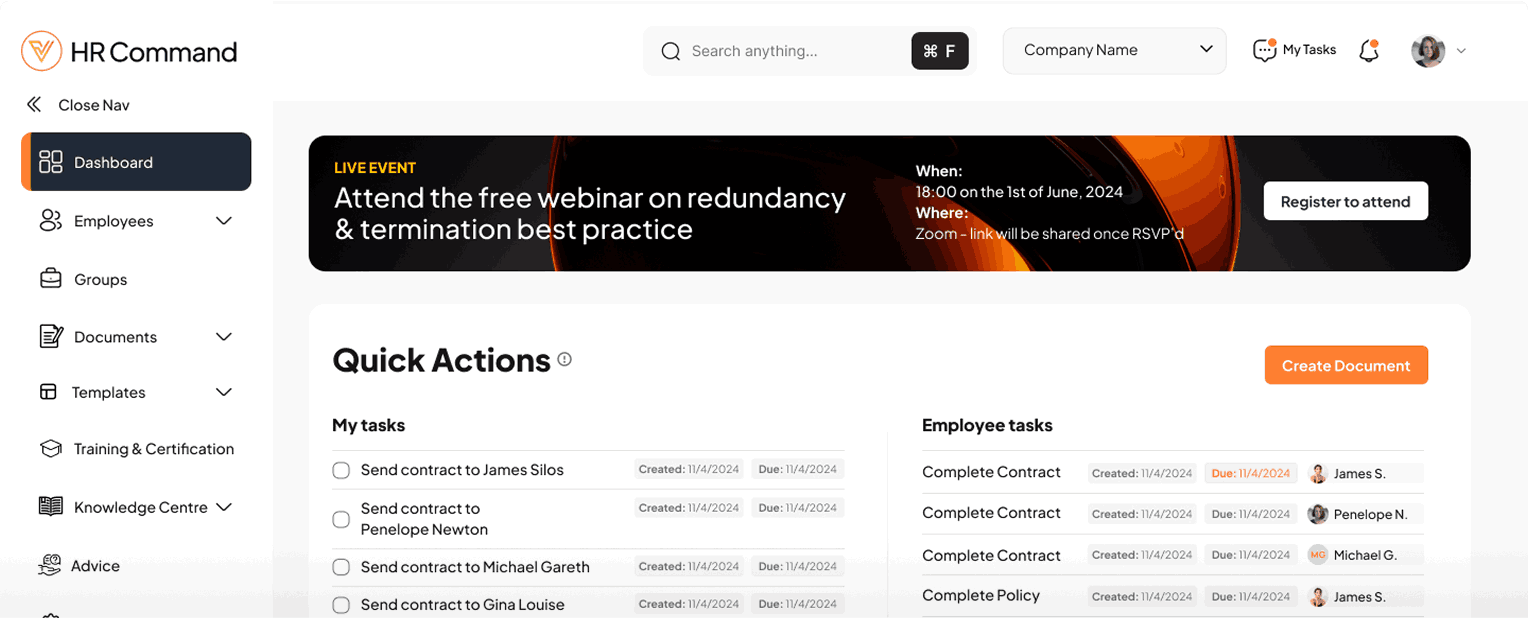
New templates in HR Command this month:
- Public Holiday Substitution Agreement
- Public Holiday Substitution Policy
- Contract of Employment – Award Covered Full Time – Hourly Wage (Simple)
- Performance Improvement Plan
- Show Cause Letter
- On-Call Allowance Letter – Above Award Employee Version
- On-Call Allowance Letter
- On-Call and Call-Out Policy
- Termination Checklist
- Fixed Term Contract
All templates are reviewed by employment lawyers and ready to use. Find them in your HR Command document library. Not a client yet? Contact us here